






 Portuguese
  Spanish



Subaru Launches Forester With External Airbag to Protect Pedestrians and Motorcyclists in Front Collisions
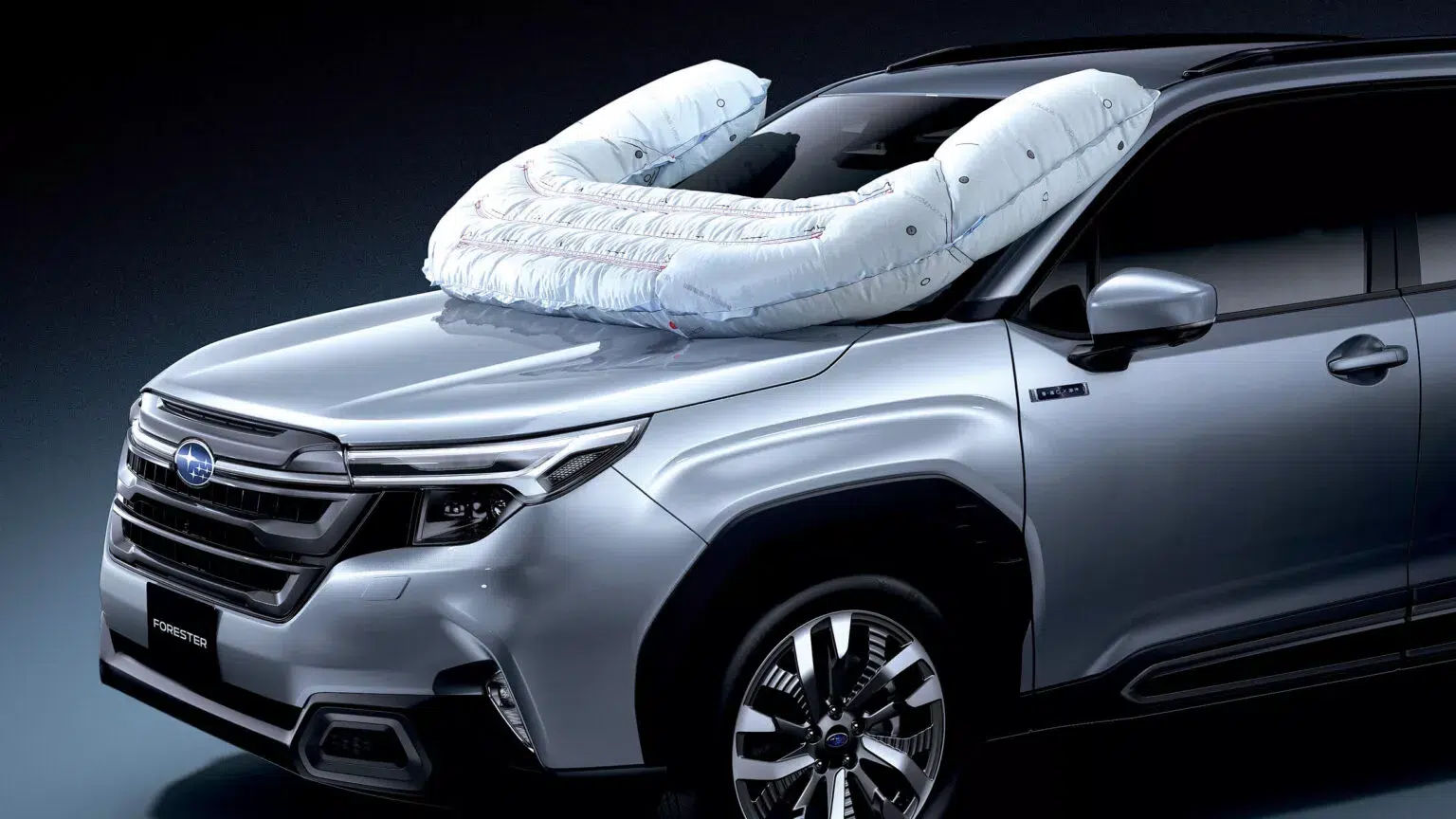
Subaru has just introduced a new version of the Forester SUV to the Japanese market equipped with a redesigned external airbag, developed to provide active protection to pedestrians and motorcyclists in the event of a frontal collision. This innovation stands out for going beyond traditional safety systems aimed solely at vehicle occupants, also focusing on those outside. With this update, the Japanese brand expands its pioneering history in vehicle safety technologies, being one of the few manufacturers in the world to invest in solutions directed toward the integrity of people external to the vehicle, especially cyclists—a group that is growing every year in major cities.
External Airbag Technology Was Thought Out to Protect Beyond Occupants
While most automakers invest in sensors, radars, and driver assistance systems to prevent accidents, Subaru decided to literally look outside the car. The new external airbag aims to act as a final layer of protection in case a collision becomes inevitable.


The system has been installed at the front of the new Forester and activates automatically when it detects imminent impact with pedestrians, cyclists, or motorcyclists. The inflatable structure covers the entire lower area of the windshield and also the sides, including the A-pillars, known for being rigid and lethal in cases of direct impact with a person’s body.
-
2027 Toyota Corolla Cross Unveiled: New Design, Enhanced Fuel Efficiency, Reduced Maintenance Costs, Advanced Technology, Connected Services, and Up to 10-Year Warranty

-
Fiat Cronos Precision 2018: Affordable Sedan with Spacious Trunk and Reliable Maintenance
-
Volkswagen to Cut Production by 1 Million Cars by 2030, Reducing Jobs and Platforms, Focusing on More Profitable Models

-
Toyota Launches First 100% Electric Car in Brazil: bZ4X with 343 HP, All-Wheel Drive, 361 km Range, Priced at $419,990 BRL, Limited to 99 Units



This unprecedented approach to airbag architecture significantly expands the protected area, increasing the chances of reducing serious or fatal injuries in low or medium-speed collisions.
Evolution of a Project Begun in 2016
Although the concept of an external airbag is not exactly new to Subaru, what we see now is a significant evolution of the technology. In 2016, the brand was one of the first to introduce this type of equipment in vehicles such as Impreza, WRX, Legacy, Crosstrek, and Levorg.
At that time, the device was positioned close to the windshield, inflating over the hood to cushion the impact of a pedestrian’s head. However, this design showed limitations when the person being hit was a cyclist, whose center of mass is higher.
With the new Forester, Subaru completely redesigned the structure, extending side protection and reinforcing the stability of the inflatable panels even in misaligned impacts. The update considers both pedestrians and cyclists, vulnerable groups that account for thousands of victims every year in urban centers.
External and Automated Airbag Is a Differential
So far, solutions for cyclist protection have mainly involved individual-use equipment, such as inflatable vests with impact sensors—the case of the Helite B’Safe, for example. These products, while effective, rely on correct and constant usage by the cyclist, which limits their reach and effectiveness.
Subaru’s proposal breaks this logic by embedding protection directly in the vehicle. In other words, the responsibility shifts to the manufacturer, not the victim, which addresses a frequent criticism of current safety systems, which often require ideal behaviors from the people who will be impacted.
With the new external airbag, protection becomes active, automatic, and universal, working even if the pedestrian or cyclist is not using any additional safety equipment.
Launch Limited to Japan, but With Global Potential
For now, the technology is only available in the Japanese market, where the new Forester with the external airbag has already been approved. Subaru of the United States has not yet confirmed whether it plans to offer the model with this specification in other countries, but the expectation is that the advancement will provoke a reaction from competitors.
Industry experts believe that, given the growth of the SUV fleet and the increasing concern over road safety, other automakers may adopt similar solutions in the coming years, especially if Subaru’s model demonstrates good results in independent tests and collision reports.
Technical Advance That Can Save Lives
According to studies on frontal impacts between cars and cyclists, the risk of death significantly increases when the point of impact occurs in the region of the A-pillars, which are highly rigid and close to the windshield. By covering these areas with an inflatable cushion, Subaru’s new system represents a technical advance with real potential to save lives.
Additionally, the side protection of the airbag reduces the risk of direct contact between the cyclist’s head and the glass or the vehicle’s metal structure, which can be decisive in low-speed collisions, where the difference between a minor injury and a fatal one is minimal.
Cost and Mass Production Challenge
One of the barriers to the mass adoption of external airbags is the cost of development, integration with the body, and certification testing. Furthermore, as these are technologies aimed at third parties—and not the vehicle occupants—many automakers still hesitate to invest heavily in this type of solution.
However, with the evolution of traffic regulations and the increasing focus on urban safety, the trend is for systems like the one developed by Subaru to gain traction in the coming years, especially in markets with a strong culture of active mobility, such as European countries and some regions of the U.S.








