Portuguese
  Spanish


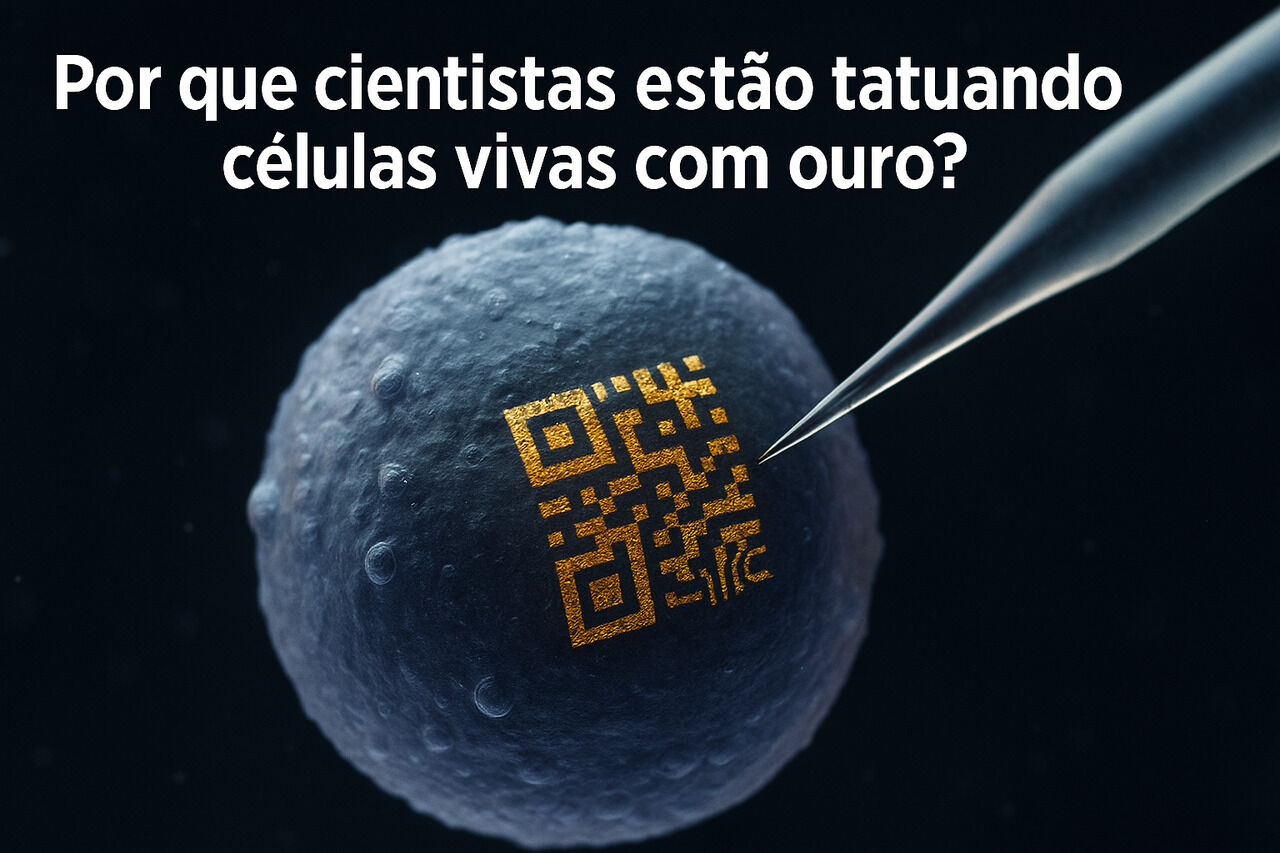

Scientists Apply Gold Tattoos on Living Cells and Test Connection Between Electronic Circuits and Biological Tissues with Promising Results
Researchers at Johns Hopkins University in the United States have developed a technique capable of applying tiny gold tattoos on living cells.
The experiment marks a promising advance in the attempt to integrate electronic circuits into biological organisms.
The study was published in the scientific journal Nano Letters and represents an initial step toward creating sensors and electronic components that function within living tissues.
-
China Develops Custom 140-Ton Electric Mining Truck with 770 kWh Swappable Battery, Deploys 290 Units in Xinjiang’s Largest Zinc Mine

-
Meta to Launch Arena, a New Prediction App Targeting 3.56 Billion Users, Competing with Polymarket and Kalshi

-
Scientist Challenges Famous Human Evolution Theory, Argues Homo Sapiens Evolved Gradually Over Thousands of Years
-
15-Year-Old American Builds Ocean Generator with PVC Pipe and 3D-Printed Propeller for $12, Wins National Prize, Presents at White House, and Makes Forbes 30 Under 30 List




Unlike conventional tattoos applied to the skin, these nanoscale tattoos have a different purpose.
They are not motivated by aesthetics, but rather by scientific applications. The technique uses nanopoints and gold nanowires to form structures on living cells, with the potential to function as biological sensors.
The intention is to create components that do not harm the cells and can monitor their movement and development without interference.
How the Technique Works
Despite being called tattoos, the process resembles more the application of a sticker. There are no needles.
The structures are formed in steps and then fixed onto the cells. The resulting image resembles a small QR Code or a tangle of golden wires.
The technique is still in its early stages but has already shown positive results.
In one of the tests, scientists tattooed fibroblasts, cells that play a role in maintaining connective tissue.
The gold pattern remained stuck to the cell for 16 hours, even with the natural movement of the cellular structure.
In another experiment, the tattoo was applied to rat brains outside the body. According to the authors, the cells did not die after application, indicating that the material is well-tolerated.
“We are talking about applying something like an electronic tattoo on a living object, dozens of times smaller than the head of a pin,” explained David Gracias, professor of chemistry at the university and one of the study’s authors. “This is the first step toward connecting sensors and electronic components in living cells.”
Future Applications and Health
The next challenge is to make the circuits more complex and durable. Researchers also intend to expand testing to other types of cells, beyond fibroblasts.
The expectation is that, with the evolution of the technology, it will be possible to monitor the health of individual cells in real time, anticipating diagnoses and treatments.
Gracias emphasizes that microscopic sensors applied directly to cells could offer a new way to care for health. “With technologies to track the health of isolated cells, we might be able to diagnose and treat diseases much earlier and not wait until the whole organ is damaged.”
For now, gold tattoos represent a pioneering experiment that connects electronics to biology in a practical and non-invasive way.
The fact that cells remain alive and active after application is an important milestone. It signals that this type of integration is possible without compromising the natural functioning of the organism.
Skin tattoos are already used for health monitoring, such as measuring blood pressure. Now, researchers are aiming for even smaller structures, inside the cells, to enhance the possibilities of caring for the human body from a microscopic level.
With information from Canal Tech.