





 Portuguese
  English
  Spanish
  4 min of reading
  0 comments


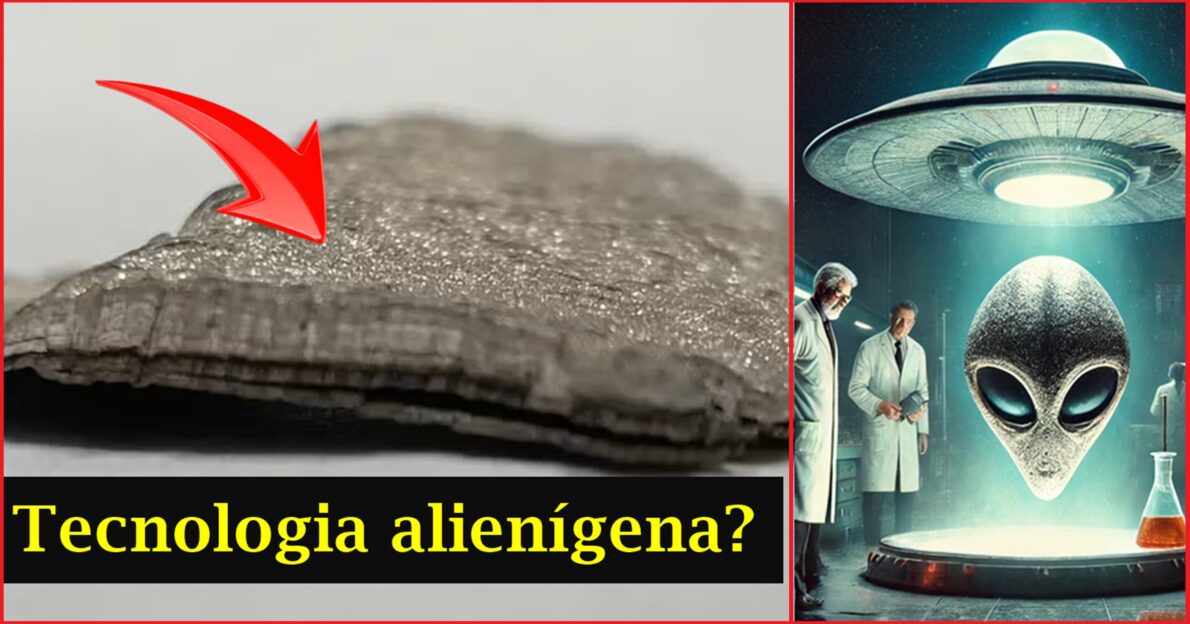
UFO Hunters Claim to Have Found a Metal Fragment That May Be of Alien Origin. Discover More About This Intriguing Discovery and What It Could Mean for the Search for Extraterrestrial Life!
UFO Hunters believe that a mysterious metal fragment may be evidence of alien technology, leading the object to be analyzed at a renowned national laboratory. Curiosity about the possibility of extraterrestrial life has always fascinated humanity, and this intriguing piece of metal, supposedly fallen to Earth in 1947, has raised profound questions about its true origin.
The fragment was found near Roswell, amidst a purported UFO wreck, which caused a great public uproar.
At the time, many believed that a flying saucer had collided with Earth. Later, authorities revealed that the wreckage belonged to a U.S. military balloon used to monitor Soviet nuclear activities. However, the origin of the metallic fragment remained a mystery for decades.
-
The world’s smallest island nation approves a historic change to abandon the name inherited from the colonial period and redefine the identity of an island of just 21 km² that once became wealthy from phosphate and now faces an economic crisis and climate threat in the Pacific.

-
Young Ethiopian turns trash into fashion with tires, cardboard, and electrical wires, goes viral with videos that look like luxury editorials, and surpasses 5 million followers by catching the attention of artists, photographers, and designers.

-
Archaeologists find a 164-foot underground tunnel in Jerusalem and are intrigued by the giant structure, full of mysteries and with no clear answer about who built it or what it was used for.

-
Sky Bridge closes in Itaipava: BR-040 and downtown Petrópolis face six months of detour




The Mysterious Metal Alloy

Interest in the metal fragment was reignited when Tom DeLonge, lead vocalist of the band Blink-182 and UFO enthusiast, acquired it through his organization, To the Stars Academy.
DeLonge’s team set out to research the fragment, whose properties indicated the possibility of an extraterrestrial origin. The unusual structure of the material sparked interest from scientists enthusiastic about UFOs, who suggested it could be a “techno-signature” – a signal of alien technology.
To investigate further, the All-Domain Anomaly Resolution Office (AARO) took on the case. This entity, responsible for studying unidentified anomalous phenomena for the U.S. government, sent the fragment to Oak Ridge National Laboratory (ORNL) in 2022.
Scientists at ORNL aimed to determine whether the fragment was of terrestrial or alien origin by investigating its physical and chemical properties.
Composition and Structure of the Fragment
The fragment mainly contains an alloy of magnesium, zinc, bismuth, and lead, along with other trace elements.
One of the scientists’ major curiosities was the use of bismuth, a metal that could act as a terahertz waveguide. It is a device that channels electromagnetic waves for different purposes, such as communication or, theoretically, levitation.
When analyzing the sample, ORNL scientists investigated biosignatures and techno-signatures.
Biosignatures are natural substances that indicate the presence of life, while techno-signatures reveal the existence of advanced technologies, potentially created by extraterrestrial civilizations.
Investigating the Biosignatures
The isotopic analysis of the metals present in the fragment, such as magnesium and lead, indicated that they had a terrestrial origin.
The scientists reached this conclusion by examining the isotopic signatures – the ratios of different isotopes of elements – and discovered that these signatures were compatible with materials that formed within our own solar system.
Magnesium, for instance, displayed a unique isotopic signature that originated from a specific stellar formation region.
Although the material had undergone some isotopic fractionation, a process caused by stressors such as heat and pressure, it still conformed to known patterns of the Earth. Lead also displayed typically terrestrial isotopic signatures, eliminating the possibility of an alien origin.
Techno-Signatures: Surprising Properties, But Inconclusive
With alien biosignatures ruled out, scientists turned their attention to techno-signatures. Transmission electron microscopy revealed that the crystalline structure of the magnesium in the fragment resembled Earth-produced alloys.
Still, scientists considered the possibility that the fragment had been part of a terahertz waveguide.
Waveguides are devices capable of directing electromagnetic waves, like the magnetron in a microwave oven.
The hypothesis suggested that if the bismuth in the sample were pure and organized in a single layer, it could have been used to guide terahertz waves, enabling the development of advanced levitation technology.
However, the bismuth in the fragment was neither pure nor organized properly to function as a waveguide.
Instead of a single layer, bismuth was present in multiple layers interspersed with magnesium, and it contained lead, which would impair its functionality as a terahertz waveguide.
Scientists’ Conclusions: Did the Material Belong to UFOs?
After a detailed analysis, scientists at ORNL concluded that all evidence pointed to a terrestrial origin for the extraterrestrial fragment.
The report suggested that the material had been manufactured on Earth, possibly using an unusual combination of elements by modern standards. Additionally, the fragment showed signs of having suffered damage due to heat and mechanical stress.
Despite these conclusions, To the Stars Academy continues to seek more definitive answers about the fragment.
In a statement published on its website, the organization stated that there are outstanding questions about the origin and purpose of the object, as well as other anomalies that need to be investigated.
Although ORNL’s analysis ruled out the hypothesis that the fragment is a piece of alien technology, it continues to intrigue scientists and UFO enthusiasts.
The story behind the object may be linked to the development of magnesium alloys in the post-World War II era when these materials were poorly understood and used in aircraft.








-

1 person reacted to this.