






 Portuguese
  Spanish


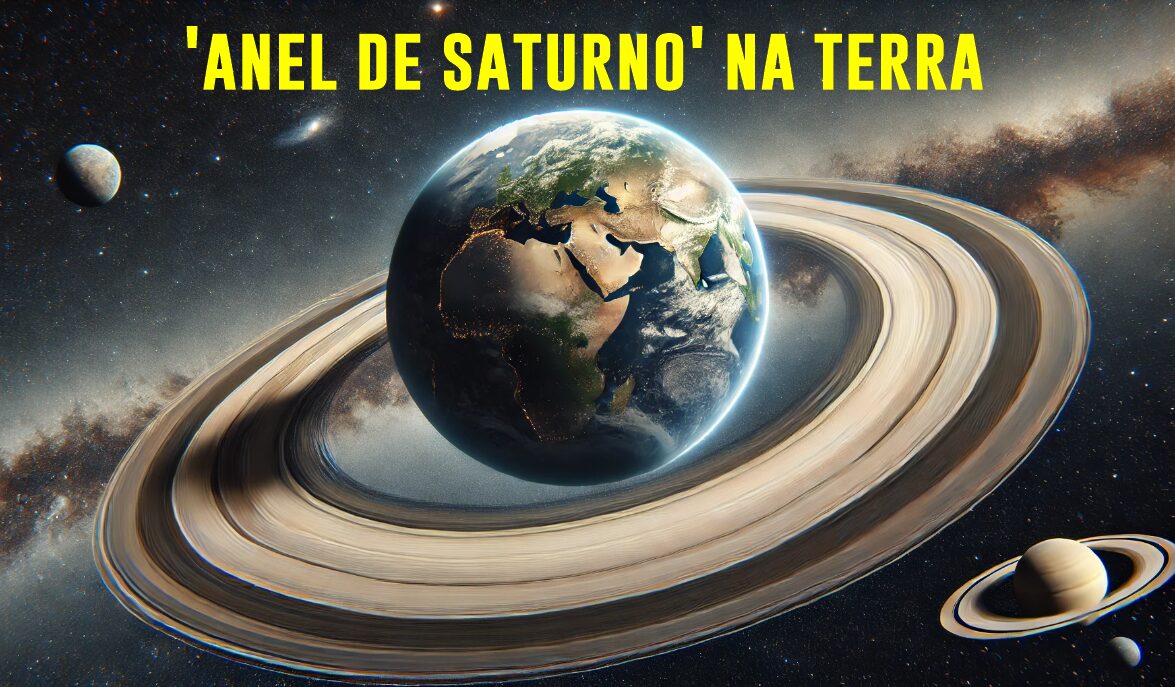

Geologists Discovered Evidence That Earth May Have Had A Ring Like Saturn’s, Formed By Space Rocks That Oribited The Planet 466 Million Years Ago. See What This Incredible Discovery Reveals About Our Planet’s Past!
About 466 million years ago, Earth may have exhibited a feature that we now associate with Saturn: a ring of space debris. Recently, geologists suggested that, during a period of intense geological activity, our planet may have harbored a ring formed by remnants of an asteroid, which offers an intriguing explanation for some unusual events in the geological record.
About 466 million years ago, Earth underwent a series of cataclysmic events, with meteorites colliding with the surface and tsunamis stirring the oceans. Sedimentary rocks from that time display an unusual amount of debris from meteorites.
These debris not only were abundant but also have something peculiar: they show signs of having been exposed to cosmic radiation for less time than would be expected, compared to meteorites that hit Earth today.
-
Chinese Farmer with No Formal Education Builds Over 60 Homemade Robots from Scrap Metal, Each Bearing His Surname

-
Telescope Set to Discover 100,000 New Planets Arrives at Launch Site, Ushering in a New Era of Astronomy

-
Humanoid Robots Transition from Demonstrations to Real Work in Factories
-
Anti-poaching patrol in Thailand accidentally discovers hidden cave with 2,000-year-old petroglyphs, geometric engravings, and mysterious three-finger patterns on sandstone walls.


About one million years after these events, Earth entered the Hirnantian Glacial Age, one of the coldest periods in the last 500 million years. Scientists suggest that these seemingly unrelated events may be related to a fascinating phenomenon: the presence of a ring around Earth.
The ‘Saturn Ring’ Theory on Earth
Geologists, led by Andrew G. Tomkins from Monash University in Australia, published a study in the journal Earth and Planetary Science Letters proposing that Earth may have had a ring of space debris, just like Saturn.
This ring would have formed after the destruction of an asteroid that passed close to Earth, exceeding the Roche limit — the critical distance at which the gravity of a celestial body can fragment an object that approaches.
The theory is based on a series of craters formed about 466 million years ago during the Ordovician impact peak, a period marked by a torrential rain of meteorites.
Tomkins and his team used tectonic plate movement models to map the location of these craters and discovered that all the impacts occurred near Earth’s equator. This peculiar pattern, rather than a random distribution as would be expected, piqued the scientists’ interest.
A Disintegrated Asteroid Forming A Ring
Tomkins’s team suggests that a large asteroid passed so close to Earth that it was disintegrated by the planet’s gravity. The resulting fragments gathered in a ring around the equator, which persisted for millions of years.
Gradually, these fragments fell to Earth, causing the increase in meteorite impacts observed in the sedimentary rocks from this period.
This theory also offers a possible explanation for the Hirnantian Glacial Age. The presence of a ring may have blocked some sunlight, leading to global cooling. However, scientists are still investigating how rings around a planet can affect its climate.
They believe the ring could have reflected some sunlight back to the surface, affecting temperatures in different hemispheres.
Evidence and Challenges
The research, while innovative, is still far from definitive. Birger Schmitz, a geologist from Lund University in Sweden, praised the idea as creative but warned that the available data is still insufficient to assert that Earth actually had a ring. One of the main discrepancies is that the dated craters belong to two distinct periods, suggesting that not all impacts occurred simultaneously.
Tomkins and his team believe that a possible explanation for this discrepancy is the formation of a mini-moon from the asteroid’s debris, which would have orbited Earth for a time before collapsing and causing more impacts. However, this hypothesis still needs to be confirmed by future studies.
Scientists are now planning to mathematically model asteroid fragmentation and the formation of planetary rings. The aim is to better understand how these rings develop and how they may have influenced Earth’s climate millions of years ago. If the hypothesis of an Earth ring is confirmed, this discovery could change our understanding of the planet’s geological and climatic history.
Despite the lingering doubts about the theory, the possibility that Earth may have exhibited a ring, even if temporary, opens new doors for studying celestial bodies and their interactions with planets. After all, our planet continues to hold fascinating secrets that are gradually being unveiled by science.


