






 Portuguese
  Spanish
  5 min of reading
  0 comments


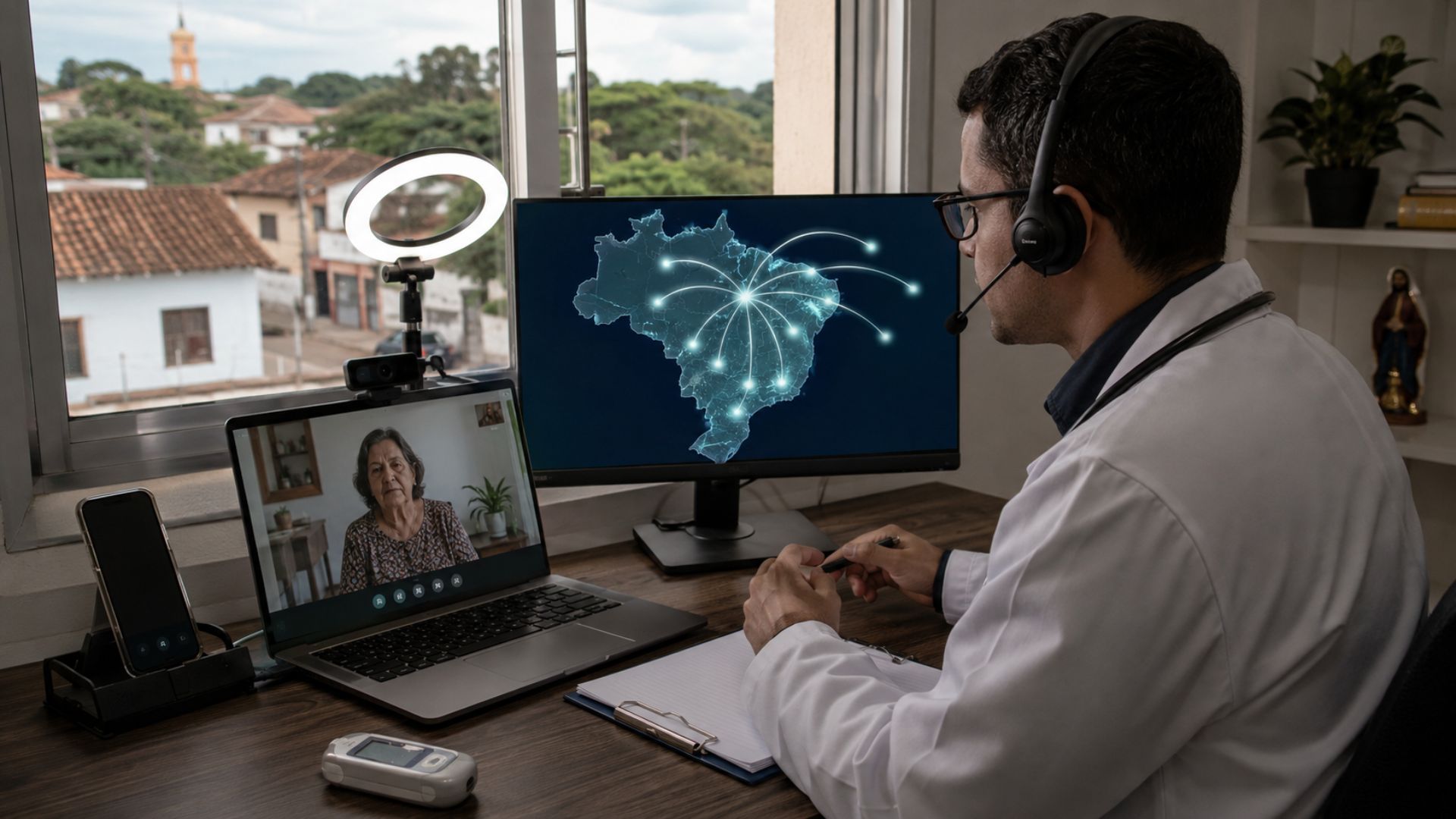
A general practitioner who lives in a city of 50,000 inhabitants in the interior of Paraná attends, on average, 12 patients per day. Almost none of them are from the municipality where he lives. The majority are in São Paulo, Rio de Janeiro, Belo Horizonte, and Brasília. The consultations last 30 minutes, cost R$ 250 each, and are paid at the time of scheduling, via link. His monthly income exceeds R$ 60,000. The rent for the apartment where he lives and works, with a room adapted for teleconsultation, is R$ 2,200.
Cases like this, rare five years ago, are no longer an exception in Brazil. Telemedicine has become a career path for thousands of doctors who have discovered that they can live far from the capitals, have quality of life, and still serve the entire country with earnings equivalent to — or higher than — those of colleagues in large urban centers.
The leap of telemedicine in numbers
The growth is significant. In 2025, Brazil recorded 3.1 million remote medical appointments, a number fifteen times greater than in 2020, when only 200,000 online consultations were conducted. The data comes from a survey by Saúde Digital Brasil in partnership with Serasa Experian.
-
Brazilian Joins Homeownership Consortium, Faces Decade of Dual Payments Totaling $141,000, Surpassing Traditional Mortgage

-
Land Rover to Halt Production in July, Putting 371 Jobs at Risk, as Chinese Automaker Negotiates to Convert Factory to 100,000 Vehicles Annually by 2027

-
Mexican Pest Threatens U.S. Cattle Herds at Historic Lows, Potentially Boosting Brazilian Beef Exports as Burger Prices Soar

-
Brazilian Freight Bill Progresses in Congress with $5,000 Minimum Wage, 70% Advance Payment, and Fines Up to $1 Million, as Agriculture and Industry Warn of Rising Costs and Legal Uncertainty


The majority of these appointments were conducted via video (80%) and resolved in the consultation itself (72%), without the need for referral. Platforms like Doctoralia, one of the largest appointment schedulers in the country, recorded a 57% increase in telemedicine appointments between 2023 and 2024, reaching the mark of 3 million consultations in the year — an average of 270,000 teleappointments scheduled per month.
The regulation consolidated this expansion. Law 14.510/2022 authorized the practice of telehealth throughout the national territory, and Resolution CFM 2.314/2022 established the rules for teleconsultation, telediagnosis, telemonitoring, and teleinterconsultation. The in-person consultation remains the “gold standard,” but teleconsultation was officially recognized as a legitimate form of medical care.
How much a doctor can earn attending online
The values vary by specialty and billing model, but it is possible to work with ranges. In direct private care, with scheduling and billing by the doctor himself, the ticket for a general clinic consultation ranges from R$ 200 to R$ 400. Specialties such as psychiatry, endocrinology, and nutrition operate between R$ 350 and R$ 800. Follow-up consultations usually cost between 50% and 70% of the first consultation’s value.
In a four-shift weekly schedule, with eight to ten consultations per shift, a general practitioner can earn between R$ 30,000 and R$ 60,000 monthly. In psychiatry, with a higher ticket and a very high return rate (patients return monthly), earnings can exceed R$ 80,000. These numbers are compatible with the average remuneration of assistant doctors in capital hospitals — but with a much lower cost of living.
Telemedicine platforms that connect doctors to health plans, such as Conexa, Teladoc, and Einstein Conecta, pay between R$ 25 and R$ 80 per attended consultation, with guaranteed volume. It is a model with a lower margin per appointment but with greater predictability — suitable for those who are starting or want to supplement their income.
The specialties that work best online
Not all medicine can be done remotely. But several specialties have adapted well to the model:
- Psychiatry: leads by far. The consultation is essentially a conversation, the bond is maintained through video, and the monthly frequency ensures recurring revenue.
- General practice and internal medicine: according to the Saúde Digital Brasil survey, they are responsible for most online consultations in the country.
- Endocrinology and nutrition: exam follow-up, medication adjustment, and nutritional guidance work very well remotely.
- Follow-up pediatrics: initial consultations are usually in-person, but subsequent follow-up adapts to the remote model.
- Follow-up gynecology: guidance consultations, contraceptive prescriptions, and exam reviews.
- Dermatology: with reservations — consultations with specific complaints work, but detailed skin examinations still require in-person visits.
Cases that require physical examination, procedures, or direct imaging continue to be in-person due to ethical and technical requirements.
What is needed to start attending online
The good news is that the entry barrier is low. To start attending via telemedicine, the doctor needs:
- Active and regularized CRM in the state where they are registered;
- Registration on a telemedicine platform (or own structure with a secure video conferencing platform);
- ICP-Brasil digital certificate (e-CPF A3 or A1), to sign electronic prescriptions with legal validity;
- Electronic medical record integrated with an online schedule, digital prescription, and financial control — it’s the base of remote operation;
- Stable internet and suitable environment, with good lighting, neutral background, and acoustic privacy;
- Online payment system, with payment link or recurring card.
The integration of these elements into a single system is what makes the operation viable on a daily basis. When scheduling, records, prescriptions, reminders, and finances are on separate platforms, administrative time eats into the margin.
The advantages of living outside major centers
What has made the difference is the combination of capital income and interior costs. A doctor living in a medium-sized city pays rent from R$ 1,500 to R$ 3,000, compared to R$ 6,000 to R$ 12,000 in the medical neighborhoods of São Paulo or Rio. Food, transportation, and services also cost significantly less. Commuting time between home, office, and hospital, which in capitals consumes hours per day, simply disappears when the office is the room next to the bedroom.
There is also the possibility of operating in a hybrid model: maintaining a small physical office in the city of origin, serving the local population, and dedicating two or three weekly shifts to telemedicine for patients from outside. This model has proven especially profitable in medium-sized cities in the South and the interior of Minas Gerais, São Paulo, and the Northeast.
The precautions that still apply
Telemedicine does not suspend the ethical and legal responsibility of the doctor. An electronic medical record with secure storage is mandatory. The LGPD fully applies to online consultations, and patient data must be handled with encryption and access control. Prescriptions must be made with an ICP-Brasil digital signature to have full legal validity. And the doctor remains accountable for conduct as in any in-person consultation.
Another concern is the clinical limit. Cases that show signs of severity, urgency, or require a physical exam need to be referred for in-person care. Teleconsultation functions as an entry point and as follow-up, not as a substitute for the entire medical practice.
What lies ahead
The market continues to expand. A study by Frost & Sullivan projected that the telemedicine sector in Brazil would grow at an annual rate of 38%, reaching around R$ 16 billion by 2025 — numbers that have been confirmed by the most recent reports. Integration with artificial intelligence, automated triage systems, and intelligent medical records promises to make operations even more efficient in the coming years.
For those who want to venture into medicine without needing to live in a capital, without assuming the fixed cost of a large physical office, and without giving up high revenue, telemedicine has ceased to be a secondary alternative and has become a consolidated career path. The countryside doctor who serves the entire country is no longer an exception — it has become part of the map.





Be the first to react!