






 Portuguese
  Spanish
  3 min of reading
  0 comments


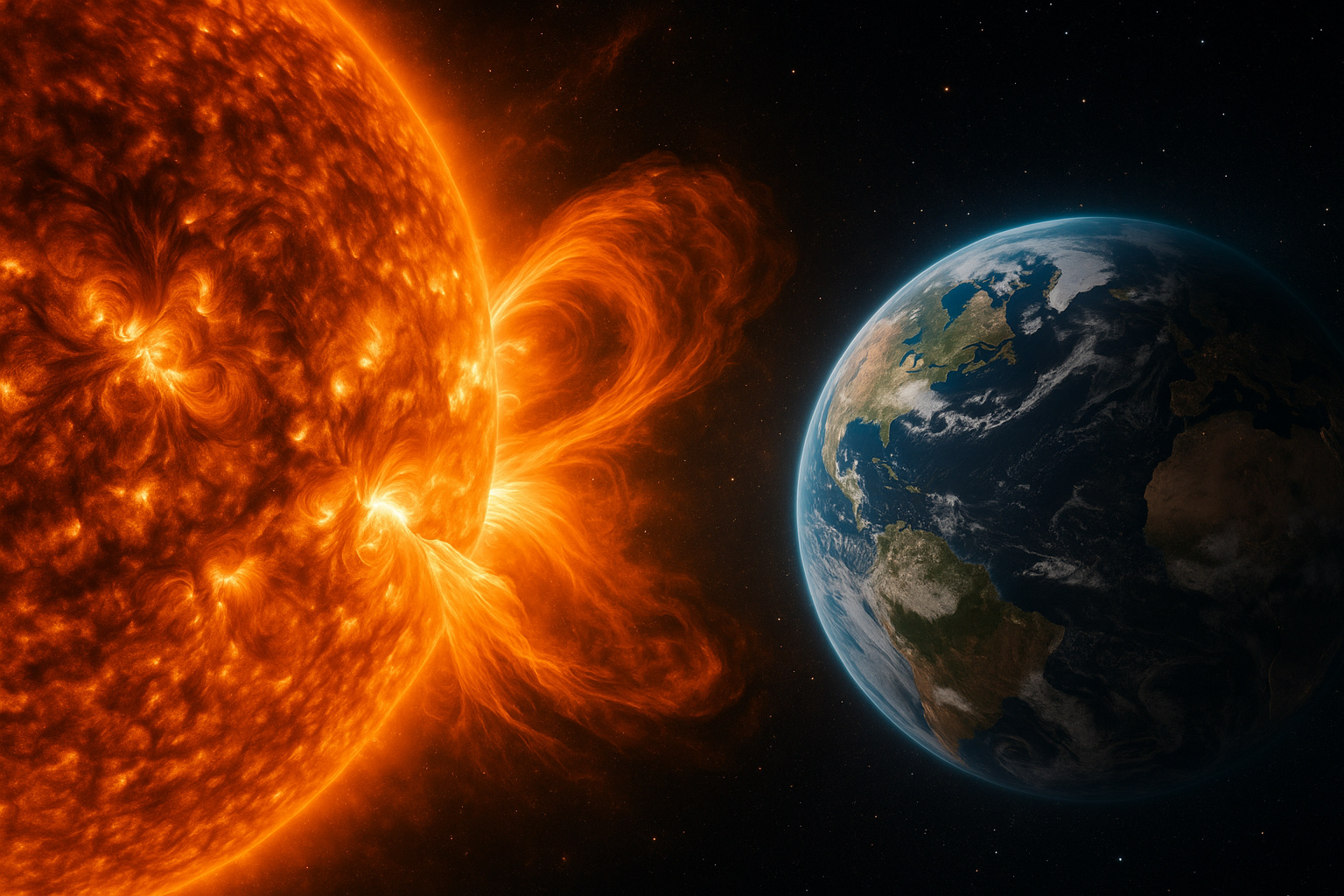
Severe Solar Storm Drives International Monitoring And Reignites Concerns About Immediate Technological Impacts.
The approach of one of the strongest solar storms in the last 20 years has reignited a debate among experts, scientific agencies, and governments.
The phenomenon is expected to occur this November, according to the British Geological Survey (BGS).
The storm was initially given a G3 classification, but was upgraded to G4 by the NOAA Space Weather Prediction Center.
This upgrade reinforces the severity of the event.
Satellite observations indicate a concrete possibility of reaching the maximum level G5.
This risk prompted the postponement of Blue Origin’s launch on November 12, 2025.
In Brazil, experts from the INPE are monitoring the movement.
The effects can also be felt in South America.
The increase in intense solar phenomena is not recent.
In May 2024, a G5 solar storm caused disruptions in GPS-dependent agricultural systems.
The episode illustrated the operational vulnerability of entire economic sectors.
The current technological dimension makes events like this even more relevant.
Logistical, agricultural, and banking operations depend on satellite communication.
These sectors remain susceptible to abrupt failures.
How The Solar Phenomenon Interferes With Terrestrial Systems
Solar storms directly interfere with modern technological networks.
This interference occurs even during episodes of moderate intensity.
In 2024, several regions recorded temporary drops in radio signals, according to analyses by the BGS.
The fact highlighted the fragility of global communication systems.
These episodes reinforce the need for coordinated monitoring actions.
They also reinforce the importance of rapid responses.
The measures include enhancements in observation satellites.
They also include protection protocols for sensitive equipment.
Continuous research is essential to understand solar phenomena.
Research also helps to mitigate impacts.
-
Helicopter Drops 180 Tons of Sand and Gravel on Swedish River to Revive Ecosystem Damaged by Decades of Exploitation

-
Brazilian Company Launches Retro Smartphone with 48 MP Camera, T9 Keyboard, and Privacy Features for Social Media-Free Use

-
Self-Taught Chinese Farmer Builds 5-Ton Submarine from Scrap, Launches It in Anhui River
-
Invisible Induction Technology Enables Wireless Power for Blenders, Coffee Makers, and Air Fryers, Reducing Countertop Cables



The effects vary depending on the intensity of the storm.
The disruptions can affect transformers and satellites.
They can also compromise navigation signals.
Experts observe that predictability has limitations.
The exact intensity still has a margin of uncertainty.
Prevention Measures And Recent Improvements
With modern technologies, monitoring centers have expanded their response capabilities.
The NOAA continuously monitors space weather.
The INPE, in Brazil, operates an active observation network.
This network provides real-time updates.
Even so, the unpredictable nature of the phenomenon requires constant revisions.
The protocols need to evolve to mitigate risks.
They also need to ensure operational stability.
The modernization of satellites strengthens monitoring.
The creation of emergency response flows reduces impacts.
The standardization of scientific reports also aids in prevention.
These measures depend on continuous investments.
Institutional cooperation remains essential.
Expected Impacts And Future Challenges
The Sun is advancing in its activity cycle.
This cycle is expected to peak around 2026.
Experts project the possibility of new intense events.
Scientists advocate for investments in resilient technologies.
Engineers advocate for robust monitoring protocols.
Collaboration between NOAA, BGS, and INPE is crucial.
Cooperation ensures effective alerts.
It also ensures rapid responses.
The current storm is drawing global attention.
The debate about protecting critical infrastructure is likely to grow.
Communication systems form the backbone of strategic sectors.
Satellites sustain essential operations.
Thus, the ongoing solar storm reignites important discussions.
Technical preparation becomes a priority.
Global cooperation can redefine security standards.
These standards will be used to deal with extreme solar phenomena.





-

1 person reacted to this.