






 Portuguese
  Spanish


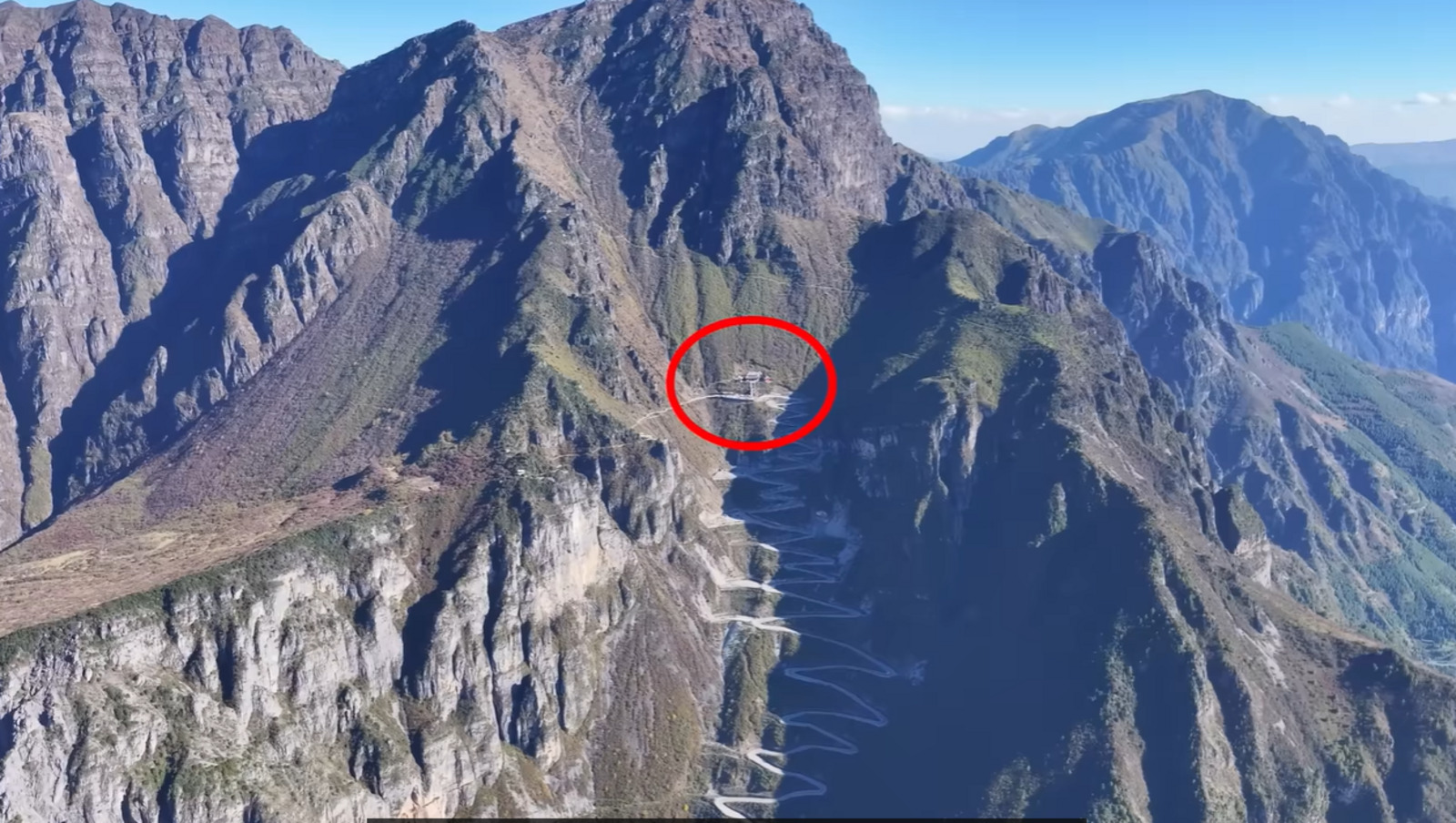

Access to Zixia Palace combines dirt road with 49 curves, 99-step staircase, extreme altitude, and sunrises over valleys covered by a vast sea of clouds in China
In the southwest of China, Zixia Palace has become a destination by bringing together a Taoist temple, an altitude of up to 3,500 meters, and a climb with 49 curves, nearly a thousand meters of elevation change, and landscapes that make the arrival part of the journey.


Where it is
Zixia Palace is located in the Dongchuan district of Yunnan province, in the southwest of China. The temple was built on the slopes of Guniu Mountain and is among the highest Taoist sanctuaries in the world.
The altitude varies between 3,230 and 3,500 meters above sea level, according to the source consulted. This elevated position helps explain the temple’s prominence due to faith and landscape.
-
Man Converts Water Tank into $20,000 Luxury Boat, DIY Video Reaches 571,000 Views on World Tech Channel

-
Inventor Builds Amphibious Vehicle with Kayak and Electric Motors, Gains 223,000 Views on Quiet Nerd Channel
-
Former Yale Hospital Cleaner Returns as Resident Doctor After a Decade; Shay Taylor-Allen Transitions from Janitorial Duties to Medical Practice

-
Microsoft Submerges 855 Computers in Nitrogen-Filled Capsule 35 Meters Under the Scottish Sea, Records Eight Times Fewer Failures Than on Land After Two Years





The complex draws attention for its location and traditional Chinese architecture. The contrast between the building and the rugged terrain around it enhances the impact on those who reach the top of the mountain.
The main access to the temple is via a staircase with 99 steps and 12 meters wide. It leads visitors to the main hall, from where the region can be seen.
The road
The climb to Zixia Palace is one of the most striking points of the destination. From the village of Wangjiaqing, visitors face a dirt road approximately 5 kilometers long.
This stretch features 49 hairpin turns. Many of them make nearly 180-degree turns, requiring attention during the journey to the top.
Every kilometer, the altitude rises about 200 meters. At the end of the route, the vertical gain reaches 1,000 meters, making the route a challenge for drivers.
At some points, the slope of the road reaches 20%. Therefore, the road is listed on specialized websites as one of the most dangerous and exciting routes on the planet.
More than 600 years
The history of Zixia Palace begins over 600 years ago, during the reign of Emperor Yongle of the Ming Dynasty. The original temple emerged as a place of worship and spiritual retreat for Taoist monks.
At high altitudes, these monks sought a purer connection with the divine. The site established itself as a religious space amid an isolated and hard-to-reach landscape.
The current structure is the result of a reconstruction carried out in the 2000s. The work preserved the traditional Chinese style but adapted the space to welcome visitors.
Today, the temple houses several statues of Taoist deities. Devotees and tourists also bring offerings of incense, attracted by the wide view and the mystical atmosphere of the complex.
At the Top of Zixia Palace
Those who conquer the 49 curves find at the top an experience that goes beyond the climb. The wind is constant, the cold can be more intense than at the base, and the scenery opens up in all directions.
The complex has a simple snack bar, with items like noodles and baked sweet potatoes. These foods help those who arrive tired to regain energy before continuing the visit.
The greatest spectacle usually appears at dawn. The Zixia Palace is a privileged spot to observe the sunrise and the sea of clouds over the valleys.
When the fog accumulates in the lower parts, the illusion of a white ocean appears to the horizon. This scene helps explain why photographers and nature lovers seek the place.
Trails and Altitude
In addition to access by car, the Zixia Palace serves as a starting or ending point for trails on Guniu Mountain. One of the known routes connects the temple to the wooden viewpoint.
This route is about 12 kilometers long and can take up to 7 hours. The walk transforms the visit into a physical journey.
The region also hosts ecological walking and trekking events. In these activities, the 7 kilometers of winding road are used as the main route.
For the more experienced, there is the possibility of climbing the 49 steps of the staircase on foot and continuing to the highest points of the mountain range. In these sections, the altitude exceeds 4,000 meters.
Whether by car or on foot, the trip to Zixia Palace combines effort, altitude, and striking scenery. It is a journey that tests limits and offers a visual reward that is hard to forget.
With information from BMC News.


