Portuguese
  Spanish


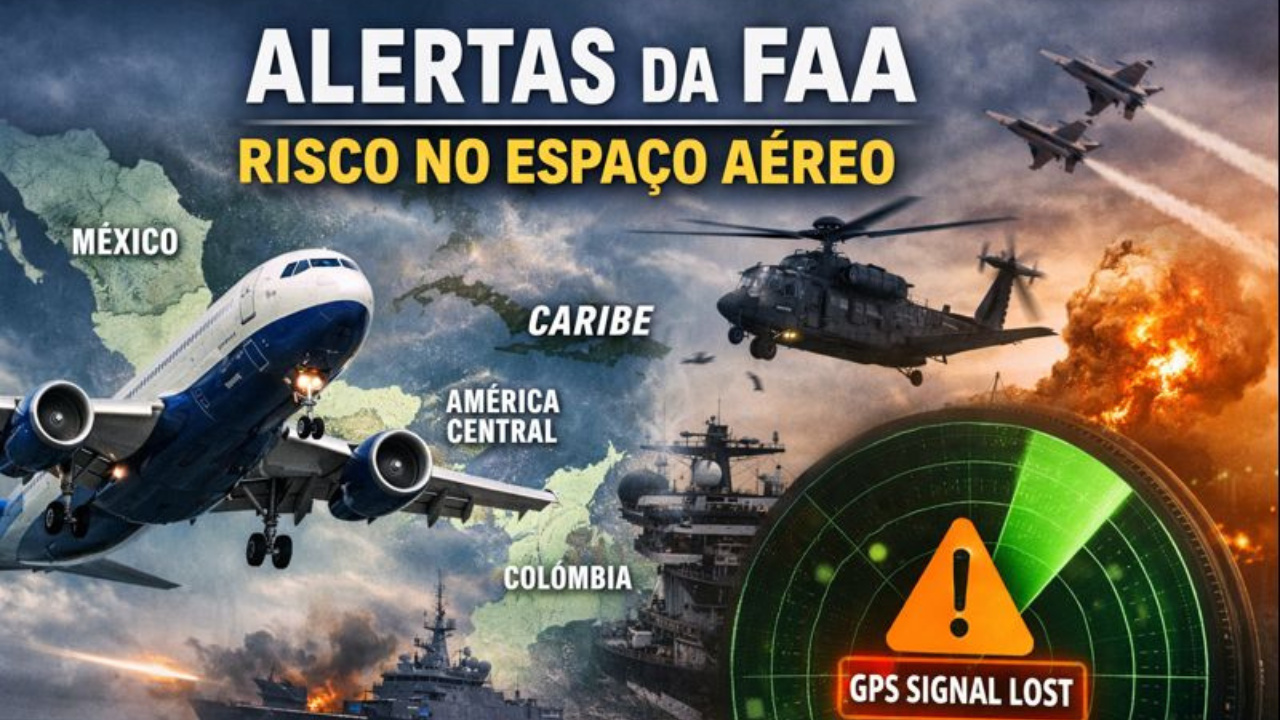

FAA Alerts Cite Military Tensions in the Caribbean and Risks to Central America’s Airspace for Up to 60 Days.
The FAA alerts have put international airlines on high alert starting this Friday (16).
The Federal Aviation Administration of the United States has decided to issue formal notices for flights crossing the airspace of Central America and parts of South America.
The measure is in effect for 60 days and responds to the increasing military tensions in the Caribbean, the risk of GPS interference in aviation, and the need to reinforce the safety of international flights on strategic routes.
-
Brazil Welcomes Spanish Wamos Air and Nigerian Air Peace, Potentially Transforming International Routes and Increasing Competition

-
Offshore air transport soars in Brazil, surpasses 2.5 million passengers, and reveals how oil has transformed Rio’s airports into key pieces of national logistics.

-
Latin America becomes the “global champion” of aviation taxes, tickets may become more expensive in Brazil, and IATA’s warning exposes risk for flights, tourism, and passengers.
-
Brazil has lost 85 air routes since 2019 and is still flying less than before the pandemic, leaving passengers with fewer destinations, fewer frequencies, and a more limited air network.




Right at the beginning of the announcement, the agency made it clear what is at stake. According to the FAA, the notices apply to Mexico, Central American countries, Ecuador, Colombia, and areas of airspace in the eastern Pacific Ocean.
The aim is to alert crews and companies about possible military activities and failures in satellite navigation systems, which are essential for the safe operation of aircraft.
FAA Alerts and the Risks in Central America’s Airspace
The FAA alerts started immediately and will remain active for two months.
During this period, airlines must review flight plans, reinforce security protocols, and constantly monitor operational information.
The central concern involves the airspace of Central America, a region that concentrates important routes between North America, the Caribbean, and South America.
Additionally, the agency highlighted the possibility of GPS interference in aviation, a problem that can affect navigation accuracy and require alternative procedures from pilots.
Although GPS has redundant systems, any instability increases the workload on crews and operational risk, especially in areas with heavy traffic.
Military Tensions in the Caribbean Raise the Alert Level
The backdrop for the notices is the worsening of military tensions in the Caribbean.
The government of then-President Donald Trump built a large-scale military force in the southern Caribbean and launched an attack on Venezuela, resulting in the arrest of Nicolás Maduro.
Since then, official statements have begun to suggest the possibility of new military actions in the region, including against Colombia.
In the week leading up to the alerts, Trump stated that cartels were controlling Mexico. Additionally, he suggested attacks on ground targets as a way to combat drug trafficking.
This rhetoric increased regional instability and led civil aviation authorities to adopt a more cautious stance.
Direct Impact on the Safety of International Flights
Following the attack on Venezuela, the FAA imposed restrictions on flights across the Caribbean. As a result, hundreds of operations were canceled by major airlines, affecting passengers and logistics chains.
This coordination, according to the FAA, is essential to preserve the safety of international flights in conflict scenarios.
Nevertheless, the operational impact was significant, reinforcing the warning that geopolitical events can quickly affect commercial aviation.
JetBlue Case Highlights Real Risks in Flight
A recent incident illustrates the risks mentioned in the FAA alerts.
Last month, a passenger jet from JetBlue had to perform evasive maneuvers to avoid a mid-air collision with a U.S. Air Force tanker aircraft near Venezuela.
Flight 1112, which was headed to New York, had departed from Curaçao and was flying over an area about 64 kilometers off the Venezuelan coast.
During the journey, the Airbus crew reported that the military aircraft was not transmitting its transponder code.
The incident raised concerns about the safety of international flights in areas of military operation.
Continuous Monitoring and Next Steps
In light of this scenario, the FAA advises airlines to maintain constant monitoring of routes crossing the airspace of Central America and adjacent regions.
Furthermore, it recommends frequent updates of operational information and training for crews to handle possible navigation failures.
Therefore, the FAA alerts serve as a clear sign that civil aviation is directly exposed to geopolitical developments.
As long as the military tensions in the Caribbean persist, the priority will continue to be the preservation of the safety of international flights.
see more about at: U.S. alerts flights in Central and South America for risk of military actions | CNN Brazil