Portuguese
  Spanish


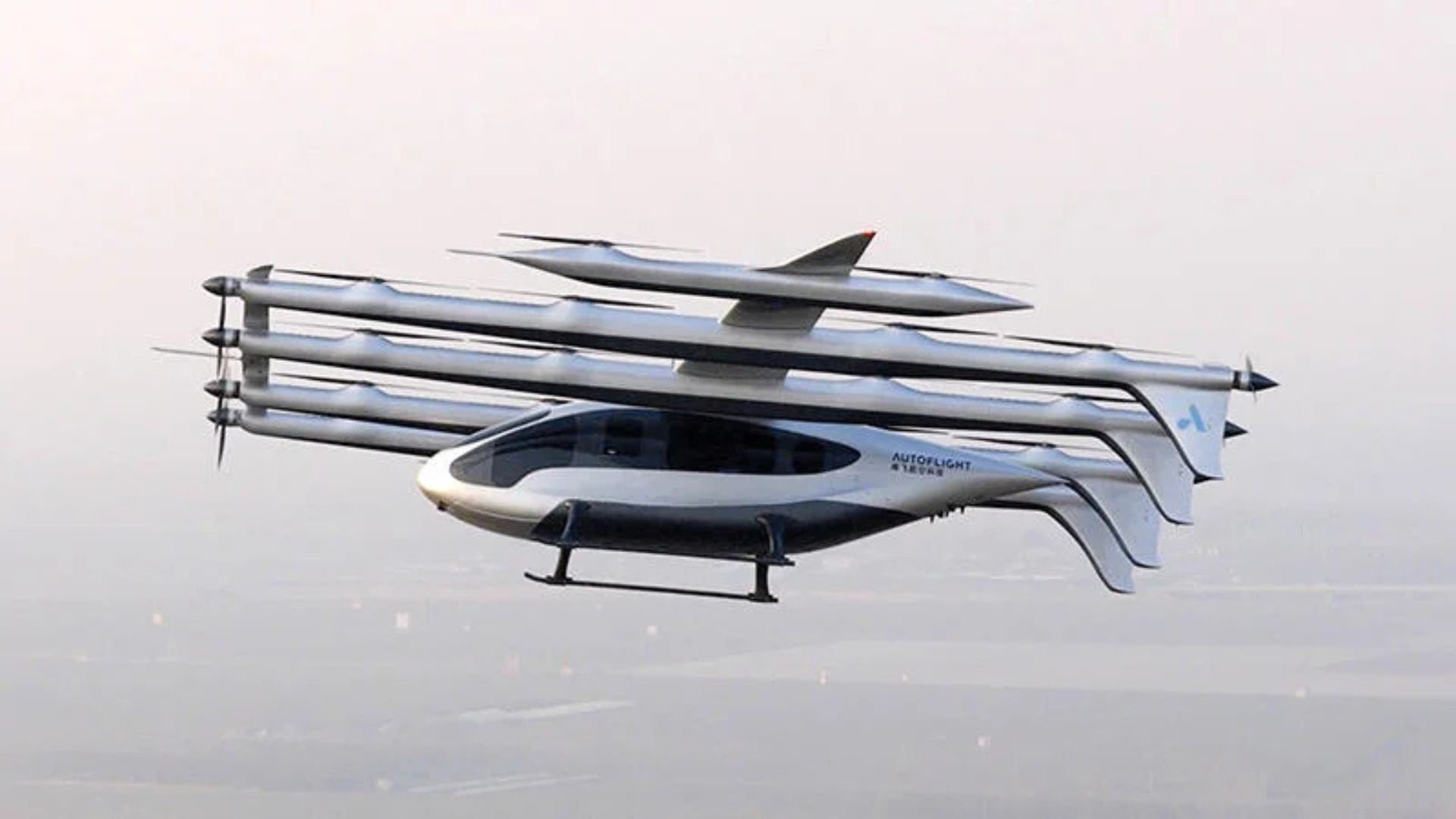


China launched a giant 5-ton and 20-engine eVTOL designed to carry up to 10 passengers on regional routes.
In 2026, the so-called “flying cars” stopped being associated only with small urban eVTOLs and entered a new phase in China with the V5000 Matrix, an electric vertical takeoff and landing aircraft developed by AutoFlight, in Kunshan, Jiangsu Province. According to the manufacturer itself, in a statement on February 5, 2026, the model was presented as the first 5-ton class eVTOL to complete a public demonstration of full transition, moving from vertical flight, to cruising, and returning to vertical landing.
The project drew international attention for its unusual size for an eVTOL. The Associated Press reported, in coverage made in February 2026 at AutoFlight’s test unit in Kunshan, that the Matrix is 5 tons, can carry up to 10 passengers, has a 20-meter wingspan, 17.1 meters in length, and can fly for about an hour without recharging.
Live Science highlighted that the V5000 uses 20 lift motors, an architecture designed for redundancy, and was designed in versions with a range of up to 250 km in the electric configuration and up to 1,500 km in the hybrid alternative, according to company representatives.
-
Brazil Welcomes Spanish Wamos Air and Nigerian Air Peace, Potentially Transforming International Routes and Increasing Competition

-
Offshore air transport soars in Brazil, surpasses 2.5 million passengers, and reveals how oil has transformed Rio’s airports into key pieces of national logistics.

-
Latin America becomes the “global champion” of aviation taxes, tickets may become more expensive in Brazil, and IATA’s warning exposes risk for flights, tourism, and passengers.
-
Brazil has lost 85 air routes since 2019 and is still flying less than before the pandemic, leaving passengers with fewer destinations, fewer frequencies, and a more limited air network.




V5000 Matrix attempts to transform the concept of air taxi into electric regional transport
Most current eVTOLs were created for short urban trips, usually carrying two to four people on limited routes.


The V5000 Matrix follows a different path. AutoFlight‘s proposal is to create a larger electric aircraft capable of operating not only within cities but also on longer regional connections.
This completely changes the vehicle’s profile and brings the project closer to a mix between a compact regional airplane and an electric air taxi.
Chinese aircraft has about 5 tons and 20 electric motors
The size of the V5000 drew attention right from the first images released by the company. According to information published by the specialized press, the aircraft weighs approximately 5 tons and uses a system with 20 electric motors distributed throughout the structure. These motors work together during vertical takeoff, landing, and transition to horizontal flight.
The large number of propellers also helps with the system’s operational redundancy. Like other eVTOLs, the V5000 uses the VTOL concept, an acronym for “Vertical Take-Off and Landing.”
This means that the aircraft can ascend and descend without the need for a long conventional runway like those used by traditional airplanes.
In practice, this system opens up space for the use of compact vertiports near urban centers, airports, or industrial regions.
Sky Dragon model was designed to carry up to 10 passengers
The passenger version of the project was named Sky Dragon. According to AutoFlight, the aircraft was designed to carry up to 10 passengers, which is far above the capacity of most eVTOLs currently under development worldwide.

This increase in capacity is precisely one of the main differentiators of the Chinese project. Another impressive number of the project is the physical dimension of the aircraft.
According to information released by the international press, the V5000 has approximately 20 meters of wingspan, placing the vehicle in a much larger category than most urban “flying cars” already presented. The size reinforces the proposal to expand the platform’s range and cargo capacity.
Inaugural flight took place in February 2026 in China
The first flight of the V5000 was conducted in February 2026. The presentation marked another step in the global race involving vertical takeoff electric aircraft, a sector that has received billions of dollars in investments in recent years.
Companies from the United States, Europe, the United Arab Emirates, and China are competing for technological leadership in this emerging market. The project is also part of China’s strategy to expand in advanced air mobility technologies.
In addition to electric cars, batteries, and drones, Chinese companies have started to invest heavily in eVTOLs and urban air mobility systems. The intention is to position the country as one of the world leaders in the future electric air transport industry.
Large eVTOLs can change regional logistics and executive transport
If projects like the V5000 advance commercially, they could operate in multiple sectors. Besides passenger transport, aircraft of this size could be used in regional logistics, executive transport, medical evacuation, and rapid connection between nearby cities.
The capacity for up to 10 people greatly expands the operational range of the platform. One of the central promises of eVTOLs involves emission reduction and lower noise levels.
Electric motors tend to produce less sound vibration than conventional turbine-powered helicopters. This is seen as an important factor to allow more frequent operations near densely populated urban areas.
Global flying car race already moves billions of dollars
The advanced air mobility sector has become one of the most competitive technology markets of the decade. Companies like Joby Aviation, Archer Aviation, EHang, and Eve Air Mobility compete for the development of urban electric aircraft.
The V5000 represents a Chinese attempt to also enter the larger category. Despite technological advancement, autonomy still represents one of the main challenges of the sector.
Current batteries have significant energy density limitations compared to traditional aviation fuel.
Therefore, larger projects like the V5000 require much more complex solutions for energy distribution and weight management.
Urban infrastructure will need to change to accommodate electric aircraft
The expansion of eVTOLs depends not only on the aircraft but also on the creation of adequate infrastructure.
Vertiports, charging stations, urban air control, and integration with airports are part of the necessary changes for large-scale commercial operation. Several countries have already started studying these adaptations. The most impressive aspect of the V5000 might be its scale.
While many eVTOLs resemble small manned drones, the Chinese project is much closer to a new generation regional electric aircraft.
The numbers help show this: about 5 tons, 20 motors, 20 meters wingspan, and capacity for up to 10 passengers.
China bets on giant electric aircraft to compete for the future of air mobility
The development of the V5000 shows that the flying car race is no longer just a competition for small urban taxis.
Companies have started trying to expand the reach, capacity, and size of electric aircraft, seeking to transform eVTOLs into regional air transport platforms.
In the end, the Chinese project represents an ambitious attempt to create a new category between helicopters, regional airplanes, and flying cars, using electric propulsion and vertical takeoff to change the way people can travel between nearby cities in the coming decades.