Portuguese
  Spanish


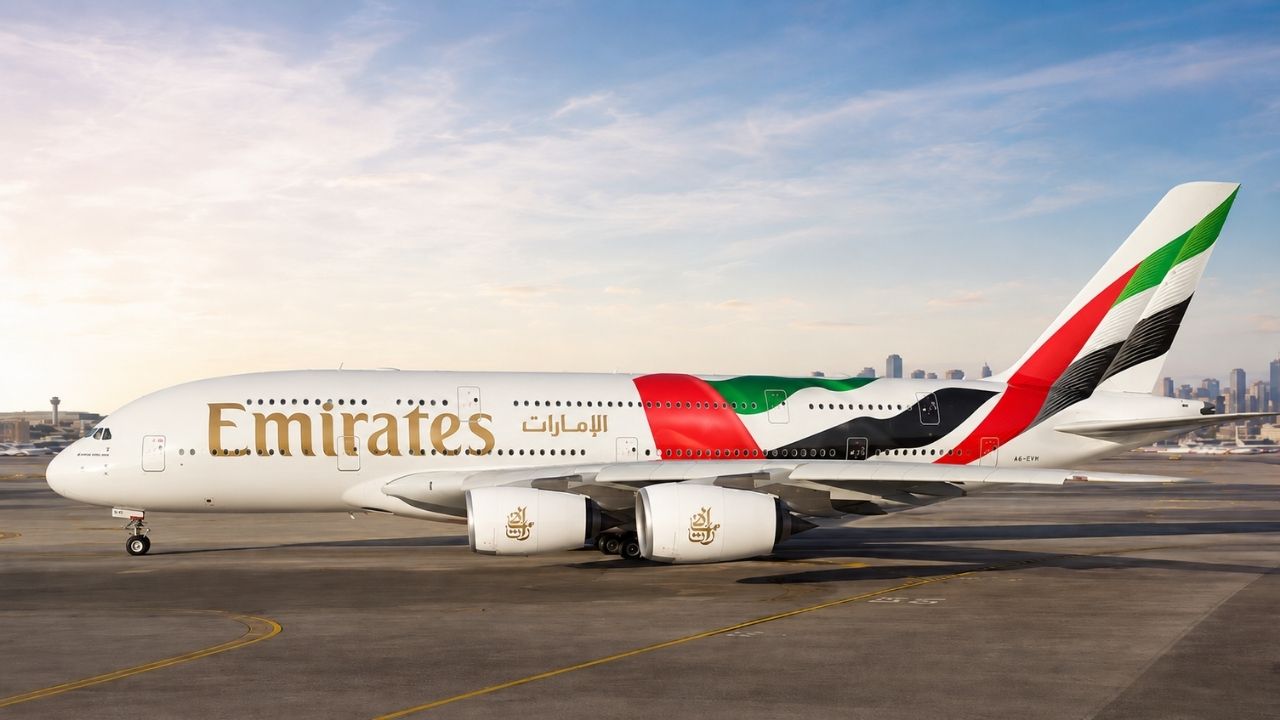


The United Arab Emirates gained a new showcase in the skies with Emirates, which expanded the presence of the national flag on an Airbus A380 and transformed the aircraft into an aerial display of identity, unity, and global reach amidst tensions in the Middle East.
The United Arab Emirates gained a new impactful image in international air transport with Emirates, which unveiled a special livery on an Airbus A380 featuring the national flag extended across the entire fuselage of the aircraft. The initiative transforms the world’s largest passenger plane into an aerial showcase of rare proportions and expands the visual presence of one of the country’s strongest symbols on long-haul routes.
According to the R7 portal, what makes the novelty seem bigger than a simple aesthetic change is precisely the size of the chosen stage. By extending the UAE flag beyond the tail and spreading it in 3D style across both sides of the superjumbo, the company not only renews the aircraft’s visual identity but also converts an already iconic aircraft into a political, symbolic, and visual message across the skies.
Emirates’ Airbus A380 has become a flying symbol of global reach

The new livery was applied to aircraft A6-EVG, one of the A380 models operated by the airline. According to Emirates, the design expands on the existing tail art and extends the colors of the UAE flag to the rest of the fuselage, creating a much more visible and striking display in international operation.
-
Brazil Welcomes Spanish Wamos Air and Nigerian Air Peace, Potentially Transforming International Routes and Increasing Competition

-
Offshore air transport soars in Brazil, surpasses 2.5 million passengers, and reveals how oil has transformed Rio’s airports into key pieces of national logistics.

-
Latin America becomes the “global champion” of aviation taxes, tickets may become more expensive in Brazil, and IATA’s warning exposes risk for flights, tourism, and passengers.
-
Brazil has lost 85 air routes since 2019 and is still flying less than before the pandemic, leaving passengers with fewer destinations, fewer frequencies, and a more limited air network.


In practice, this means that one of the most recognizable aircraft in commercial aviation now carries a national element on an even larger scale. The visual impact is not just in the flag itself, but in the contrast between the size of the aircraft and the decision to use almost its entire side as a surface for symbolic projection.
This detail helps explain why the livery garnered attention right from the announcement. The Airbus A380 is already a machine associated with grandeur, and transforming it into a full-fledged support for a national symbol increases the message’s reach in airports, runways, and international routes.
The UAE flag moved from the tail and dominated the aircraft’s fuselage
Emirates has carried the UAE flag in its fleet’s visual identity for many years. What changes now is the scale of this presence. Instead of remaining concentrated on the tail, as is traditional, the flag now occupies a much larger area of the aircraft.
This redesign completely alters the visual perception of the aircraft. The superjumbo ceases to be just an airplane with a national brand and begins to function as a large moving aerial billboard. It’s a simple change in concept, but very powerful in execution.
By extending the flag across both sides of the fuselage in a three-dimensional composition, the company enhances the visual strength of a symbol that was already part of its image. The difference is that now this symbol doesn’t just appear as a signature. It becomes the center of attention.
The campaign was born at a time of regional tension and reinforces the idea of unity
According to the company, the initiative is part of the campaign “This Flag Will Always Fly High”, launched in response to a national call by Mohammed bin Rashid Al Maktoum, who encouraged citizens and residents to raise the flag as a symbol of unity and solidarity in the face of recent regional challenges, including the war in the Middle East.
This context gives another dimension to the special livery. It ceases to be merely a branding action and also carries institutional and emotional weight. Instead of just presenting a visual novelty, Emirates associates the aircraft with a message of national cohesion during a period of regional instability.
The speech by Sheikh Ahmed bin Saeed Al Maktoum, President and Chief Executive of Emirates and Group Emirates, reinforces this interpretation. By stating that there is no greater stage for the flag than the skies, the company makes it clear that the A380’s fuselage was chosen to amplify an idea of belonging, strength, and international visibility.
New York and Brisbane have already seen the aircraft, and the livery is set to expand to other routes
The special livery has already been used on flights to New York, in the United States, and Brisbane, in Australia. The expectation is that it will gradually appear on more routes operated by the A380 within Emirates’ global network.
This point is important because it shows that the action was not conceived solely for promotional photos or one-off displays. The intention is to put the aircraft into real circulation and make the international air network itself an extension of the campaign.
When a model of this size passes through highly visible destinations, the effect multiplies. The aircraft ceases to be merely a personalized aircraft and begins to function as an itinerant piece of international communication, visible in some of the world’s busiest airports.
The planet’s largest passenger aircraft amplifies the message’s impact in the skies
The Airbus A380 is currently the largest commercial passenger aircraft in operation worldwide. This fact, in itself, explains why the new livery attracts so much attention. It’s not just any aircraft receiving special artwork, but the largest commercial model in regular service.
This increases the message’s power on two fronts. The first is visual, because the enormous fuselage transforms the flag into an impossible-to-ignore element. The second is symbolic, because choosing the largest available aircraft associates the gesture with grandeur, projection, and global presence.
The decision also reveals how Emirates continues to leverage the A380 not just as an operational asset, but as an image icon. In an industry where airlines’ visual identities often follow discreet patterns, using the world’s largest aircraft as a national showcase is a direct way to differentiate oneself.
The Boeing 777 is expected to be the next step in a visual strategy that goes beyond a single superjumbo
The company also confirmed that plans are underway to introduce a similar design featuring the UAE flag on one of its Boeing 777 aircraft. This move shows that the initiative is not expected to be restricted to the A380.
The Boeing 777 is the second-largest commercial aircraft in operation and represents the backbone of Emirates’ long-haul fleet. By signaling that this model may also receive the new visual concept, the company expands the possibility of transforming the campaign into a more comprehensive language within its global operation.
This step also reinforces that the action is not isolated. It is part of a broader visual strategy, where the fleet becomes a medium for institutional messaging, national identity, and international presence.
Emirates has used special liveries before, but has now elevated the scale of the gesture
This is not the first time the airline has opted for special liveries to mark important moments. In 2017, Emirates launched a personalized decal featuring the image of Zayed bin Sultan Al Nahyan on its hundredth A380, as part of the celebrations for the Year of Zayed. Ten aircraft displayed that design.
In the same year, the company also put into operation 40 aircraft with special liveries dedicated to Expo 2020 Dubai. These precedents show that the company had already been using the fuselage as a means of visual communication and institutional celebration.
The difference now lies in the combination of scale, context, and symbol. Instead of honoring a specific event or historical figure on a limited number of aircraft, the company chose its own national flag and applied it to the planet’s largest passenger aircraft, increasing the reach and immediate interpretation of the message.
What this livery reveals about aviation, identity, and the competition for global attention
Ultimately, Emirates’ new development reveals something greater than a change in an aircraft’s appearance. It shows how commercial aviation also operates in the realm of image, national representation, and the competition for global attention.
By transforming the Airbus A380 into a showcase for the flag of the United Arab Emirates, the company combines technology, design, symbolic diplomacy, and international presence in a single visual gesture. The aircraft remains a means of transport, but also takes on a narrative role: that of representing a country and reinforcing an idea of unity in the face of a delicate regional scenario.
That’s why the livery deserves attention. It doesn’t just talk about Emirates or about a special plane. It talks about how large companies use their most visible assets to project identity, mobilize national symbols, and occupy the skies as a space for messaging, visual power, and international recognition.