






 Portuguese
  Spanish


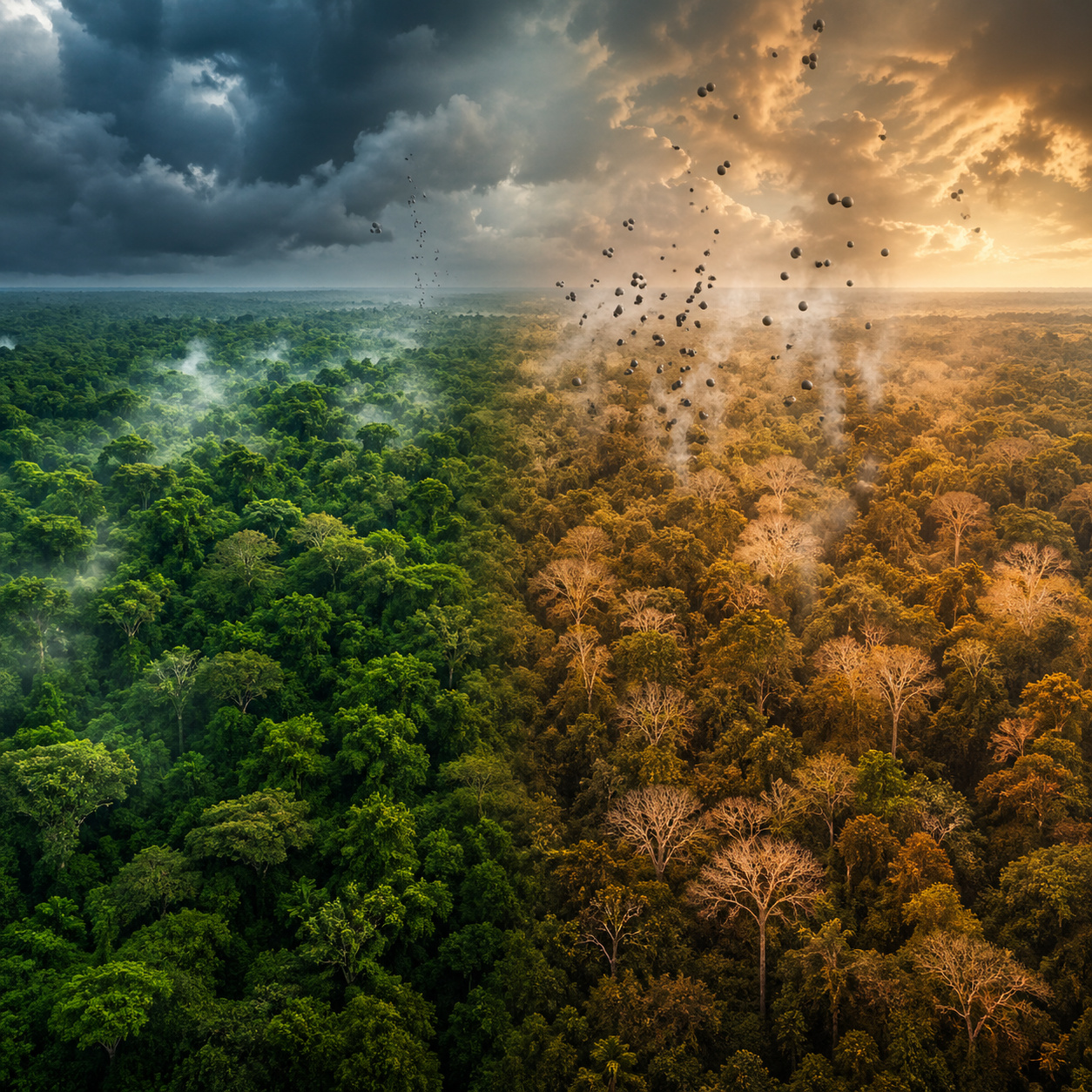


2026 study reveals Amazon became a carbon source in 2023 without an increase in fires, after forest lost its absorption capacity.
According to the journal AGU Advances, in a study published in February 2026 by the American Geophysical Union, the Amazon became a net carbon source in 2023, releasing between 10 and 170 billion kilograms of carbon into the atmosphere, including emissions associated with fires.
The change represents a historic shift: the planet’s largest tropical forest, which has absorbed carbon since long before human civilization existed, began to emit more than it captured. The phenomenon was more intense in the second half of the year, driven by a combination of global warming, elevated ocean temperatures in the Atlantic and Pacific, a prolonged dry season, and the climatic transition from La Niña to El Niño.
The central point of the study is not just the volume of emissions, but the mechanism identified: fire emissions remained within the long-term historical average between 2003 and 2023. What caused the forest to become an emitter was the standing vegetation itself, which reduced its capacity to absorb carbon under extreme water and thermal stress.
-
James Webb Telescope Uncovers Unexpected Clues on Mysterious Moon, Potentially Redefining Planetary Origins

-
$1.5 Billion Sleipnir Vessel Transforms Ocean into Floating Construction Site with 12 Hybrid Engines and Capacity to Lift 20,000 Tons

-
23 Years After Tragedy, Brazil’s Alcântara Space Center to Launch New Suborbital Rocket in 2026 with South Korean SEBIT Project Targeting Near-Space Tests
-
Entrepreneur Turns Neighbor’s Coffee Grounds Waste into Eco-Friendly Pellets, Earning Up to $40,000 Monthly in Brazil


Amazon rainforest functions as a carbon sink by balancing photosynthesis and respiration, but depends directly on water availability
The Amazon covers approximately 5.5 million square kilometers of living biomass, functioning as one of the planet’s largest climate regulators.
Under normal conditions, the forest acts as a net carbon sink. Trees capture CO₂ from the atmosphere through photosynthesis and store this carbon in wood, roots, soil, and leaf litter.


Carbon balance studies indicate that the intact Amazon historically sequestered between 0.4 and 0.7 gigatons of net carbon per year, contributing significantly to buffering global warming.
This balance depends on two fundamental factors: sunlight and water. While light is abundant in the tropics, water is the limiting element.
Extreme water stress in 2023 forced trees to close stomata and halt carbon absorption
During the 2023 drought, vast areas of the Amazon faced severe water deficits. Under this stress, trees activate a defense mechanism: the closing of stomata, small pores in the leaves responsible for gas exchange.
When stomata close, CO₂ intake is drastically reduced or halted, limiting photosynthesis. However, plant respiration continues to release CO₂. The result is a negative balance: the forest shifts from being a carbon absorber to an emitter.
Eastern Amazon region already acted as a carbon source before 2023 due to deforestation and prolonged warming
Previous studies published in the journal Nature had already identified that parts of the Amazon, especially the east and southeast, had been acting as net carbon sources between 2010 and 2018.
These regions showed greater deforestation and warming over the past decades, as well as increased water stress during the dry season.
The 2026 study expands this scenario by showing that, in 2023, climatic stress was intense enough to reverse the carbon balance of the entire forest, not just the most degraded areas.
2023 drought was not the most intense in history, but occurred in a hotter and more critical climatic context
The 2023 drought did not surpass previous events like those of 2005 and 2015/2016 in all water deficit indicators.

However, it occurred in a warmer climate context. The year 2023 was the first to consistently exceed 1.5°C above pre-industrial levels over twelve months.
Furthermore, tropical Atlantic and equatorial Pacific sea surface temperatures were significantly above average.
Temperature increase intensifies evapotranspiration and reduces tree tolerance to water stress
The temperature in the Amazon has increased by about 0.5°C since 1980, with greater warming during the dry season.
This increase raises the evaporative demand of plants and reduces the threshold of tolerance to water stress. Even small temperature variations amplify the impact of droughts on vegetation.
Traditional climate models are efficient for calculating emissions from direct deforestation. However, they have limitations in capturing the impact of intact forests under stress.
A forest may appear healthy in satellite images, but be absorbing less carbon due to invisible physiological changes.
Reduced photosynthesis, slow tree mortality, and growth loss affect carbon balance at multiple scales
The process occurs at different levels. At the leaf level, stomatal closure reduces photosynthesis. At the tree level, mortality can occur slowly, without immediate visible signs. At the forest level, consecutive years of stress reduce net biomass growth.

The Amazon also regulates the hydrological cycle of South America. Trees release large volumes of water vapor into the atmosphere, forming the so-called flying rivers.
When transpiration decreases, the volume of moisture transported also drops, reducing rainfall in regions such as the Central-West and Southeast of Brazil.
Amazon rainforest stress can worsen droughts in agricultural regions and impact hydroelectric reservoirs
Reduced rainfall directly affects agriculture and energy generation. The impact of the Amazonian drought propagates to other regions, amplifying economic effects.
A study published in February 2026 in the Global Change Biology showed that the Congo Basin experienced an expansion of wetlands between 2007 and 2024.
This process increased forest productivity and reduced net carbon emissions. The main difference between the two regions is the level of deforestation.
The Amazon suffered greater degradation, compromising its hydrological systems. The Congo maintains greater ecological integrity.
Scientists still don’t know if the Amazon can recover its carbon absorption capacity after 2023
The study highlights that it is not yet possible to determine if the change is permanent. The forest has already demonstrated recovery capacity after previous events.
The most critical data is that the change occurred without an increase in deforestation. The forest was standing, but stopped absorbing carbon.
Now we want to know: if the Amazon can become a carbon source even without deforestation, what does this mean for the future of the global climate?


