Portuguese
  Spanish


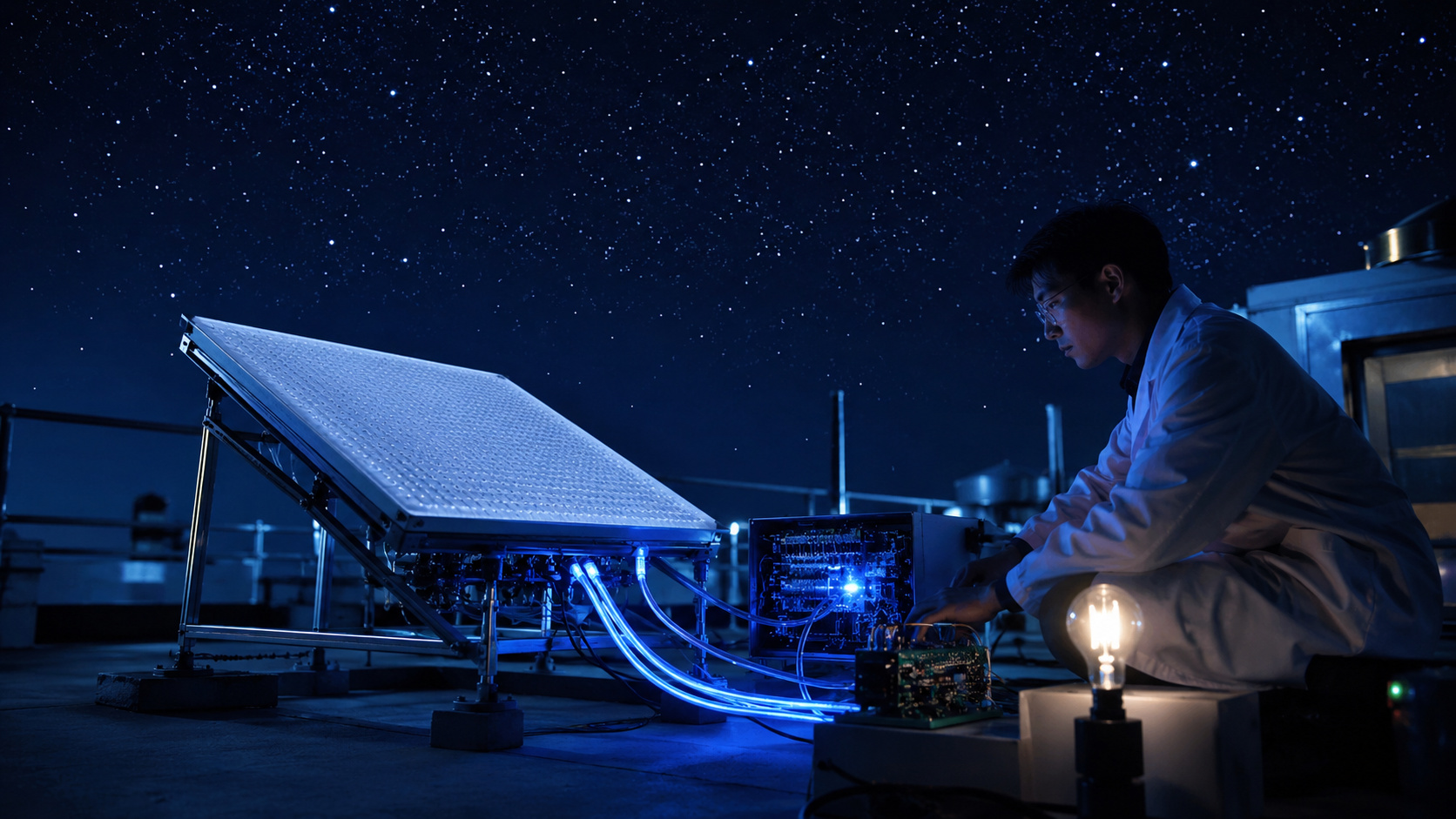


Scientists develop technology that generates electricity at night using radiative cooling and the cold of space.
While the whole world tries to solve the problem of intermittent renewable energy, researchers are exploring an idea that seems straight out of science fiction: generating electricity using the cold of space during the night. Instead of capturing energy from the Sun, wind, or water, the technology attempts to harness the heat that the Earth itself continuously loses to the Universe.
The concept is based on a physical phenomenon called radiative cooling, a natural process by which Earth’s surfaces emit heat in the form of infrared radiation to deep space, whose effective temperature is close to −270 °C. Scientists claim that this thermal difference can be transformed into electricity using highly sensitive thermoelectric systems.
The Earth loses heat to space every night
Even during the early hours, when there is no sunlight, the Earth continues to emit energy into space in the form of infrared radiation.
-
Artist’s 15-Meter Lighthouse in the Mojave Desert, 160 km from the Sea, Intrigues Visitors with 19 km Range After Years of Bureaucracy

-
Bluetti AC70 Solar-Powered Station: Powers Fridge and Wi-Fi During Blackouts, Delivers 1,000W, 3,000 Charge Cycles, Priced at $900

-
Enormous Black Hole Phoenix A* Challenges Scientific Understanding with Mass of 100 Billion Suns, Surpassing Famous TON 618 in One of the Largest Known Galaxy Clusters
-
Say Goodbye to Storing Wine in a Regular Fridge: Midea’s Climate-Controlled Cellar Holds 34 Bottles, Maintains 5-18°C, and Uses Only Half a kWh Daily


This process is called radiative cooling and is part of the planet’s natural thermal balance. According to studies on long-wave radiation, thermal emission is literally the main way by which the Earth loses energy to space.
The effect can be noticed on very dry nights when roofs, cars, and surfaces become cooler than the ambient air. Now, researchers are trying to turn this invisible phenomenon into real electricity generation.
Scientists have created a system that produces energy using the “cold of the Universe”
The principle of the device is relatively simple in theory. During the night, a special surface loses heat to the sky through infrared radiation and becomes cooler than the surrounding air. This temperature difference is then exploited by a thermoelectric generator, capable of converting thermal flow into electricity.


Researchers at Stanford University have developed experimental systems of this type and have managed to power small electronic devices using only the heat radiated into the night sky.
In practice, the device works almost like a “reverse solar panel”: instead of capturing heat from the Sun, it exploits the Earth’s heat loss to the sky.
New study achieved 350 mW per square meter during the night
The latest advances attracted attention because they significantly increased the power generated. A study published in 2024 described a nighttime generation system based on radiative cooling that reached about 350 mW/m² of sustained power density.

According to the authors, this represents an important advancement over previous experiments, which typically operated in the range of tens of mW/m².
The researchers claim that the performance was improved using:
- spectral optimization of thermal radiation
- reduction of parasitic heat losses
- better thermoelectric conversion
- more efficient thermal engineering
The study also states that future systems combined with thermal storage could reach levels close to 1000 mW/m² under certain conditions.
Technology tries to solve one of the biggest problems of solar energy
The main potential advantage lies precisely in nighttime generation. Traditional solar panels stop producing electricity after sunset. This forces electrical systems to rely on:
- batteries
- hydroelectric plants
- thermoelectric plants
- complex transmission networks
Generation based on radiative cooling attempts to fill precisely part of this nighttime energy gap.

According to researchers, even small amounts of continuous electricity can be extremely useful for:
- remote sensors
- IoT devices
- environmental monitoring
- decentralized systems
- ultra-low power electronics
The system’s “fuel” is the thermal difference between the Earth and space
The most curious aspect of the technology is that it does not rely on traditional fuel. The system uses as an energy resource:
- ambient heat
- infrared radiation
- natural thermal difference between the Earth’s surface and deep space

In physical terms, the Universe functions as a gigantic cold reservoir to which the Earth continuously loses thermal energy.
Scientists describe space as a “natural thermal sink” capable of allowing electricity generation even in the total absence of sunlight.
Efficiency is still low to power entire houses
Despite the potential, the studies themselves make it clear that the technology is still far from replacing large power plants.
Current energy densities remain much lower than those of:
- conventional solar panels
- wind turbines
- hydroelectric plants
Researchers treat the technology mainly as:
- complementary generation
- solution for sensors
- low-power electronics
- hybrid systems
- decentralized applications
In other words: the technology has not yet become a practical alternative for powering entire neighborhoods.
Researchers believe thermal engineering can boost performance
Even so, the field is advancing rapidly. The latest studies show that small changes in:
- thermal emissivity
- radiative materials
- insulation
- system geometry
- thermoelectric efficiency
can significantly multiply electrical generation.
The researchers themselves state that the theoretical limits calculated by thermodynamics are much higher than current results.
The next generation of energy may use the cold of space as a renewable resource
For decades, space was seen only as a frozen void above Earth’s atmosphere. Now, scientists are beginning to treat it as an active part of future energy systems. The idea of generating electricity from the heat that Earth loses to the Universe still seems strange, but experiments already show that it works physically.
And perhaps this is the most impressive aspect of the discovery: while humanity tries to capture sunlight during the day, researchers are already learning to transform the cold darkness of the night into a source of energy.