






 Portuguese
  Spanish


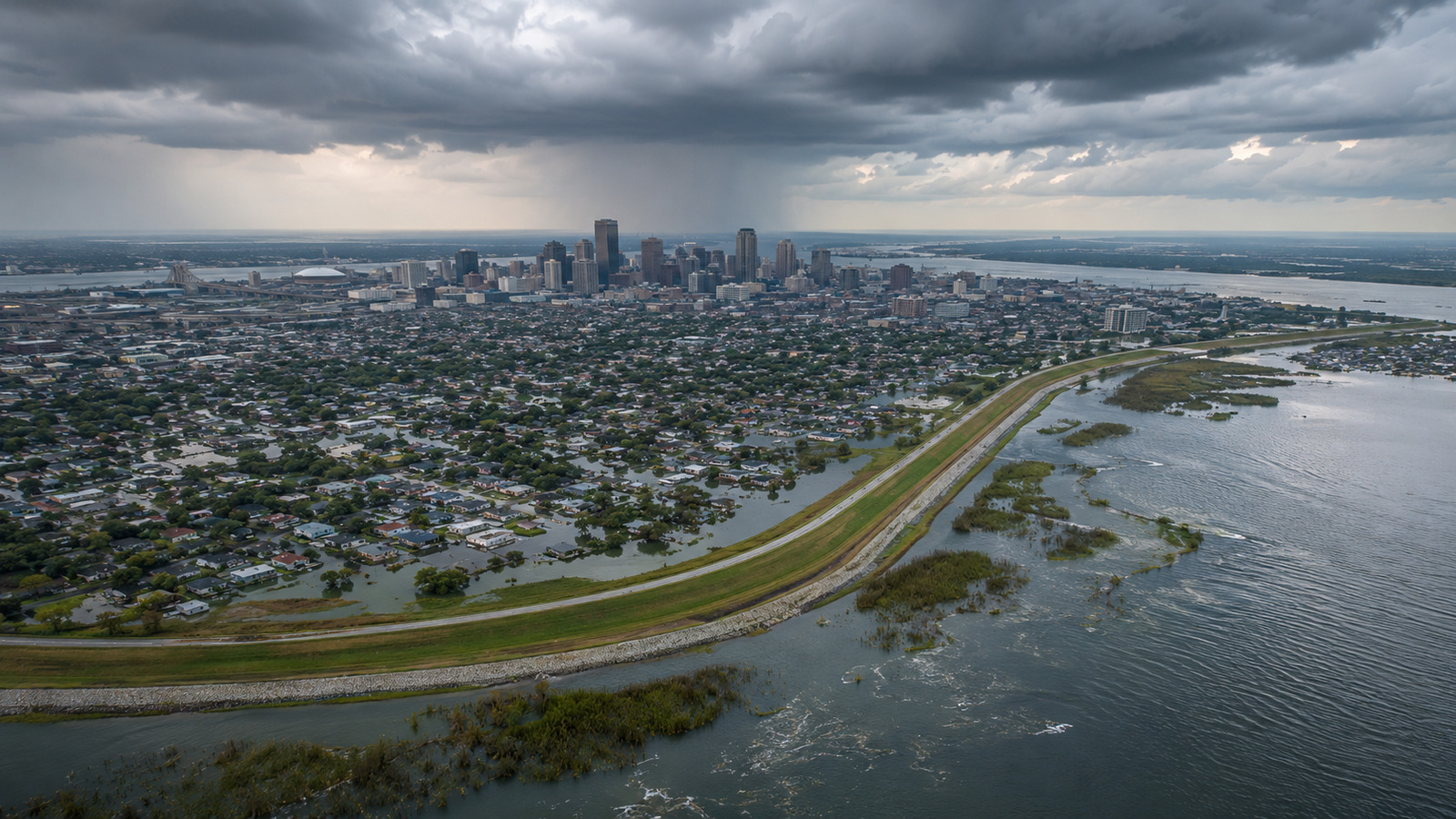

Study points out that New Orleans has passed climate “point of no return,” with risk of being surrounded by the Gulf of Mexico this century, as erosion, land subsidence, and sea level rise pressure residents
The planned retreat from New Orleans should begin immediately, as the city could be surrounded by the Gulf of Mexico within this century, pressured by rising sea levels, wetland erosion, and the sinking Louisiana coast.


Study sees city surrounded by the ocean
The new study states that the New Orleans area could be swallowed within a few generations, with continuous ocean advance and accelerated loss of the wetlands that still protect the coastal region.
The assessment estimates that the city “may well be surrounded by the Gulf of Mexico before the end of this century.”
-
Alaska’s 1,287 km Pipeline Built on 78,000 Metal Supports to Prevent Thawing, Survives Earthquakes and Remote Forests, Highlighting the Challenge of Hot Oil in a Harsh Environment

-
Brazilian Student Innovates Sustainable Ceramic Tableware Using Rice Husks and Recycled Glass, Achieving Up to 60% Waste Composition and Comparable Performance to Conventional Materials
-
AI-generated fake doctors deceive elderly in Brazil, health videos go viral with nearly 300,000 views, turning disease fear into a global audience and money machine.

-
Innovative Thermal Battery in Brazil Can Store Renewable Energy for Weeks, Offering Cheap Electricity and Winter Heating




This scenario makes a planned retreat an immediate issue for municipal, state, and federal authorities.
Low-lying southern Louisiana faces combined threats. Sea level rise is driven by global warming, while stronger hurricanes amplify existing risks.
Another factor is the gradual sinking of a coastline fragmented by the oil and gas industry. The study projects a sea level rise of between 3 and 7 meters.
It also predicts the loss of three-quarters of the remaining coastal wetlands. As a result, the coastline could migrate up to 100 kilometers inland, isolating New Orleans and Baton Rouge.
Researchers compared the current warming to a similar warm period that occurred 125,000 years ago. For them, the region is the “most physically vulnerable coastal zone in the world.”
Population lives in a high-risk area
New Orleans has about 360,000 inhabitants and is situated in a bowl-shaped basin below sea level. The geography itself increases the risk of severe flooding.
A separate study pointed out that 99% of the population is at high risk of severe flooding, the highest exposure among U.S. cities.
Shao said there is no specific deadline for how much time the city has left, but stated that New Orleans faces one of the highest rates of sea level rise in the world.
She also agrees that relocation will have to occur. While acknowledging the political and emotional weight of the issue, she argues that a planned retreat will be the ultimate solution at some point.
Jesse Keenan, a climate adaptation expert at Tulane University, stated that, in paleoclimatic terms, New Orleans has disappeared, and it remains to be seen for how long.
Levees won’t hold in the long term
After Hurricane Katrina in 2005, billions of dollars were invested in levees, floodgates, and pumps to protect New Orleans.
Even so, the study warns that these structures already require major improvements to remain sufficient and will not be able to save the city in the long term.
The assessment maintains that the Louisiana coastal region has already passed the point of no return, even if climate mitigation remains the first step against the worst-case scenarios.
Keenan stated that even if climate change stopped today, the city’s days would still be numbered. New Orleans would be surrounded by open sea.
Keenan advocates for coordinated action to support residents who will leave the region, starting with the most vulnerable communities, such as those in Plaquemines Parish outside the levee system.
For him, New Orleans is in a “terminal state” and needs a clear diagnosis. This would make it possible to organize the transition of people and the economy.
Erosion has already swallowed an area the size of Delaware
Since the 1930s, Louisiana has lost 2,000 square miles of land, an area equivalent to Delaware. In the next 50 years, another 3,000 square miles are expected to disappear.
The speed of loss is extreme: an area the size of a football field is devastated every 100 minutes.
Levees and other infrastructure had restricted the natural meandering course of the Mississippi. As a result, sediments carried by the river were pushed into the Gulf of Mexico, failing to replenish coastal wetlands.
The Mid-Barataria Sediment Diversion, initiated in 2023, attempted to restore a more natural flow in the Mississippi Delta. The estimate was to create more than 52 square kilometers of new land in 50 years.
Jeff Landry, Louisiana’s Republican governor, canceled the project last year. He claimed the $3 billion cost was too high and threatened the state’s fishing industry.
The new study states that losing this plan effectively means giving up extensive coastal areas of Louisiana, including the New Orleans region.
Without a plan, exodus could turn into disorder
This month, the U.S. Supreme Court allowed the fossil fuel industry to federally challenge a state jury decision.
The decision required Chevron to pay $740 million to remedy damages caused to wetlands by channel dredging, well drilling, and wastewater discharge.
Keenan stated that the combination of these decisions creates a scenario where the state has stopped trying to build land. For him, this accelerates the process.
The researcher said authorities could buy time, but that option was discarded. He also stated that it is certain that New Orleans’ levees will fail multiple times again.
In this scenario, planned retreat appears as an alternative to reduce chaotic migration. The United States has never transferred a large city on a large scale.
Still, several communities have already relocated for economic reasons, and others are now moving due to the climate crisis. In Louisiana, infrastructure could be planned to the north, beyond Lake Pontchartrain.
Keenan states that the exodus has already begun. Without action, residents will leave gradually, in an uncoordinated dynamic, pressured by the increasing difficulty of obtaining insurance.
Timothy Dixon, an expert from the University of South Florida, said that New Orleans will not disappear in 10 years, but that policymakers should have thought about relocation a century ago.
Louisiana has already recorded population losses in recent years. The study warns that this trend could accelerate in a disorderly fashion if the risks are not addressed immediately.
Landry’s office was contacted for comment but did not respond. Without a public strategy, the debate about planned retreat remains surrounded by costs, emotional ties, economic impacts, climate urgency, and the absence of an official response from the state government.
With information from The Guardian.


