






 Portuguese
  Spanish


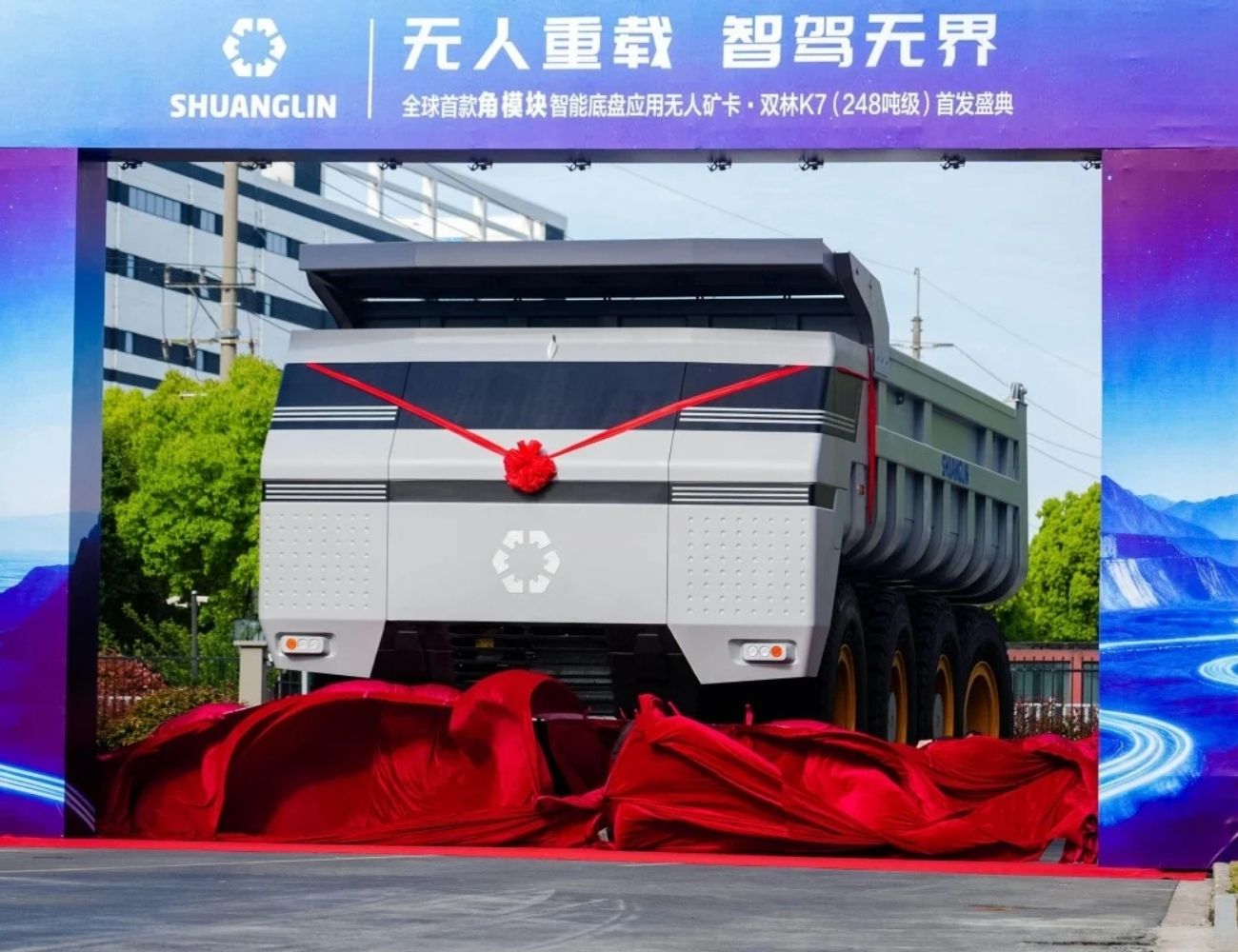

The Shuanglin K7 mining truck emerged as one of the most daring projects in China’s new race for heavy automation by combining lateral movement, rotation on its own axis, autonomous operation, a payload of 158 tons, and a quick battery swap system, in an attempt to change the logic of safety and productivity in open-pit mines
The Shuanglin K7 mining truck was presented by China as a new bet to modernize open-pit mining operations, debuting in Shanghai, on April 18, as part of a strategy that combines automation, electrification, and extreme maneuverability. Developed by the Shuanglin Group, based in Shanghai, in partnership with Tsinghua University, the vehicle was designed to tackle narrow areas, steep slopes, and loading points where conventional machines often lose time, space, and safety.
What makes this mining truck so striking is the combination of features that normally don’t appear together in a vehicle of this size. It can move sideways like a crab, rotate on its own axis, transport 158 tons of payload, operate 24 hours a day, and swap its battery in just five minutes. According to the source, the proposal also targets a historical problem in the sector, operational risk, with the potential to reduce mining accidents by up to 90% by eliminating complex maneuvers and the need for a driver on board.
The giant trying to turn the tables in mines
At first glance, the K7 already draws attention due to its size. The source describes the vehicle as a mechanical titan over five meters tall and almost 14 meters long, created to work in an environment where size usually means difficulty in maneuvering.
-
Ancient Ritual Circle, Hidden for 5,000 Years, Discovered in Scotland’s Machrie Moor Using Sensors, Revealing a “Phantom Stonehenge”

-
Engineers Develop Fridge-Sized Machine to Produce 95-Octane Synthetic Fuel from Air and Water, Aiming to Sustain Combustion Engines Without Oil
-
Two-Armed Robot Uses AI to Reassemble Destroyed Pompeii Frescoes, Solving an “Impossible” Puzzle
-
New Law in Brazil Requires Breaks for Type 1 Diabetes Management at Work, School, and Public Exams


This is precisely where the project tries to change the rules. Instead of accepting the traditional limitations of a heavy truck, the proposal for the Chinese mining truck was to invert the logic of the problem. If common models get stuck in tight spaces and depend on multiple back-and-forth maneuvers, the K7 tries to turn this bottleneck into an advantage with lateral movement and rotation on its own axis.
How the mining truck moves like a crab
The K7’s major differential lies in how its wheels were designed. According to the source, it is the world’s first autonomous transport truck to use a corner module with distributed electric drive, meaning the wheels no longer depend on a traditional axle.
In practice, each wheel functions as an independent unit, with its own motor, steering system, and brakes. Since these modules are controlled by wires, rather than conventional metal rods, the mining truck can move laterally, slide diagonally, and reposition its body on inclined tracks with much more freedom than a common model.
Why rotating on its own axis changes operation so much

In open-pit mines, space is rarely abundant. Loading areas, narrow trenches, and steep ramps turn every maneuver into a loss of time and increased risk. Traditional trucks require multiple adjustments to align, reverse, and reposition the load.
The K7 was designed precisely to escape this operational trap. By rotating on its own axis and moving sideways, the mining truck can pass through points where other vehicles would simply get stuck against the terrain or be forced into slow and dangerous maneuvers. This affects not only agility but also visibility and safety in high-risk environments.
The numbers that explain the size of the bet
The source compiles numbers that help understand why the K7 is being treated as such an aggressive project. The vehicle offers a 158-ton payload, a body with 100 cubic meters of volume, and a maximum loaded speed of 29 km/h.
Additionally, the battery swap system takes only five minutes, while regenerative braking allows for the recovery of 85% of energy. Preliminary data also indicates that automation can increase overall transport efficiency by 35%. In an industry that measures productivity by cycle, downtime, and operational risk, these numbers place the mining truck far above a mere futuristic concept.
What a five-minute battery swap means in practice
In heavy operations, stopping is expensive. The larger the vehicle and the more continuous the workflow, the more valuable any solution that reduces interruptions becomes. This is why the five-minute battery swap stands out as one of the K7’s most strategic points.
Instead of relying on long charging periods, the mining truck was designed to maintain almost uninterrupted transport. This brings electrification closer to the brutal logic of mining, where the machine cannot afford to be idle for hours waiting for energy. The goal is clear: keep the cycle active as much as possible, day and night.
Safety is where the project aims to make the biggest impact
Mining is an activity marked by risk. Blind spots, uneven terrain, reduced space, and heavy-load maneuvers create an environment where a single error can result in a serious collision. The foundation highlights this very scenario to explain why the K7 seeks to position itself as more than an engineering innovation.
By eliminating the need for a driver and reducing reliance on complex maneuvers in tight areas, the technology can decrease the risk of accidents by up to 90%. This is perhaps the strongest argument for the Chinese mining truck: not just doing more, but exposing fewer people to the type of operation that historically exacts a high cost in human error.
What happens if the system fails
One of the big questions with heavy autonomous vehicles is what happens when something goes off script. In the case of the K7, the foundation states that electronic redundancy allows the truck to continue transporting with 70% capacity, even in the event of a partial system failure.
This point is crucial because confidence in autonomous fleets depends not only on ideal performance but also on the ability to continue operating when the scenario is no longer perfect. For a mining truck to operate on a large scale, it needs to prove not only that it is intelligent but also that it is resilient.
China aims to accelerate automated mining by 2030
The K7 does not appear in isolation. The foundation shows that China is pushing the industry towards a full integration of smart technologies by 2030, replacing human teams with autonomous electric fleets in various operations.
This movement is already underway in large facilities in Inner Mongolia and the Gobi Desert, where hundreds of autonomous trucks are being deployed. Some mines are reportedly approaching 90% electrification, which helps explain why Shuanglin’s mining truck emerges as part of a broader transformation, rather than an isolated laboratory experiment.
What makes this mining truck seem different from everything else
The industry is already familiar with enormous, autonomous, and electrified trucks. What makes the K7 particularly striking is the combination of uncommon attributes in the same package. It doesn’t just rely on software, nor just on batteries, nor just on size. The proposal brings together lateral movement, turning on its own axis, independent modules on each wheel, ultra-fast battery swapping, and driverless operation.
This combination makes the project seem less like an incremental evolution and more like an attempt to redefine what a mining truck can be in extreme environments. It’s as if China decided to look at an old mining problem and respond with a machine that moves almost like no heavy truck has moved before.
Between the mountain and the machine, the competition is now for total efficiency
At its core, the K7 is born to solve a very objective equation. More difficult mines demand greater productivity, less risk, and less lost time. If a conventional truck hesitates, backs up, repositions, and exposes the operator to blind spots, the new Chinese model attempts to cut each of these steps.
The ambition is evident. To make the mining truck not just a cargo vehicle, but a central piece of the smart, electrified, and autonomous mine that China wants to make standard by the end of the decade. The real test will come in the field, on rough terrain, in mud, on slopes, and at the 24/7 pace of heavy operation.
If this mining truck can truly move sideways, rotate on its own axis, swap batteries in five minutes, and reduce risks by up to 90%, are we seeing just an impressive novelty or the beginning of a profound change in how mines will operate from now on?






