






 Portuguese
  Spanish


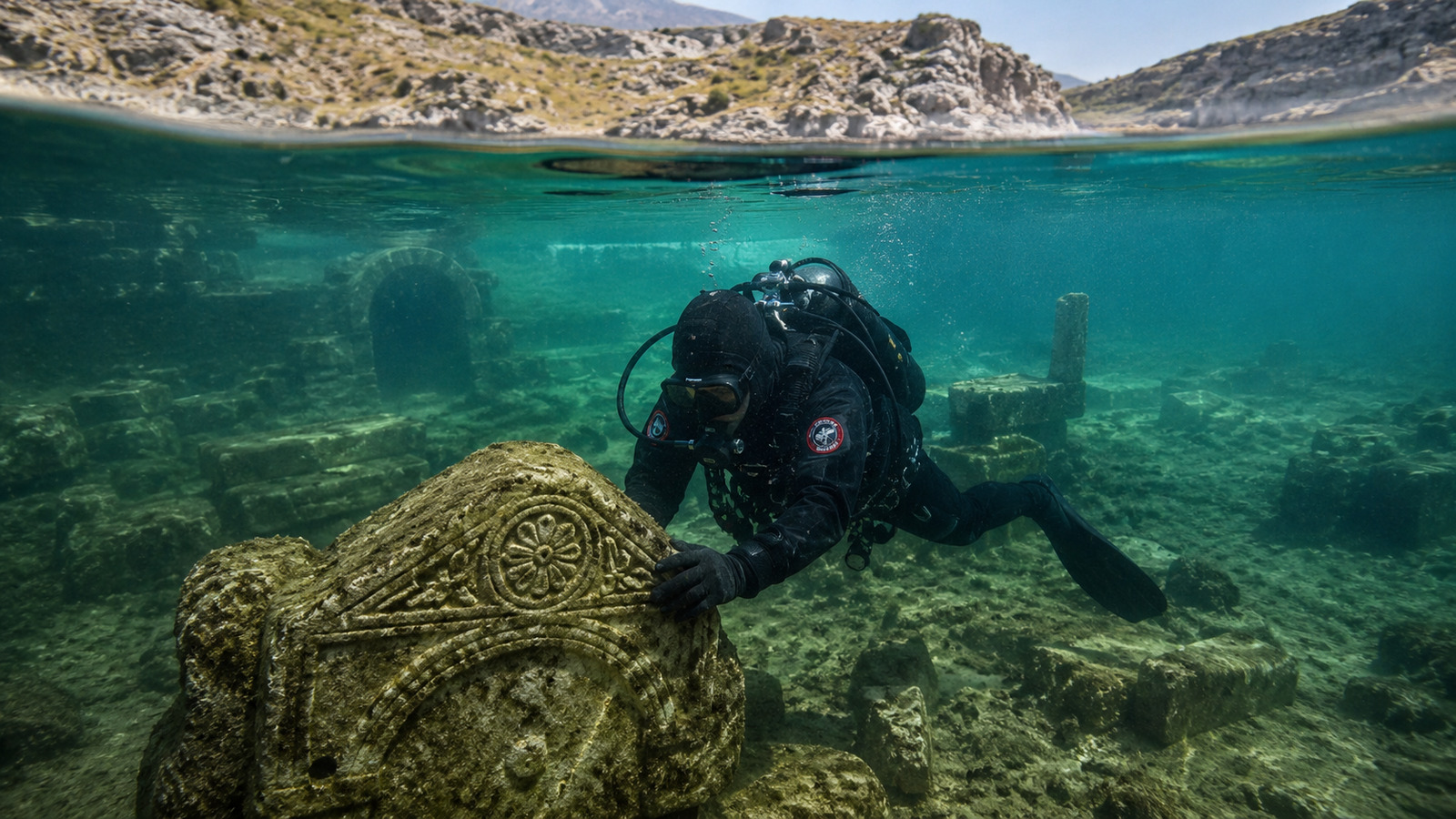

Found during Turkish police diving training, submerged complex near Dicle Dam brings together mosques, tombs, gravestones, madrasahs, civil constructions, and a Byzantine bath preserved after decades underwater
Submerged ruins dating back 2,400 years were found at the bottom of a lake formed by the Dicle Dam in southeastern Turkey during local police training, revealing preserved ancient structures and traces from different historical periods.


Discovery occurred during training dive
The discovery happened in the Eğil region, near the Dicle Dam, built to control the waters of the Tigris River. The site drew attention after a training dive conducted by the Turkish Gendarmerie.
During the activity, agents found ancient structures at the bottom of the lake. Underwater images revealed constructions linked to moments in the region’s history.
-
China Develops Custom 140-Ton Electric Mining Truck with 770 kWh Swappable Battery, Deploys 290 Units in Xinjiang’s Largest Zinc Mine

-
Meta to Launch Arena, a New Prediction App Targeting 3.56 Billion Users, Competing with Polymarket and Kalshi

-
Scientist Challenges Famous Human Evolution Theory, Argues Homo Sapiens Evolved Gradually Over Thousands of Years
-
15-Year-Old American Builds Ocean Generator with PVC Pipe and 3D-Printed Propeller for $12, Wins National Prize, Presents at White House, and Makes Forbes 30 Under 30 List




The most striking point was the state of preservation. Even after decades submerged, parts of the constructions still retained their original form, allowing local details to be observed.
The submerged ruins show how entire areas can disappear underwater after major works, but still retain signs capable of explaining ancient ways of life.
Constructions reveal uses of the ancient area
Underwater images showed a variety of ancient constructions at the bottom of the lake. The diversity of the findings indicates that the region was important to different civilizations over time.
Among the identified elements are religious, educational, funerary, and civil structures. This collection helps to understand how ancient populations organized spaces for living, worship, learning, and burial.
Divers found ancient mosques with visible structural parts, tombs, preserved gravestones, madrasahs used as religious schools, remains of civil constructions, and the Byzantine bath Deranbad.
These elements reinforce the relevance of the submerged ruins for daily reconstruction. Each preserved structure expands the understanding of architecture and human presence.
Preservation surprised researchers
The good state of the structures drew attention because part of the constructions maintained original characteristics even after being submerged for decades. This condition facilitates the work of archaeologists.
The presence of preserved tombs and gravestones also increases the historical value of the find. These remains help to show how ancient communities occupied the area before it was covered by water.
The submerged ruins also show that flooded environments can hide important records. In some cases, water limits direct contact with air and helps to slow down degradation.
This process does not eliminate the effects of time, but it contributes to maintaining visible forms and structures. Therefore, the lake created by the dam began to function as involuntary preservation.
Underwater archaeology expands investigation
Underwater archaeology is essential in areas that cannot currently be studied by common terrestrial methods. It allows access to structures hidden by water and the recovery of unknown information.
In the case of the Dicle Dam, the submerged area became a historical laboratory. The study can reveal information about the culture, architecture, and social organization of the populations that lived there.
This type of investigation also documents impacts caused by dams and floods. Regions modified by major works can hold records of cities, temples, religious schools, baths, and civil spaces.
Among the gains are the recovery of lost historical information, the study of the preservation of submerged materials, and the understanding of ancient cities.
Dam hid and preserved vestiges
The Dicle Dam played a dual role in the history of these structures. By covering ancient cities, it concealed part of the regional past, but also preserved fragments for decades.
The inhabited valley became an artificial lake, creating a new landscape over a complex history. The submerged ruins show how human advancement can unintentionally preserve historical traces.
Today, the discovery in Eğil offers a new way to observe the past. The finding demonstrates how civil constructions can survive underwater and keep alive part of the local human memory.
Based on information from Revista Oeste.






