






 Portuguese
  Spanish
  8 min of reading
  0 comments


December’s supermoon occurs near Christmas, appearing larger and brighter on the eastern horizon at dusk, with an optical effect that makes the Moon seem giant and close.
According to the National Observatory, the Full Moon on December 23, 2026, will be the largest supermoon of the year — and the last. The moment of the Full Moon will occur on that day at 10:28 PM Brasília time, with the Moon at a distance of just 356,740 kilometers from Earth. The moment of perigee — the point of maximum approach of the Moon in its entire orbit — will occur hours later, on December 24 at 5:29 AM, at a distance of 356,566 kilometers. This means that on the night of the 23rd, when the Moon is full, it will already be practically at the closest point it can be to Earth: less than 200 kilometers from perigee.
The astronomer from the National Observatory, Dr. Josina Nascimento, confirms that this is the only event of the year that simultaneously satisfies all three scientific criteria used to define a supermoon: a distance below 360,000 km, an interval of less than 12 hours between the Full Moon and perigee, and proximity above 90% of perigee. For those who will spend the night of December 23 outdoors, wake up early on the morning of the 24th, or simply look to the east on the evening of the 23rd, the sky offers the closest and brightest celestial object of the year — right on the night before Christmas.
The elliptical orbit that explains everything
The Moon does not orbit Earth in a circle. It orbits in an ellipse — an oval trajectory in which one of the foci is occupied by the center of the Earth. This means that throughout each 27.3-day cycle, the Moon passes through a point of maximum distance, called apogee, and a point of minimum distance, called perigee.
-
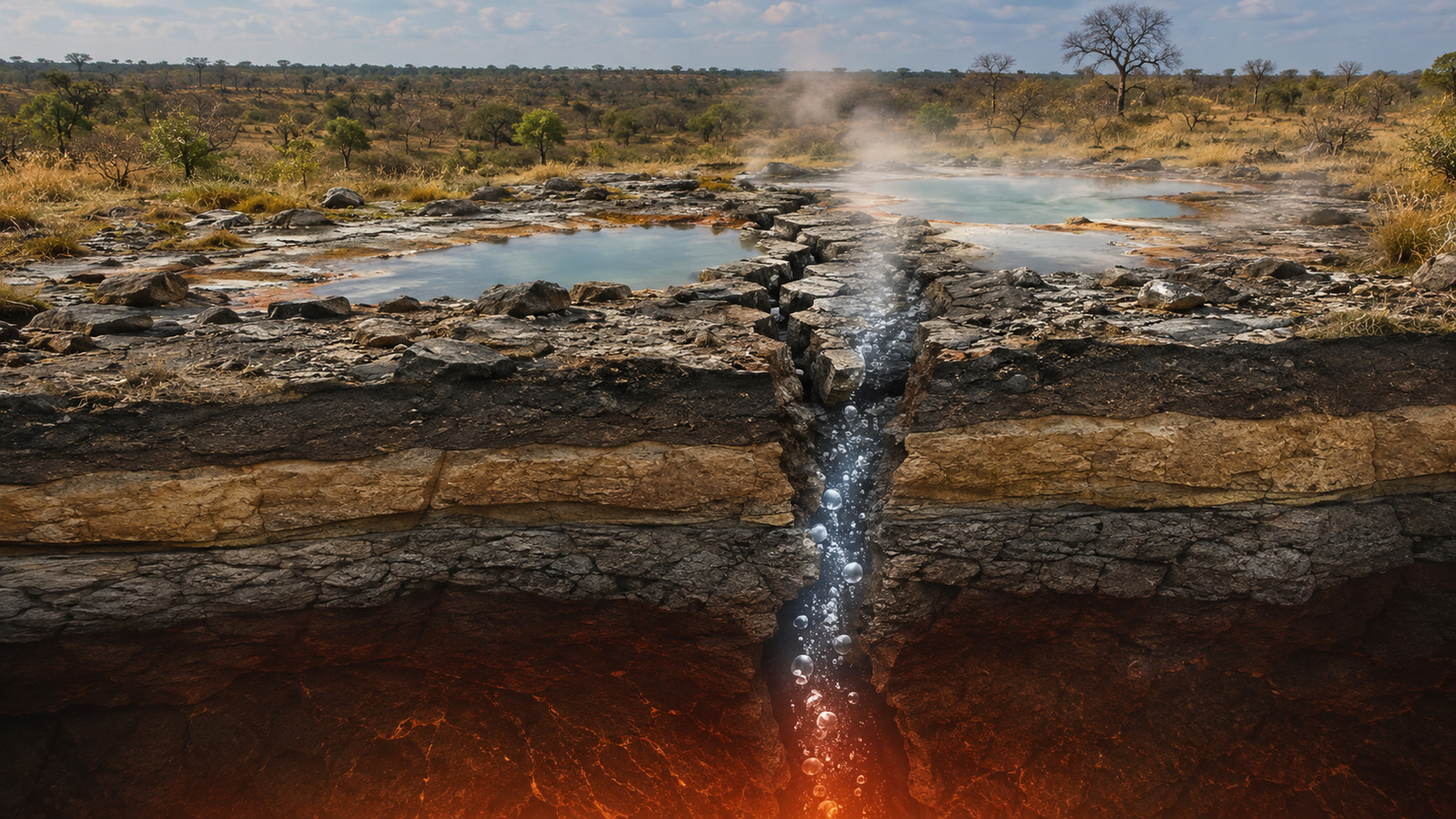
A rare gas cuts through the hot springs in Zambia and reveals a deep fault that may penetrate the crust down to the Earth’s mantle.

-
Forget the image of a frozen and still continent: scientists have just revealed hundreds of earthquakes beneath East Antarctica, in an area where no one expected to find this phenomenon.

-
Huawei will install Chinese batteries in 24 cities in the Amazon, in a project worth R$ 850 million that could become the largest energy storage system in Brazil.

-
China connects to the power grid the largest ultra-large battery storage station ever built in the world and signs a billion-dollar contract that consolidates a technology capable of sustaining entire cities with clean energy.


The average distance between Earth and the Moon is approximately 384,000 kilometers. At apogee, this distance reaches about 406,000 kilometers — more than 50,000 kilometers beyond the average. At perigee, it drops to about 356,000 kilometers — almost 30,000 kilometers short of the average. The difference between perigee and apogee is approximately 50,000 kilometers — equivalent to four Earth diameters.

This variation in distance produces a variation in the angular size of the Moon as seen from Earth. At apogee, the lunar disk occupies an angle of 29.4 arcminutes in the sky. At perigee, it occupies 33.4 arcminutes — almost 14% larger in angular diameter. The area variation is even greater: a 14% increase in diameter corresponds to approximately a 28% increase in the disk’s area. And the brightness variation follows: a Moon at perigee reflects 30% more light than a Moon at apogee because the larger apparent disk captures and reflects more sunlight to the observer’s eyes.
The Full Moon on December 23 will be 356,740 kilometers away — well below the average distance of 384,000 and close to the absolute perigee of 356,566 km that it will reach a few hours later. It is one of the closest supermoons possible, with an angular size that approaches the maximum allowed by orbital geometry.
The illusion no one can fully explain
There’s a reason why the most impressive time to observe the supermoon isn’t when it’s high in the sky — it’s when it’s rising. When the Moon is near the horizon, it appears much larger than when it’s high in the sky. This is called the lunar illusion, and it’s a visual phenomenon for which there is still no single, definitive explanation. NASA describes the phenomenon: an optical illusion makes human eyes perceive the celestial body as larger when it is near the horizon.
What is known for sure is that the illusion is purely psychological, not optical. The Moon is not physically closer to the observer when it is on the horizon — in fact, it is slightly more distant, because the observer is on the Earth’s surface and the horizon is further from the center of the Earth than the zenith.
If an observer photographs the Moon on the horizon and then photographs the same Moon when it is high in the sky, using the same camera and settings, the two images will show the lunar disk as practically the same size — possibly even slightly smaller on the horizon due to the greater distance. The illusion happens only in the human visual system, not in lenses or sensors.

The most accepted hypotheses involve the involuntary comparison the brain makes between the Moon and terrestrial objects in the visual field. When the Moon is on the horizon, it is visually close to trees, buildings, hills, power lines — objects that the brain uses as a scale reference. When it is at the zenith, it is alone in the empty space of the sky, without any comparative reference.
The distance suppression theory — developed by psychologist Lloyd Kaufman — proposes that the brain interprets objects on the horizon as more distant than objects at the zenith, and knowing that the Moon maintains the same size, it compensates by calculating it as larger to accommodate the perceived greater distance. The result is a Moon that appears enormous near the horizon and normal when high — even though it is the same object at the same actual size.
For the December 23 supermoon, this illusion adds to the real size difference: a Moon that is already 14% larger than the micromoon, appearing even larger due to an optical effect on the horizon, tinted orange by the same Rayleigh scattering process that colors sunsets. It is the most accessible astronomical spectacle on the calendar — no equipment required, no travel required, no training required.
What happens to tides when the Moon approaches
The supermoon is not just a visual event. It has a measurable and immediate physical effect: it amplifies tides. The gravitational force that the Moon exerts on Earth — and which is responsible for tides — varies with the inverse cube of the distance. This means that a small reduction in distance produces a proportionally greater increase in gravitational force. When the Moon is at perigee, as on the night of December 23 and the early morning of December 24, the gravitational force is approximately 30% greater than when it is at apogee.
This extra force produces more intense spring tides — the so-called full moon tides, which are already naturally larger than normal tides because the Sun and Moon are aligned with Earth. During a supermoon, the spring tide is amplified even further by the perigee effect.

Supermoon spring tides can be between 5 and 15 centimeters higher than normal spring tides — a small difference compared to the total tidal range, but enough to be noticeable on beaches with flat topography and to exacerbate episodes of coastal erosion or flooding in vulnerable regions.
On the Brazilian coast, the Full Moon of December 23 will coincide with the period of highest tourist frequency on the beaches — the start of summer holidays, with crowded beaches on the south and southeast coasts of the country. The combination of amplified spring tide with potential coastal erosion can make sea bathing conditions more dangerous than usual for those who do not pay attention to tide table forecasts.
Why December 2026 is the best month of the year to see the supermoon
Not all supermoons are equal. The distance to perigee varies from cycle to cycle, and some perigees are closer than others — depending on how the ellipse of the lunar orbit is oriented relative to Earth, which changes slowly over months due to the gravitational influence of the Sun and other planets.
The Full Moon of December 23 will be a supermoon by all three criteria, as the instant of the Full Moon will be at 10:28 PM with the Moon at a distance of 356,740 km and the instant of perigee will be on the 24th at 5:29 AM. None of the other full moons of 2026 simultaneously meet these three criteria. The November supermoon, on November 24, is close to the limit of distance criterion 1, but does not satisfy criterion 2 of temporal proximity between Full Moon and perigee. The January supermoon was at 362,312 km — well above December’s 356,740 km.

In terms of absolute distance to perigee, December 2026 represents the closest Moon of the year — and one of the closest possible in any year, because the minimum perigee of the long-period lunar cycle is around 356,400 km. The difference between the December 2026 perigee and the theoretically possible minimum perigee is only 200 kilometers — a fraction of 0.05% of the total distance.
What orbital physics says about when the next one will be even bigger
The lunar orbit oscillates slowly over longer cycles — the 18.6-year cycle called the draconic node cycle, which determines when eclipses are possible, and the 8.85-year cycle called the apsidal line cycle, which determines when perigee is closer or farther.
When these cycles align favorably, perigee can be closer than the typical 356,400 km — reaching approximately 356,000 km in exceptional cases. The November 2016 supermoon reached a distance of 356,509 km and was the closest since 1948 and the closest predicted until 2034. The December 2026 supermoon, with a perigee of 356,566 km, does not break the 2016 record but is in the same range — much closer than average and close to the minimum possible within current cycles.
The comparison between close supermoons and average supermoons is impossible to the naked eye in a single observation — there is no reference in the sky to compare absolute sizes. The 14% difference in diameter between a supermoon and a micromoon exists, is real, and is detectable in comparative photos, but it is rarely perceived by casual observers who look at the Moon once and do not have the micromoon as a point of reference. What is noticeable, even without reference, is the brightness: 30% more luminous than the micromoon means a perceptibly clearer night sky, slightly sharper shadows on cloudless nights, and a sense of physical presence of the satellite that ordinary moons do not produce.
The Cold Moon of December in the Southern Hemisphere
In the northern hemisphere, the December Full Moon is traditionally called the Cold Moon — a name of North American indigenous origin that describes the coldest month of the boreal winter, when the bright satellite over the snowy landscape was one of the few points of light on a long winter night.
In Brazil, December is summer — the exact opposite. The Full Moon of December 23 rises when the sun is still setting, shines brightly as families gather on Christmas Eve, and remains in the sky until the dawn of the 24th.


For a country that celebrates Christmas in the summer heat, with open windows and outdoor parties, the supermoon of December 23, 2026, is a detail of the scenery that most people will see without knowing that it is the closest and brightest Moon of the year. Just look east right after sunset. The orange disk that will rise on the horizon is no closer than it was on any other night of the year.









Be the first to react!