Portuguese
  Spanish


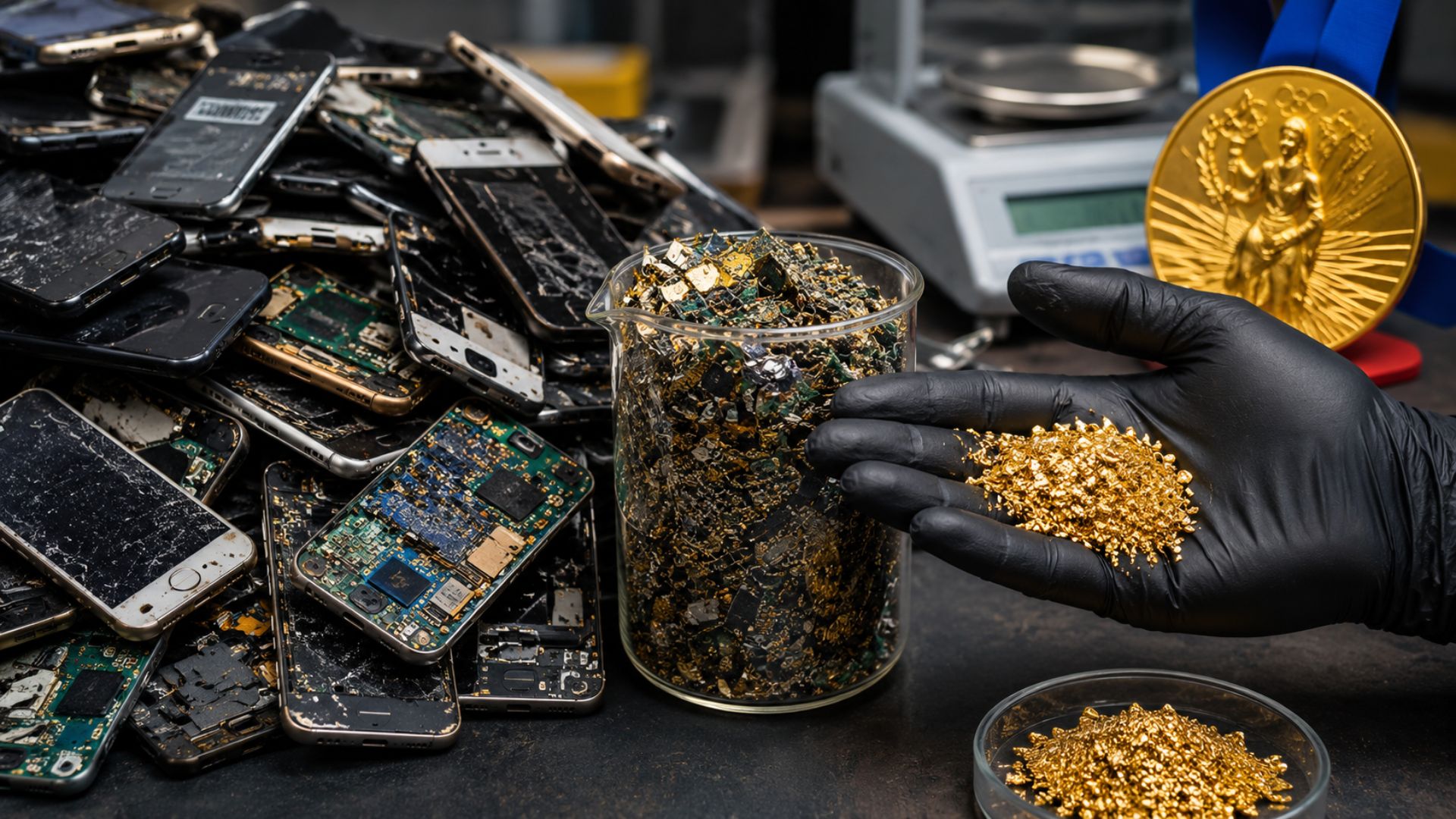

The number is impressive, but it’s a ceiling, not an average: it depends on which ore is compared. Even so, the calculation explains why Japan collected almost 79 thousand tons of electronics and 6.2 million cell phones to melt all the Tokyo medals, in an effort that involved more than 90% of the country’s municipalities and showed where the forgotten gold is.
A ton of old cell phones can hide up to 800 times more gold than a ton of ore extracted from a conventional mine, according to United Nations data. It is this hidden wealth in the drawers of homes, offices, and businesses that drives the so-called urban mining, an expanding practice that turns electronic waste into a strategic source of precious metals and has even literally yielded Olympic medals.
It is worth, from now on, a caution with this impressive number: the 800 times represent a ceiling, not an average. The value varies according to the type of ore used in the comparison, and some sources cite a range of 40 to 800 times more gold compared to ore extracted in the United States. In any case, the central idea remains: the circuit boards of electronics are so rich in metals that they function as a concentrated high-quality ore.
What is urban mining

Instead of digging mountains and opening open-pit craters, this approach turns to the electronic waste generated in cities, extracting from it the gold, silver, and copper that remained trapped in unused devices, often forgotten in a drawer.
-
Brazilian Startup Turns Coffee Grounds into Plant-Based Leather, Cutting Water Use by Over 50 Times for High-Impact Sustainable Fashion

-
Eco Invest Auction Aims to Unlock $10 Billion in Investments, Focusing on Green Fertilizers, Critical Minerals, Batteries, and AI for Clean Industry in Brazil

-
Half of Brazilians Prefer Lower Taxes with Private Health and Education, While 44% Opt for Higher Taxes for State-Provided Services, Datafolha Survey Reveals

-
Brazil’s Most Expensive Toll Rises to R$ 40.60 on Route from São Paulo to the Coast, Nearly Matching Bus Fare to Santos




The focus is on printed circuit boards, where the copper tracks, solders with various metals, and microcomponents coated with ultra-thin layers of gold and silver are located. The practice is one of the pillars of the so-called circular economy, a model that seeks to keep materials in use for as long as possible, reducing waste and dependence on virgin resources extracted from nature, in a continuous cycle of reuse.
How gold is extracted from cell phone boards

The process of turning circuit boards into reusable metals combines mechanical and chemical steps. First, the device is disassembled, removing batteries and plastic parts. Then, the boards are crushed into smaller particles, and techniques like magnetic separation, flotation, and screening help concentrate the metallic fractions, separating what has value from what will be discarded.
After this physical stage, the recovery of gold, silver, and copper occurs through chemical leaching and refining processes. Specific solutions dissolve the desired metals, which are then precipitated and purified until they reach a high degree of purity, sometimes in controlled furnaces and reactors that produce certified ingots. The process requires complex reagents and infrastructure but proves viable as long as there is a sufficient volume of collected material and proper management of the waste generated in the refining itself.
When electronic waste became an Olympic medal


The most striking example of urban mining happened at the Tokyo 2020 Olympic and Paralympic Games. The Japanese organizing committee launched a national campaign to collect cell phones, laptops, and other unused devices, aiming to extract metals and manufacture all the medals for the games. Collection points were spread across the country, and more than 90% of Japanese municipalities participated in the initiative.
Between April 2017 and March 2019, the project collected about 78,985 tons of electronics, including approximately 6.21 million used cell phones. From this material, enough metals were recovered to make 100% of the approximately 5,000 medals distributed at the games, with targets of approximately 30.3 kilograms of gold, 4,100 kilograms of silver, and 2,700 kilograms of bronze. It was the first time a country produced all its Olympic medals from electronic waste.
Why only 30 kilograms of gold were sufficient
An important detail helps to understand the scale of the project: the amount of gold recovered, about 30 kilograms, may seem small, but it was sufficient precisely because Olympic gold medals are not made of solid gold. In fact, they are mostly composed of silver, receiving only a thin layer of gold on the surface, which significantly reduces the amount needed of this more noble metal.
This does not diminish the achievement, on the contrary. The project had a strong symbolic and educational character, demonstrating that electronic waste contains real reserves of precious metals and that reverse logistics can be integrated into major public agendas. It is worth noting historically that Tokyo was not an absolute pioneer: the Vancouver Games in 2010 had already used e-waste on a smaller scale, and Rio de Janeiro in 2016 employed about 30% recycled material in the silver and bronze medals.
Sustainable jewelry and new uses for metals
In addition to the medals, there is growing interest from design brands and jewelers in producing sustainable jewelry from metals recovered from electronics. In these cases, the gold and silver extracted from the boards are refined until they reach purity comparable to conventionally mined metals, then transformed into rings, necklaces, and other accessories, often with certifications indicating the urban origin of the material.
This movement also resonates with the technology industry, which seeks to reduce the environmental footprint of its products by reusing metals in new components, connectors, and solders. Traceability, supported by digital systems and technical documentation, allows manufacturers and consumers to know if a particular batch of gold, silver, or copper originated from electronic waste, reinforcing socio-environmental responsibility practices and adding brand value.
Urban mining and traditional mining: the contrast
The comparison between conventional and urban mining reveals a striking contrast in environmental terms. Open-pit mining usually involves the removal of large volumes of earth, high water consumption, the use of hazardous substances in certain contexts, as well as deforestation and alteration of ecosystems. On the other hand, the recovery of metals in cities starts from materials that have already gone through the production chain, alleviating the pressure for new exploration fronts.
This does not mean that electronic recycling is free of impacts. The chemical treatment of boards requires strict control of effluents and emissions, as well as safe working conditions, especially in countries where part of this service is still done informally and dangerously. The advantage lies in the possibility of concentrating these processes in regulated facilities, with mitigation technologies, instead of spreading polluting activities across sensitive areas.
The hidden potential in Brazilian drawers
It is estimated that tons of electronic waste remain idle in homes and businesses, forming a true invisible deposit of strategic metals. Globally, the world generated more than 60 million tons of electronic waste in a single recent year, and less than a fifth of this is properly recycled, representing billions of dollars in gold, silver, and copper simply burned, buried, or forgotten.
For Brazil, which has a strong mining tradition and at the same time a large electronics market, urban mining represents a dual opportunity: reducing environmental impact and generating value from what is currently discarded. Expanding collection points, strengthening reverse logistics, and investing in certified recyclers are steps pointed out by experts so that this potential leaves the drawers and returns to the industry in an organized manner.
Urban mining shows that mineral wealth is not only in mountains and remote deposits but also in forgotten devices at home. By recovering gold, silver, and copper from electronic waste, this practice combines innovation, sustainability, and circular economy, transforming obsolete technology into medals, jewelry, and new devices. More than a curiosity, it is a trend that can redefine how society views its waste and the very idea of mining in the future.
Do you have old cell phones or electronics stored at home without knowing what to do with them? Did you imagine that this scrap could hide gold and other valuable metals? Leave your comment, tell us how many idle devices you have in the drawer, and share the article with those interested in sustainability, technology, and mining.