






 Portuguese
  Spanish


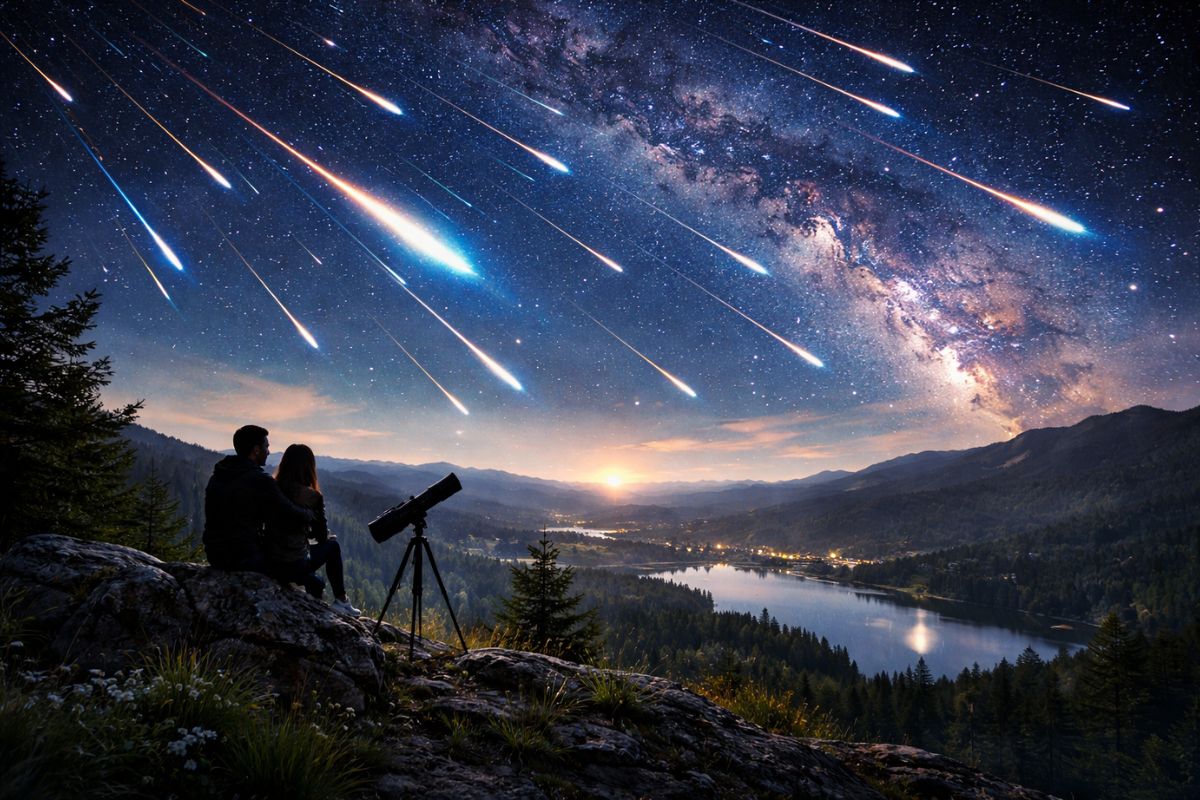

First great meteor shower of 2026, the Lirids, peaks at 2am and up to 20 meteors per hour, with observation without Moon to see shooting stars.
The first great meteor shower of 2026 arrives in the early hours from Tuesday to Wednesday, between the 21st and 22nd, and promises a show in the sky peaking around 2am. This information was provided by the geologist from the Astronomical Park of Criciúma, Maurício Thadeu Fenilli de Menezes.
The expectation is to see between 10 and 20 meteors per hour, and the conditions are considered positive because the observation takes place in the early morning, without interference from the Moon. Now, what makes the most difference is not just the time, but where you look.
What time to observe to see more meteors

The most awaited moment of the meteor shower occurs around 2am, when the activity tends to concentrate more appearances in the sky. Still, the observation is not restricted to that exact point.
-
From Father to Daughters: Aline Leaves Career to Modernize Family’s Four-Decade-Old Artisanal Cachaça Business in Rural Brazil, Expanding Production with Her Sister

-
Couple’s 17-Year-Old Home Garden Destroyed by Local Authorities, Threatened with Fines

-
Frustrated by local government inaction, Brazilian villagers crowdfund $800 to build wooden bridge for coffee transport across stream

-
The Hidden Function of the Hole in Nail Clippers Reveals a Smarter Design Than You Might Think




According to Menezes, from sunset it is already possible to have a small observation, with a chance to see some meteors before the peak time. The detail is simple, but it changes everything for those who want to prepare in advance.
How many meteors can appear in an hour
The Lirid meteor shower is described as a special event because it combines beauty and a relevant rate of appearances. The estimate indicated by the geologist is straightforward: from 10 to 20 meteors per hour.
This means that, even without counting, you can notice the pattern: a “shooting star” here, another there, and suddenly that sequence that makes everyone look up at the same time. And that’s when the early morning becomes a memory.
Sky without Moon: why this helps so much
Not always does the meteor shower come with favorable conditions, but this time the scenario is considered positive. The reason is quite practical: without the Moon’s light interfering, it becomes easier to notice the meteors, especially the more discreet ones.
For those observing with the naked eye, this difference is usually decisive. The cleaner sky without extra brightness makes the spectacle clearer, and this increases the chance that you won’t miss the most beautiful moment.
Where to look in the sky to avoid disappointment
Besides the time, the direction makes a difference. Those who want to see better should focus their gaze toward the North, indicated as the main passage point for meteorites, also popularly known as shooting stars.
Instead of constantly changing places, the ideal is to choose a spot and keep your gaze there for a few minutes. Meteors appear quickly, and the secret is to be alert when they decide to show up.
What are meteorites and why do they become “shooting stars”
Menezes explained that meteorites are fragments of rock that, upon entering the atmosphere, burn due to the energy and very high speeds. It is this process that creates the visual effect that everyone recognizes as a shooting star.
In other words, it is not a falling star, but a quick and intense phenomenon that transforms a moment into a spectacle. And sometimes it comes with a rare bonus.
The chance of seeing a bolide and why it attracts so much attention
If lucky, a bolide may appear, described as a rare and bright type of meteor. Menezes mentioned that a bolide was recorded in Criciúma on April 24, 2025, which reinforces that this type of surprise can happen.
It’s that moment when the sky seems to “light up” suddenly and everyone reacts together, even without coordinating anything. And that’s why so many people set their alarms.
Will you try to see the meteor shower tonight or do you know someone who has already witnessed this type of spectacle in the sky?


