Portuguese
  Spanish


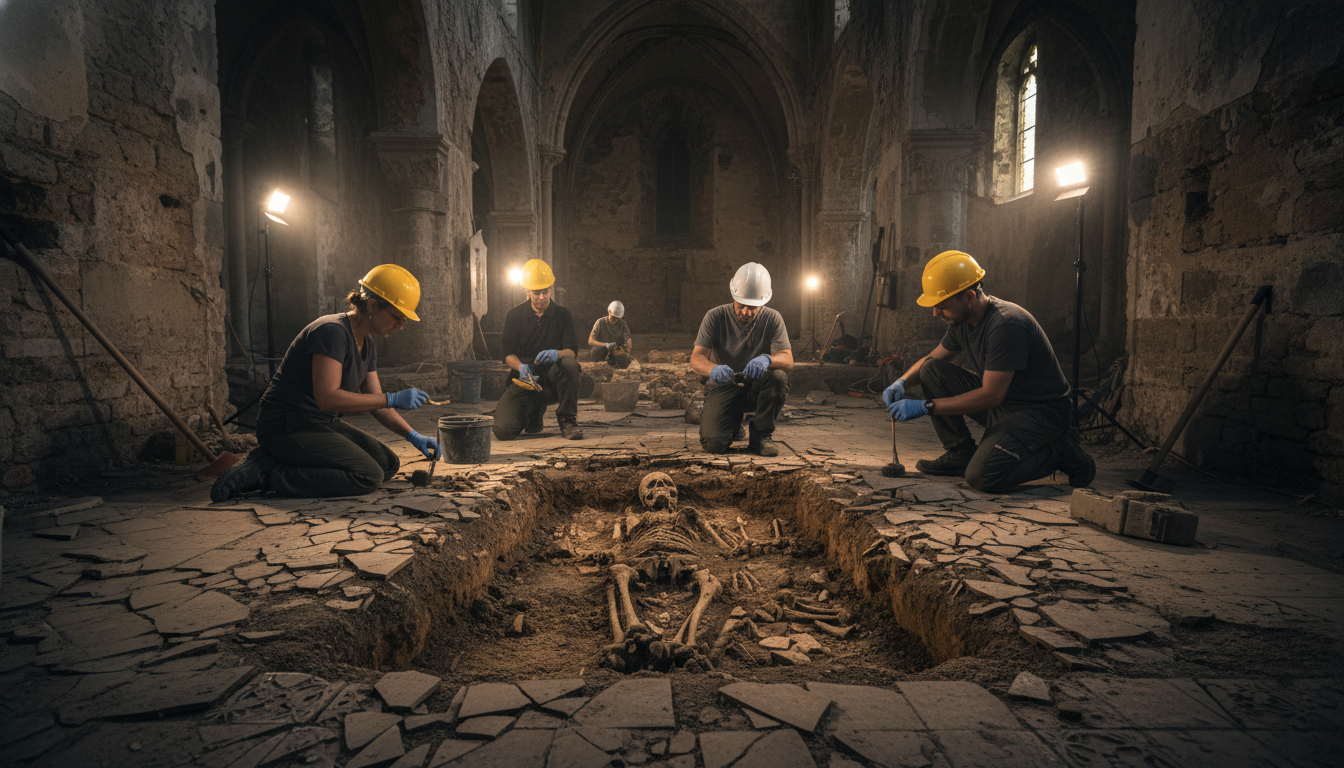

In February 2026, workers restoring the floor of an old church in Maastricht found a skeleton with a musket ball in its chest and a French coin from 1660 buried under the altar. The bullet, the coin, and the location are consistent with the death of the royal musketeer Charles de Batz de Castelmore, the historical D’Artagnan, 353 years ago.
According to CBS News, the floor of the Church of Saints Peter and Paul in Wolder, Maastricht, collapsed in February 2026. The royal musketeer inspired February 2026 during restoration work.
The royal musketeer who inspired D’Artagnan died in that same city on June 25, 1673, hit by a musket ball in the chest.
Therefore, the coincidence of evidence is what makes the discovery remarkable. Jos Valke, deacon of the church, stated: “The bullet that killed him was at chest level. Exactly as described in history books.
-
AI Video Generator Automatically Creates Subtitles and Animated Captions

-
São Paulo Unveils Latin America’s Largest Underground Reservoir, Holding 900 Million Liters, in the Greater São Paulo Area

-
Chinese Teen Wins Gold in Germany for Invention Turning Air Moisture into Underground Irrigation in Drought-Stricken Areas

-
Desertification Threatens Brazil’s Caatinga: 85% of Semi-Arid Region Affected, 30 Million at Risk, and Efforts Underway to Restore 10 Million Hectares by 2045




The evidence is very strong.”
Furthermore, archaeologist Wim Dijkman, who has been searching for D’Artagnan’s remains for exactly 28 years, was called immediately.
Dijkman stated: “We want to be absolutely sure it’s D’Artagnan.” The skeleton was transferred for analysis in Deventer, and DNA samples were sent to a laboratory in Munich.
The floor collapse and what was hidden for 350 years

The nave floor of the Church of Saints Peter and Paul collapsed during routine repairs in February 2026. Beneath the cracked tiles, workers found a burial no one expected.
The skeleton was positioned under the old altar, in a place reserved for nobles or important figures of the time.
Around the bones: a lead musket ball at chest level and a French coin minted in 1660 by Maximilian Henry of Bavaria, an ally of France.
According to Artnet News, French historian Odile Bordaz had suggested this same church as a probable burial site back in 2008.
Therefore, the discovery was not entirely accidental: it was the result of a hypothesis formulated 18 years ago.
The character who inspired Dumas: the real story of the musketeer
Indeed, Charles de Batz de Castelmore was born around 1611 in Lupiac, southern France. He became Captain of the King Louis XIV’s Musketeers of the Guard, serving three French monarchs.
Subsequently, in 1844, Alexandre Dumas published “The Three Musketeers” based on Castelmore’s diaries. The character D’Artagnan, brave and loyal, became one of the most famous icons in world literature.
Finally, the royal musketeer died on June 25, 1673, during the Siege of Maastricht, leading a charge against the city’s fortifications.
Historical accounts describe that he was hit by a musket ball in the chest. The body was quickly buried in “consecrated ground” near the French camp.
In this sense, the location of the skeleton under the altar of the old church in Wolder, which is exactly in the area of the 1673 French camp, fits the historical description with precision.
Therefore, the Church of Saints Peter and Paul was not a random location.
According to historical records, the French army camped exactly in this area during the Siege of Maastricht in 1673.
Furthermore, the presence of a French coin from 1660 reinforces the link to the period of the French military campaign in the Netherlands.
The three pieces of evidence pointing to the royal musketeer

Deacon Jos Valke listed the three pieces of evidence that make the skeleton a strong candidate:
- The musket ball: found at chest level, consistent with the cause of death recorded in historical documents from 1673
- The French coin from 1660: minted by Maximilian Henry of Bavaria, an ally of France during that period. Confirms a link to the French army
- The location under the altar: in the 17th century, only nobles or important personalities were buried under a church altar
Furthermore, Valke added: “The location of the grave indicates that it was an important person. Only royalty or important figures were buried there at that time.”
28 years of search: Wim Dijkman and the investigation
On the other hand, Wim Dijkman has been searching for D’Artagnan’s remains for 28 years. The independent archaeologist has been conducting historical research on D’Artagnan since 1998.
When the church floor collapsed in February 2026, he was the first to be called.
Subsequently, on March 13, 2026, the team extracted two teeth from the skeleton and sent them for DNA analysis to a laboratory in Munich.
However, the initial test failed due to insufficient genetic material.
Therefore, the laboratory is evaluating the use of part of the skull for a new attempt. The DNA will be compared with samples provided by confirmed descendants of Charles de Batz de Castelmore.
Consequently, the D’Artagnan case is becoming one of Europe’s most closely followed archaeological investigations.
In other words, Dijkman’s search ceased to be a solitary obsession and turned into a high-level scientific investigation.
The DNA that could change history