Portuguese
  Spanish


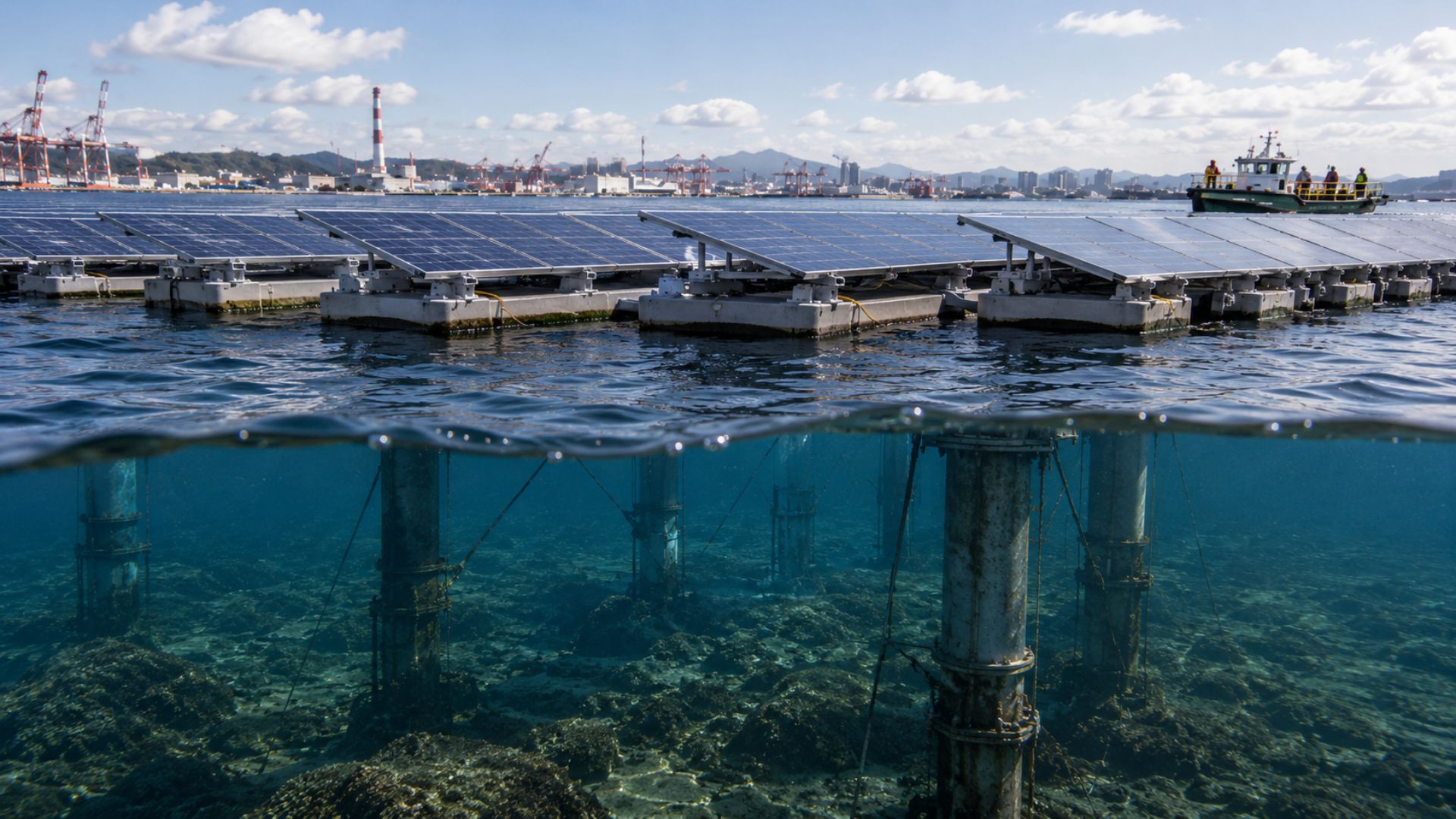

China inaugurated in Qingdao the world’s first solar power plant fully installed over seawater, according to the state-owned Sinopec. The offshore project has panels that follow the tides, occupies about 60,000 square meters, and is expected to generate 16.7 million kWh per year.
China has put into operation a solar power plant fully installed over seawater, considered the world’s first with industrial use capacity and large-scale generation. Installed in Qingdao, in Shandong province, the structure is part of the country’s effort to expand renewable sources on the coast and reduce carbon emissions.
Developed by the state-owned Sinopec, the plant occupies about 60,000 square meters and has an installed capacity of 7.5 megawatts. What stands out most in the offshore project are the solar panels, which rise and fall with the tides, staying close to the ocean surface to generate solar power directly over the sea.
How the solar power plant over the sea works

Built by Sinopec Qingdao Refining & Chemical, the plant keeps the panels very close to the water, at a distance about ten times smaller than traditional systems fixed by stakes. This proximity takes advantage of the natural cooling of seawater and, according to the company, increases the efficiency of solar power generation by 5% to 8%. The set is part of a previous offshore project, based on stakes, and together they form the largest floating photovoltaic plant ever built by Sinopec.
-
How Much Does Starlink Satellite Internet Cost for Cars, Trucks, and RVs? Prices for Antenna, Accessories, and Plans

-
Scientists Convert Food Waste into Aviation Fuel, Successfully Test 50% Blend with Conventional Kerosene to Cut Emissions and Promote Sustainable Flights
-
OnePlus N6 Smartphone to Launch in India with 8,000mAh Battery and 45W SuperVOOC Charging, Lasting Up to Three Days
-
Scientists Plan to Release Air Bubbles Underwater to Protect Antarctica’s “Doomsday Glacier” from Melting





The numbers help to size the work. The structure has a capacity of 7.5 megawatts and is expected to produce about 16.7 million kilowatt-hours per year, enough to avoid the emission of approximately 14,000 tons of carbon dioxide annually. For China, which seeks to expand clean generation in coastal areas, it is a technological showcase installed directly in Qingdao.
The challenges of generating solar energy in seawater

According to information released by the NSC portal, operating a plant over the sea means facing extreme conditions: sea spray, corrosion, barnacles, waves, strong winds, and tide variations. To overcome these obstacles, Sinopec claims to have applied three main innovations. The first are floaters and supports made with materials resistant to salt and the accumulation of marine organisms, which reduce the typical corrosion of the saline environment.
The second is an anchoring system designed to withstand winds of up to level 13 and tide variations of 3.5 meters, which helped reduce investment costs by about 10% compared to pile structures.
The third is a low-profile inspection path, which cuts operation and maintenance costs. The company already plans to expand the offshore project in Qingdao to 23 megawatts, reinforcing its renewable solar energy chain.
Why China is betting on offshore solar energy
The bet makes sense for those leading the sector. China is the largest manufacturer and consumer of photovoltaic products in the world, and solar energy already accounts for about 30% of the country’s total installed capacity, close to half of all capacity recorded on the planet. In 2020, Beijing set the goal of surpassing 1.2 billion kilowatts of installed wind and solar energy capacity by 2030.
Historically, large solar projects were concentrated in western China, but terrain difficulties and long transmission distances pushed the search for alternatives to the coast and the sea. The government treats photovoltaics as part of the so-called “new quality productive forces,” a growth model based on technology and industrial modernization advocated by Xi Jinping, which associates green development with high-quality development. Therefore, the offshore project by Sinopec gains symbolic weight.
The solar race on the coast and the maritime economy


The Qingdao movement is not isolated. In January 2025, the province of Shandong itself completed the largest single-unit photovoltaic power plant in the country on saline-alkaline mudflats along the coast, with the potential to generate about 1.442 billion kilowatt-hours per year when fully operational. The offshore plant, in turn, is expected to help power future green hydrogen projects by Sinopec.
Still, balance is needed. The Chinese solar industry is dealing with excess production capacity, which has led companies and authorities to prioritize innovation and technological advancement. Experts also note that the performance of fully offshore plants will still be tested under severe conditions, such as the typhoon season, a decisive factor in determining whether maritime solar energy will indeed establish itself on a large scale. For now, China regards the project as a milestone in its energy transition.
Solar panels that float and rise with the tide in the open ocean seem like fiction, but they are already a reality in China.
Tell us in the comments if you think offshore solar energy is the future of renewables or if it makes more sense to invest on solid ground.