Portuguese
  Spanish


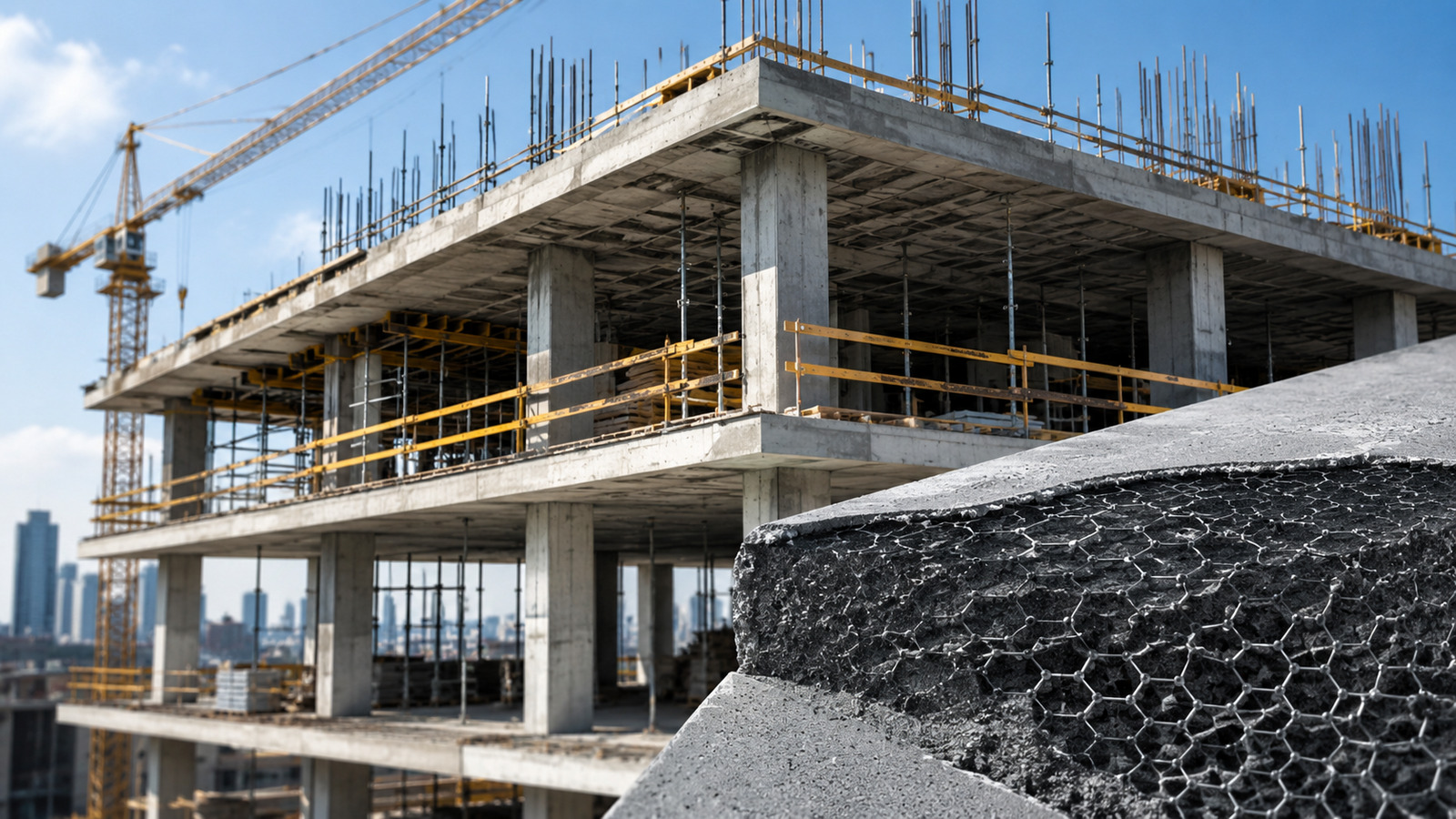

Graphene concrete can reduce material in slabs, floors, and pavements, but experts emphasize that the technology requires structural calculation, testing, quality control, and standards before cutting cement, thickness, or reinforcement
Graphene concrete promises to reduce material in specific applications, such as slabs, floors, and pavements, by using carbon nanomaterials to improve the strength, durability, and efficiency of cement, but the technology does not eliminate calculations, testing, or technical standards.


How graphene concrete improves performance
Graphene concrete uses small amounts of carbon nanomaterials in the cement matrix. The goal is to improve the material’s microstructure, enhancing strength, durability, and corrosion protection, according to the University of Manchester’s information on Concretene.
In the mix, graphene can promote cement hydration, refine internal pores, and strengthen the bond between the cement paste and aggregates. This combination can increase mechanical performance and decrease permeability.
-
Green Roofs on Homes Gain Popularity for Reducing Heat, Noise, and Rain Impact in Brazil

-
Brazilian promises his children to save a river, creates an eco-barrier in his backyard, has already removed more than 40 tons of trash from the water, and even inspires the idea in other states of the country.

-
How a Brazilian company created a system that transforms broken pallets of any brand into new assets, recycles 80 tons of plastic per month, and found a profitable solution to a problem that challenges industries across the country.
-
Invasive bullfrog capable of devouring other amphibians and laying up to 20,000 eggs is found in Florianópolis, raising an alert about the threat to native fauna.



The result, however, does not come automatically. It depends on correct dispersion, appropriate dosage, technological control, and compatible application.
When these points fail, small poorly distributed quantities can cause inconsistent performance.

Slabs can use less material, but not without a project
Reducing thickness requires caution. The University of Manchester reported a commercial slab made in Amesbury, UK, with 30% less material and removal of conventional steel reinforcement.
This example does not allow us to state that every slab can be 50% thinner. Span, load, deformation, cracking, punching, fire, durability, and standards define the thickness of each structure.
Graphene concrete expands project possibilities but does not replace structural engineering. Any reduction in cement, volume, thickness, or reinforcement needs to undergo testing, calculation, and technical approval.
Reinforcement can be reduced
In floors, pavements, or slabs on the ground, the technology may allow for the reduction or elimination of specific reinforcements, provided the project demonstrates performance. This was the case in the Amesbury demonstrator.
Even so, the result is linked to the mix, the expected loads, and the type of application. It is not a general rule for any construction nor an authorization to abandon steel without validation.
In buildings, bridges, columns, beams, and suspended slabs, reinforcement remains essential in many cases. Concrete withstands compression well, but tension, cracks, ductility, and collapse require rigorous analysis.

Safety depends on testing and control
The performance of graphene concrete depends on dosage, mixing, curing, chemical compatibility, and laboratory validation. A correct formulation can improve resistance and reduce variability, but requires control.
Before reducing cement, thickness, or reinforcement, engineers must demand traceability, testing, and technical approval.
Necessary verifications include compression, tension, modulus of elasticity, deformations, cracking, and shrinkage.
The analysis also includes durability against water, chlorides, and carbonation, compatibility with local additives and aggregates, worksite testing, curing, quality control, and compliance with applicable standards.
Environmental potential does not mean indestructible structure
The reduction of cement and emissions is among the central promises. Since cement accounts for a portion of concrete emissions, higher performance may allow for lower cement consumption in certain projects.
UKRI describes a demonstrator slab with 30% less volume than a conventional solution. The data shows environmental potential, but the technology needs industrial scale, certification, and competitive costs.
Concrete with graphene can be more resistant, dense, and durable, but it does not create virtually indestructible structures. Fires, corrosion, extreme loads, design errors, inadequate execution, settlements, earthquakes, and poor maintenance remain real risks.
The responsible promise is to design more efficient components, with lower material consumption and longer lifespan.
The Concrete Centre treats graphene in concrete as high-performance innovation, not as a substitute for structural rules.
With information from Monitor do Mercado.