Portuguese
  Spanish


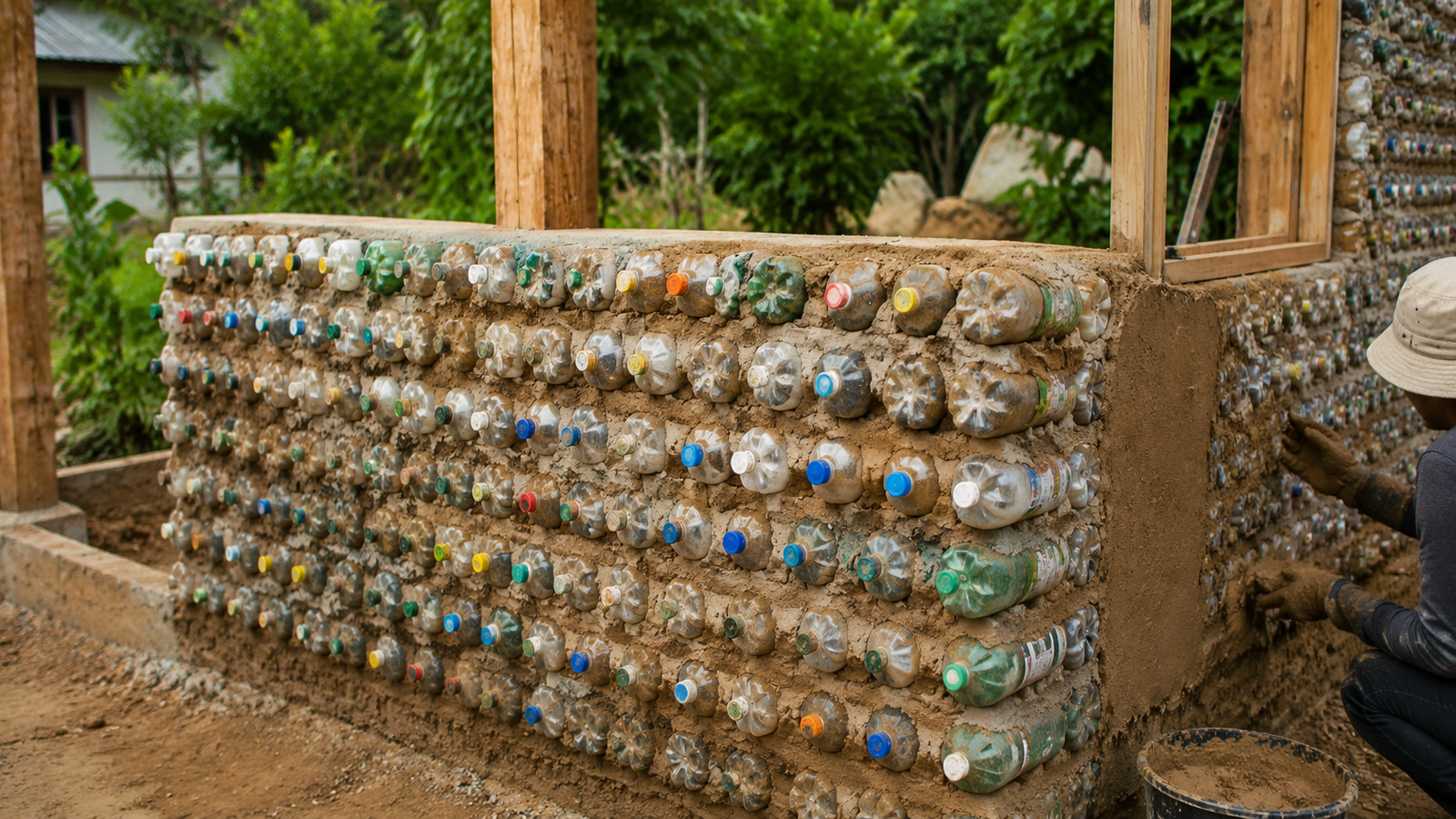


Simple technique transforms PET bottles filled with dry waste into rigid pieces for flowerbeds, benches, dividers, and small backyard projects, combining reuse, economy, and care with the material’s structural limits
An article published by O Antagonista (READ HERE) showed a very interesting alternative. PET Brick made with clean bottles and dry waste has become a simple alternative in small sustainable constructions, combining reuse, economy, and creativity to transform discarded plastic into rigid pieces used in light walls, flowerbeds, benches, and dividers.


PET Brick reuses bottles and dry waste
The PET brick works by filling bottles with dry materials, such as bags, plastic packaging, and non-organic scraps. The content needs to be well compacted to make the piece firm and resistant to crushing.
Once ready, the bottle functions as a module in small-scale ecological projects. The proposal is not to replace any construction system but to use the material in applications compatible with its limits.
-
App Drivers Unite in Major Solidarity Effort to Aid Venezuela Earthquake Victims, Mobilizing the Brazilian Amazon with Donation Campaign

-
Green Roofs on Homes Gain Popularity for Reducing Heat, Noise, and Rain Impact in Brazil
-
Brazilian promises his children to save a river, creates an eco-barrier in his backyard, has already removed more than 40 tons of trash from the water, and even inspires the idea in other states of the country.

-
How a Brazilian company created a system that transforms broken pallets of any brand into new assets, recycles 80 tons of plastic per month, and found a profitable solution to a problem that challenges industries across the country.


The sustainable result appears when the plastic stops going to waste and gains a practical function in construction. Instead of being discarded, the bottle becomes part of simple solutions in the backyard.
Technique reduces waste and saves materials
The technique is considered ecological because it reduces plastic waste, utilizes available materials, and decreases the use of conventional inputs in small constructions.
With organization, bottles that would be thrown away can become functional pieces.
This reuse makes more sense when there is care in preparing the units and attention to the destination of the waste used in the filling. The gain is in creating value from simple and accessible materials.
In do-it-yourself projects, the PET brick also stimulates creativity. The person can create low-cost solutions, as long as they respect the light, decorative, or functional purpose of the technique.

How to prepare the bottles in the backyard
The first step is to separate PET bottles of the same size, wash them well, and let them dry completely. Then, the clean and dry plastics should be gradually placed inside each unit.
Compaction is the main point of the process. With a wooden stick, the filling should be pressed until the bottle becomes hard and does not easily dent, ensuring better performance in the ecological construction.
When the filling is firm, the cap needs to be tightly closed. The ready bottles should be stored in a covered place until assembly, protected from moisture and damage before use.
Where to use without complicating the construction
The PET brick can be applied in light, decorative, and functional projects, especially when there is no heavy structural requirement. It suits protected outdoor areas, gardens, and simple backyard organizations.
Among the most practical uses are raised beds for plants, garden benches with proper finishing, low partitions in covered areas, decorative walls without structural function, playrooms, vegetable gardens, and educational spaces.
These applications allow testing the technique without turning the construction into something complex. The material works best when used to organize spaces, decorate environments, and support small-scale sustainable solutions.
Precautions avoid problems and increase the durability of the PET brick
PET bottles should not bear structural loads of houses, slabs, beams, or pillars. In larger constructions, the technique should be combined with professional guidance, an adequate base, and compatible finishing materials.
It is also essential to protect the bottles from direct sunlight, fire, and constant impacts. Coatings with mortar, clay, mesh, or proper finishing help preserve the set and make the result safer.
It is worthwhile to make the PET brick at home when the goal is to create an ecological, economical, and simple solution for small interventions. With patience, correct compaction, and planned finishing, plastic waste becomes useful pieces.
In sustainable backyard constructions, the technique reduces waste, encourages creativity, and gives new use to packaging that would take many years to disappear from the environment. The process requires care but can make construction more conscious.
With information from O Antagonista.