Portuguese
  Spanish


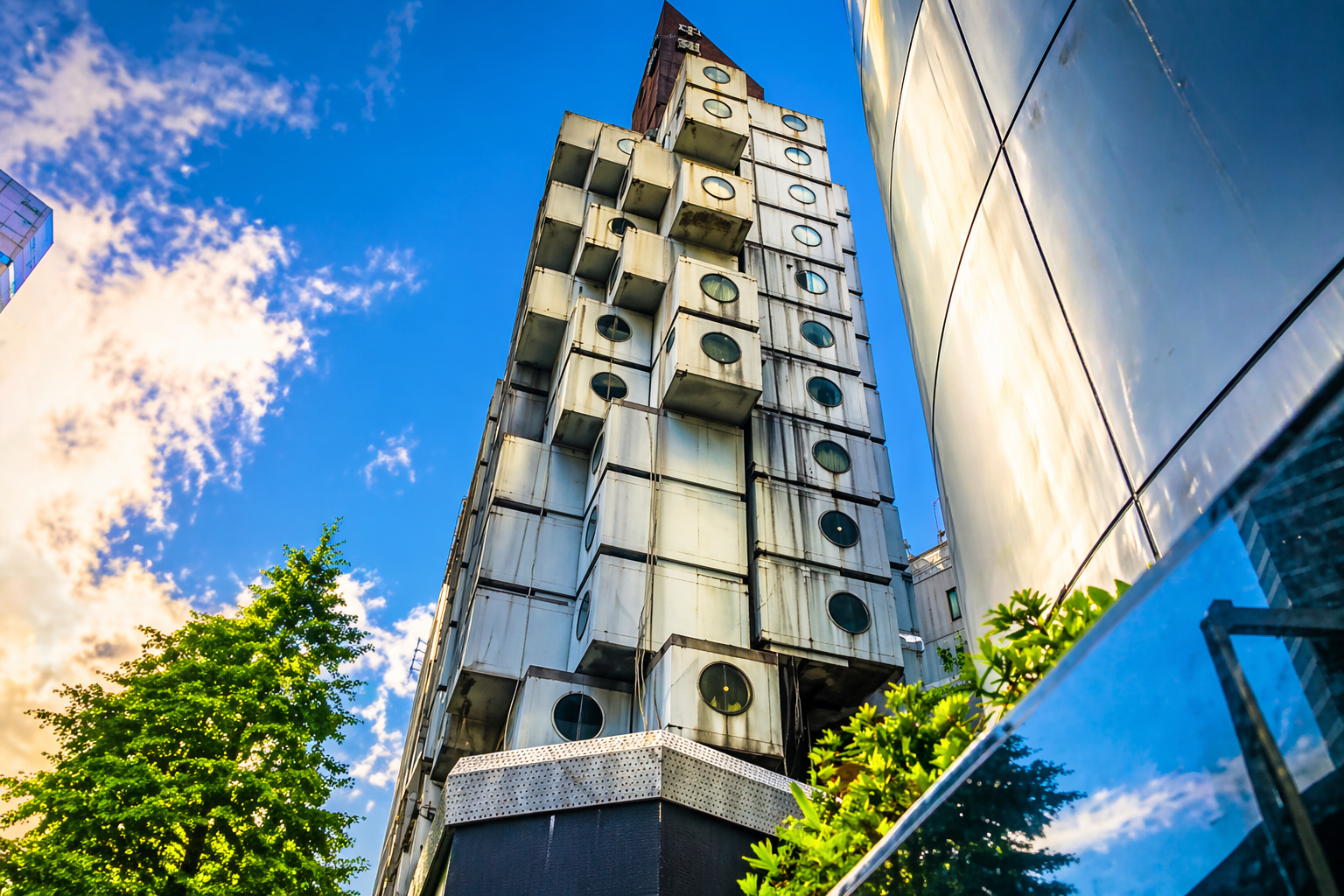


Capsule project in Tokyo inspires very small modern housing and reignites the debate on affordable urban housing around the world
The Nakagin Capsule Tower, built in 1972 in Tokyo, drew attention for its bold concept that mixes technology, architecture, and compact urban living. The building was designed as a kind of modern miniature city, with small, complete, and ready-to-use units.
The impact of this model goes beyond architectural curiosity. The proposal for compact and modular housing has returned to the center of discussions in large cities, where space is expensive and every square meter makes a difference. The idea of replacing parts of a building as if they were machine parts raises new possibilities for the future of cities.


How the capsule tower worked with compact and complete apartments
The tower was designed by Japanese architect Kisho Kurokawa as one of the main examples of the movement known as Japanese metabolism. The building housed 140 prefabricated capsules, each measuring 2.5 by 4 by 2.5 meters, functioning as complete apartments.
-
Brazilian Entrepreneur Turns Passion for Amazonian Cocoa into a Million-Real Chocolate Business After Studying in France

-
Structural Report Reveals Serious Issues at Historic Corinthians Stadium, Engineer Recommends Partial Demolition

-
For a Decade, a Young Sudanese Innovator Builds Robots from Electronic Scrap in a Makeshift Lab in Omdurman

-
Woman with no tech background uses AI to develop app, reaches 50,000 users and goes viral with 2 million views by turning conversations into an emotional support tool.



Each unit had everything necessary for living, even in a reduced space. The proposal was to offer practicality and functionality in an urban environment where housing costs are high.
The information was released by ArchDaily BR, a site specialized in architecture and urbanism, which detailed the characteristics and innovative concept of the project.
Interlocking system allowed for swapping capsules like machine parts
One of the most surprising aspects of the construction lies in how the capsules were connected to the building. Each unit was fixed to the main structure by only four high-tension screws, allowing for independent replacement of the capsules.

This solution was designed to facilitate renovations and updates over time, something uncommon in traditional construction. The idea was simple yet revolutionary: to keep the building always updated without needing to demolish the entire structure.
This concept transformed the building into a symbol of innovation and opened up space for new ways of thinking about architecture in large cities.
Rapid construction gained attention for efficiency and innovation
Another point that stands out is the construction time. The tower was erected in just 30 days, something that still impresses specialists and professionals in the field today.
The speed was made possible thanks to the use of prefabricated capsules, which arrived ready at the construction site. This reduced assembly time and showed that it is possible to build housing more quickly.
The efficiency of this model reinforces the current interest in quick and economical solutions to address the housing deficit in large urban centers.

Compact housing idea regains strength in large cities
Over the years, the concept of capsules has regained prominence. Living in reduced spaces has come to be seen as a viable alternative in cities with high housing costs.
Capsule hotels, micro apartments, and social housing projects have begun to adopt similar ideas, making better use of the available space. The trend is strong in countries like Japan and China, where population density demands creative solutions.
National Geographic Brazil, a scientific and cultural magazine, showed how life inside these capsules has become a symbol of urban adaptation and innovation in space usage.
Metabolist movement influenced new ways of thinking about cities
The project is part of the Japanese metabolist movement, which advocated for cities capable of growing and adapting over time. The central idea was to create flexible structures, with parts that could be replaced without compromising the whole.
This thinking influenced generations of architects and urban planners, especially in projects that seek to unite technology, sustainability, and efficiency. The capsule tower has become one of the most well-known examples of this philosophy.
Today, the topic is back in strong debate, especially in light of urban challenges and the need for innovative solutions.

The concept of capsules shows the way to the future of urban housing
The proposal of the Nakagin Capsule Tower shows that it is possible to think about housing differently, focusing on practicality, space economy, and adaptation over time. The idea of replaceable units remains an important reference for new projects.
The model also raises reflections on how cities can evolve to better serve the population, especially in places where space is limited and costs are high.
Do you believe that compact housing like this can be a solution for the future? Leave your comment and share this content with those interested in innovation and smart cities.