Portuguese
  Spanish


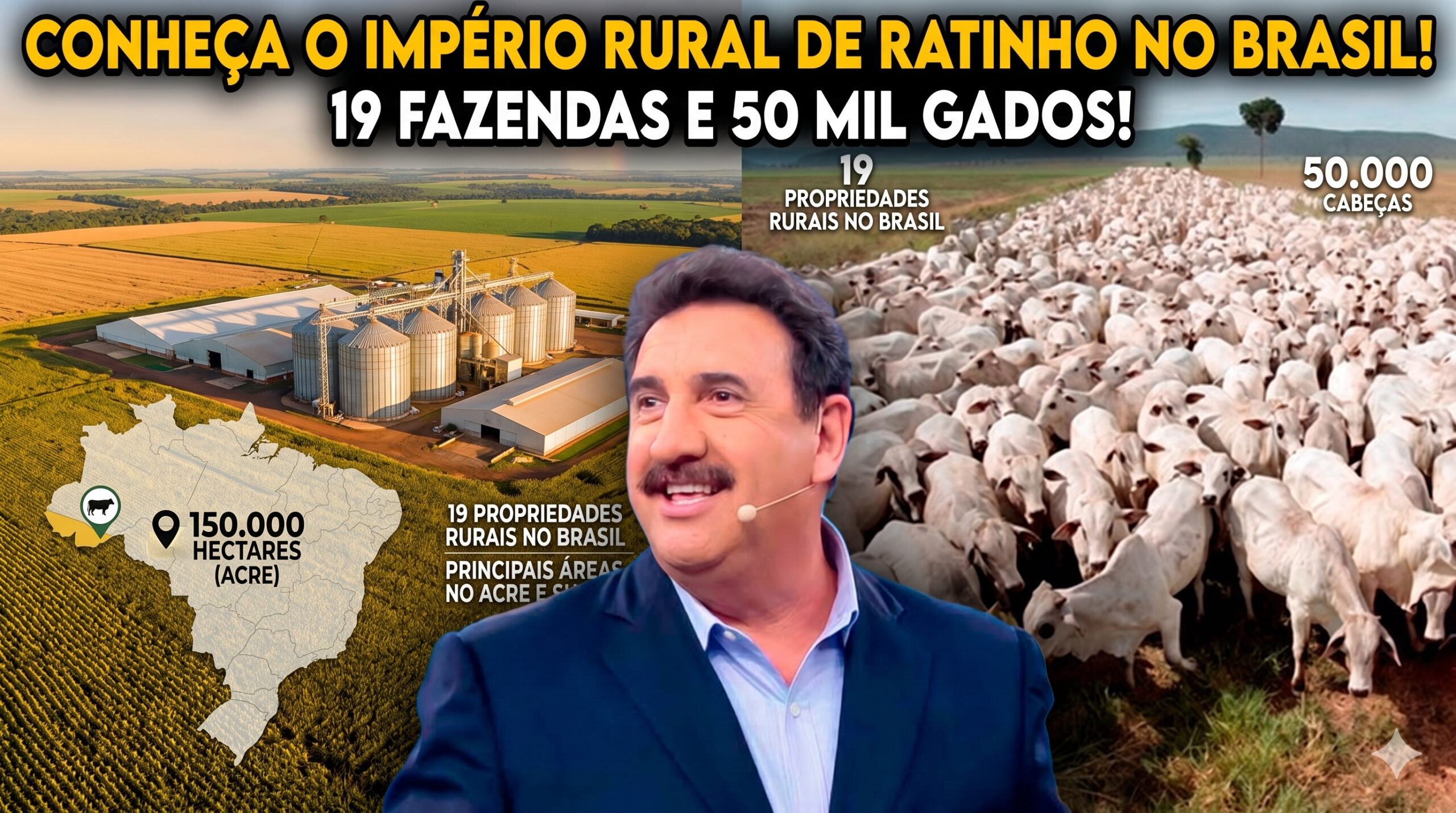

Ratinho owns 19 farms in Brazil, including areas of up to 150 thousand hectares in Acre, with a herd that has reached 50 thousand head of cattle.
According to the portal CompreRural, Carlos Roberto Massa, known as Ratinho, is the owner of 19 farms distributed among Paraná, Mato Grosso do Sul, and Acre, with a herd that has reached around 50 thousand head of cattle, as well as coffee, soybean, and corn crops. While establishing himself as one of the main presenters on Brazilian television, he simultaneously built a large-scale agricultural structure, with properties operating in both intensive production and environmental preservation.
Ratinho’s journey begins in the interior of Paraná with rural work and informal activities since childhood
Carlos Roberto Massa was born on February 15, 1956, in Águas de Lindóia, São Paulo, but grew up in Jandaia do Sul, Paraná.
From an early age, he was immersed in the rural environment, working as a lunchbox delivery boy for coffee plantation workers at the age of 9. He later worked as a shoeshiner and, at 15, spent some time working in a circus.
-
How to Prevent Brown Recluse Spider Bites: Common Hiding Spots and Free Tips to Reduce Risks

-
Natto: The Unusual Japanese Superfood Gaining Popularity on Social Media and Driving Record Exports
-
Brazilian Mayor Goes Undercover as Homeless for 24 Hours to Assess Public Services

-
15-Year-Old Entrepreneur Malu Lira Publishes 20 Children’s Books on Financial Education, Earns $500,000, and Expands Her Project to the Amazon Rainforest




The nickname “Ratinho” emerged during his youth, during amateur football matches, and eventually became part of his professional identity.
Political and television career boosted capital that was directed towards land purchases
While still young, Ratinho entered public life and, at 18, had already been elected as a councilman. In 1991, he became a federal deputy.
During the same period, he began his television career as a police reporter, later consolidating his presence in national entertainment with high-audience programs.
The income obtained throughout the 1990s and 2000s was primarily directed towards the acquisition of rural properties, rather than traditional urban or financial investments.
Ubatuba Farm in Paraná consolidated coffee operation with over 1.3 million coffee plants
Among the most well-known properties is Ubatuba Farm, located in Apucarana, in northern Paraná. Acquired in 2004 for approximately R$ 9 million, the farm has about 1,100 hectares and maintains intensive coffee production, as well as soybean and corn crops.

The property has approximately 1.3 million coffee plants and is currently estimated to be worth around R$ 80 million.
The Coffee in the Bule brand emerged from the agricultural production of the farm and reached national distribution
The production from Fazenda Ubatuba gave rise to the Coffee in the Bule brand, developed in partnership with Grupo 2 Irmãos.
The product has gained space in the national retail market and positioned itself among the best-selling brands in Brazil, with a presence in major supermarket chains.
Another relevant property is Fazenda Costa Rica, located in São João do Ivaí, also in Paraná. A significant part of the area is maintained as preserved native forest, serving as an example of coexistence between agricultural production and environmental conservation.
Farms in Acre total up to 200 thousand hectares and include forest areas with authorization for controlled exploitation
In the state of Acre, Ratinho owns two properties located in the Tarauacá region. The larger one has about 150 thousand hectares, while the second totals approximately 40 thousand hectares, amounting to between 175 thousand and 200 thousand hectares.
The areas are predominantly covered by forest and have legal authorization for logging within the limits established by environmental legislation.
In an interview with presenter Amaury Jr. on Band, Ratinho stated that the area in Acre remains mostly intact and that he has not developed intensive productive activities on the site.
He also declared that he has visited the property only once, maintaining indirect management through partners and administrators.
Properties in Mato Grosso do Sul concentrate most of the livestock with a herd of up to 50 thousand head
The main livestock operation is located in Mato Grosso do Sul, where the farms have concentrated more than 30 thousand head of cattle.

The total herd of the group has reached about 50 thousand animals, focusing on genetic crossbreeding between breeds such as Nelore, Devon, and Simental. The production uses artificial insemination techniques and genetic selection to increase productivity.
Family and business structure allows decentralized management of farms and communication businesses
The management of the properties is shared with the children, especially Gabriel and Rafael Massa, who are responsible for the daily operations.
At the same time, Ratinho maintains his presence on television and in the communication group, which includes affiliates of SBT and dozens of radio stations. This structure allows the continuity of the business without direct dependence on the founder.
Recent investments of Carlos Roberto Massa, Ratinho
The most recent investments of Carlos Roberto Massa, Ratinho, show a movement of consolidation and diversification in different regions of Brazil, with a primary focus on agribusiness and long-term assets.
Although there is no detailed public list of all new investments by state, reports indicate that the presenter has been expanding his presence in strategic areas, combining rural production, land appreciation, and participation in parallel projects related to the regional economy.
In Paraná, the state where he concentrates a significant part of his assets, investments are focused on the modernization and expansion of already established agricultural areas.
The presence in traditional agribusiness regions reinforces a strategy of productive continuity, focusing on high-value crops and integration between farming and market. Additionally, the state also serves as a base for new ventures outside of agriculture, broadening the portfolio diversification.
Still in the South, Ratinho has also started investing in the tourism sector, especially in structured projects that combine hospitality, leisure, and regional attraction. This type of investment indicates a change in profile, moving away from exclusively primary production and entering sectors with higher value addition, generating continuous revenue flow and potential for long-term real estate appreciation.
In the Northern region, especially in Acre, investments take on another dimension, with large areas of land that stand out not only for their size but for their strategic potential.
These properties are associated with discussions about sustainable land use, environmental preservation, and even initiatives related to the carbon market, reflecting a more recent trend of valuing forest assets.
In the Central-West states, such as Mato Grosso do Sul, the activities are mainly linked to large-scale cattle ranching, integrating the set of farms attributed to the presenter. In this region, investments follow a more traditional productive logic, focused on cattle raising and the consolidation of rural areas, reinforcing Ratinho’s national presence in Brazilian agribusiness.
Estimated wealth of about R$ 1 billion combines assets in media and agriculture
The fortune of Carlos Roberto Massa is estimated at approximately R$ 1 billion. A large part of this wealth is linked to rural assets distributed across different states, acquired over decades with resources from his television career.
The property structure of Ratinho brings together highly productive areas and others with limited exploitation. In his view, maintaining large tracts of land without intensive use is a long-term strategy or a model that tends to change with market demands and environmental legislation?