Portuguese
  Spanish


The mystery of Roanoke spans more than 430 years and continues to intrigue historians, archaeologists, and curious minds to this day.
One of the most enigmatic stories of English colonization in America began in 1587, on the coast of what is now North Carolina, in the United States.
In that year, more than 100 colonists arrived on Roanoke Island with the goal of establishing a permanent colony in the so-called New World.
The group was composed of men, women, and children seeking a new life in American territory.
-
Brazil Launches Ambitious Project to Recycle Toothpaste Tubes and Toothbrushes, Aiming to Revolutionize Waste Management

-
Namibia Plans to Build Homes for the Homeless Using Mushrooms and Invasive Plants to Tackle Housing Crisis

-
Brazilian Innovator Converts Old Car into Electric Vehicle Using Laptop Batteries and Forklift Motor, Achieves Nearly 90 km/h in Urban Settings
-
Brazil Launches Mobile ID as Mercosur Approves Mutual Recognition of Digital Identities for Public Services Across Member Countries



In 1590, Governor John White returned from England and found the settlement completely empty.
There were no bodies, clear signs of combat, destruction, or any definitive explanation for the collective disappearance.
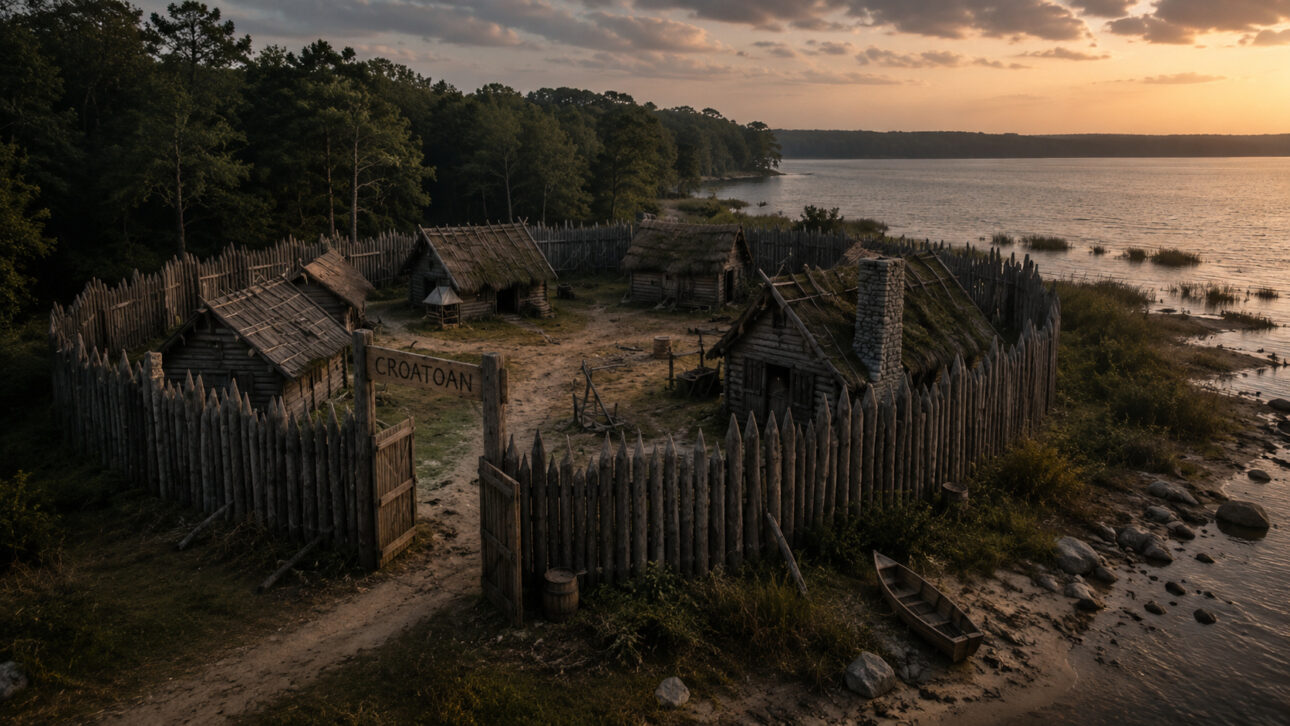
The only clue left at the site was the word “Croatoan”, carved into a tree.
The disappearance that became a historical mystery
The Roanoke colony was one of the first English attempts at permanent settlement in America.
According to historical records attributed to John White, the settlement was already facing difficulties before his return to England.
Three years later, the community simply was no longer there.
This scenario drew attention because there were no evident signs of violence.
No bodies were found in the region of the former colony.
For this reason, the case became known as one of the greatest mysteries in the colonial history of the Americas.
What the word Croatoan means
The word “Croatoan” became the main symbol of Roanoke’s disappearance.
According to the National Park Service, Croatoan was the name of a nearby island, now known as Hatteras Island.
The term also identified an indigenous people who lived in that region.
This detail led researchers to consider an important hypothesis.
The colonists may have left Roanoke voluntarily in search of shelter, food, or protection.
Thus, the word carved on the tree could indicate the destination followed by part of the group.
New clues reignite the debate
In recent years, archaeological discoveries have brought new life to the investigations about Roanoke.
Excavations found fragments of English pottery, metal tools, and other European objects in areas outside the original settlement.
According to researchers associated with the Croatoan Archaeological Society, these remnants suggest that some colonists may have survived after leaving the island.
The presence of these objects in other areas reinforces the possibility of relocation.
One line of research considers that small groups spread out among nearby indigenous communities.
Thus, the absence of a single conclusive proof may be linked to the division of the colony.
Main theories about the fate of the colonists
Despite the clues found, no explanation has been definitively proven.
Decades of studies have helped form some central hypotheses about the fate of the community.
Among the most discussed theories by historians and archaeologists are:
- Integration with indigenous peoples, forming a mixed community;
- Migration to another region, in search of better survival conditions;
- Deaths caused by hunger, disease, or conflicts, during the relocation;
- Division of the colony, with small groups following different paths.
These possibilities continue to be analyzed based on ancient documents and archaeological evidence.
Why Roanoke remains without a definitive answer
The mystery remains because there are few written records about the last moments of the colony.
The passage of time erased much of the possible physical evidence.
Rain, erosion, changes in the territory, and centuries of occupation have further complicated the work of researchers.
Even so, new excavation and analysis technologies continue to offer important clues.
According to sources such as the National Park Service, the National Parks Conservation Association, and historical records of John White, Roanoke still requires caution in the interpretation of facts.
This is because no isolated discovery has managed to explain the entire disappearance.
A mystery that spans generations
More than four centuries later, the vanished colony continues to spark interest in books, documentaries, and series.
The case brings together history, archaeology, and suspense in a narrative that still challenges experts.
The word “Croatoan” remains the greatest symbol of this mystery.
It may indicate survival, migration, or integration with indigenous peoples.
However, it also reminds us that some episodes in history remain without a definitive conclusion.
While new clues slowly emerge, Roanoke remains one of the greatest unsolved mysteries of the Americas.
Do you believe that the Roanoke colonists survived and integrated into indigenous communities, or that the group met another fate? Share your opinion!