Portuguese
  Spanish


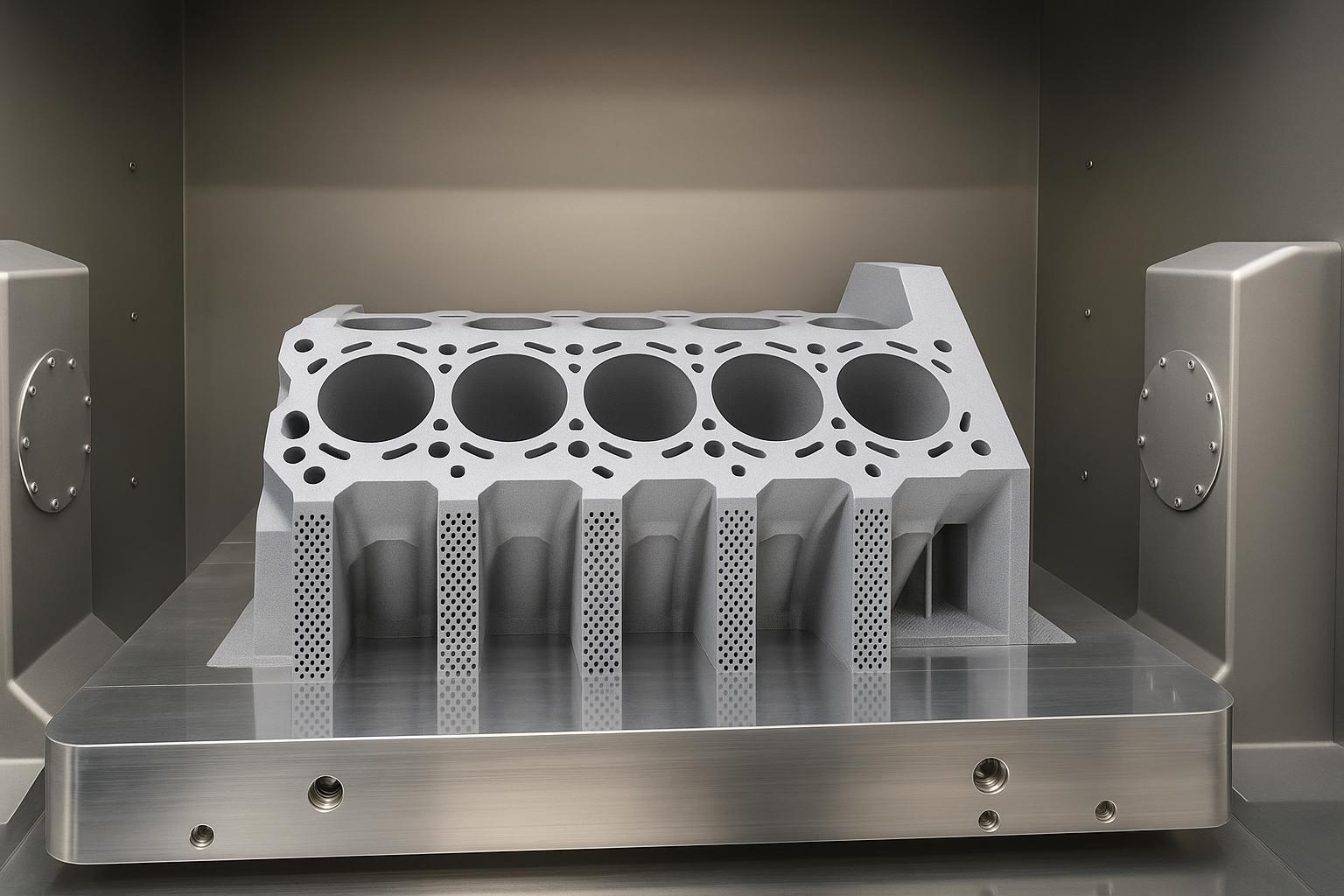

The partnership between Nikon SLM Solutions and Bosch takes 3D metal printing to a new level and paves the way for lighter, more complex automotive parts with less development time.
Nikon SLM Solutions and Bosch Industry Consulting have presented a demonstration that could change how the automotive industry views 3D metal printing: the companies produced a complete V8 engine block, in aluminum, as a single piece. The component came out of an NXG XII 600 multi-laser system, installed at the Bosch Additive Solution Center in Nuremberg, Germany.
The achievement goes beyond visual impact. It shows that additive manufacturing is no longer restricted to prototypes or test parts. In the case of the V8 block, the technology has entered a high-value application range, where it can compete with traditional processes and even work alongside them in critical parts of the automotive sector.
The most significant factor for the industry is time. In conventional casting, producing a cylinder block requires tooling, validation, and weeks or months before the first part reaches the line. Each design change still requires adjustments to this tooling, with new costs and delays. By printing the part directly from the digital file, Bosch and Nikon SLM eliminated this step and reduced dependence on this long preparation cycle.
-
Honda and Nissan Form Alliance to Tackle Competition from Chinese Automakers After $9 Billion Loss

-
Hyundai Phases Out Powerful Engine in HB20, Reduces Turbo Version in Strategic Shift Affecting Creta and HB20S, Potentially Impacting Car Prices in Brazil.

-
Carflix Overcomes Setbacks to Achieve $250 Million in Used Car Sales with Backing from Mercado Livre and SMZTO, Aiming for 300 Locations and $650 Million Revenue

-
Brazil’s Cheapest Car Outperforms Onix, HB20, Polo, and More: Priced Under $15,000 with 1.0 Engine, 681 km Range, 75 HP, and Air Conditioning.


A unique piece that would be much more difficult by the traditional route
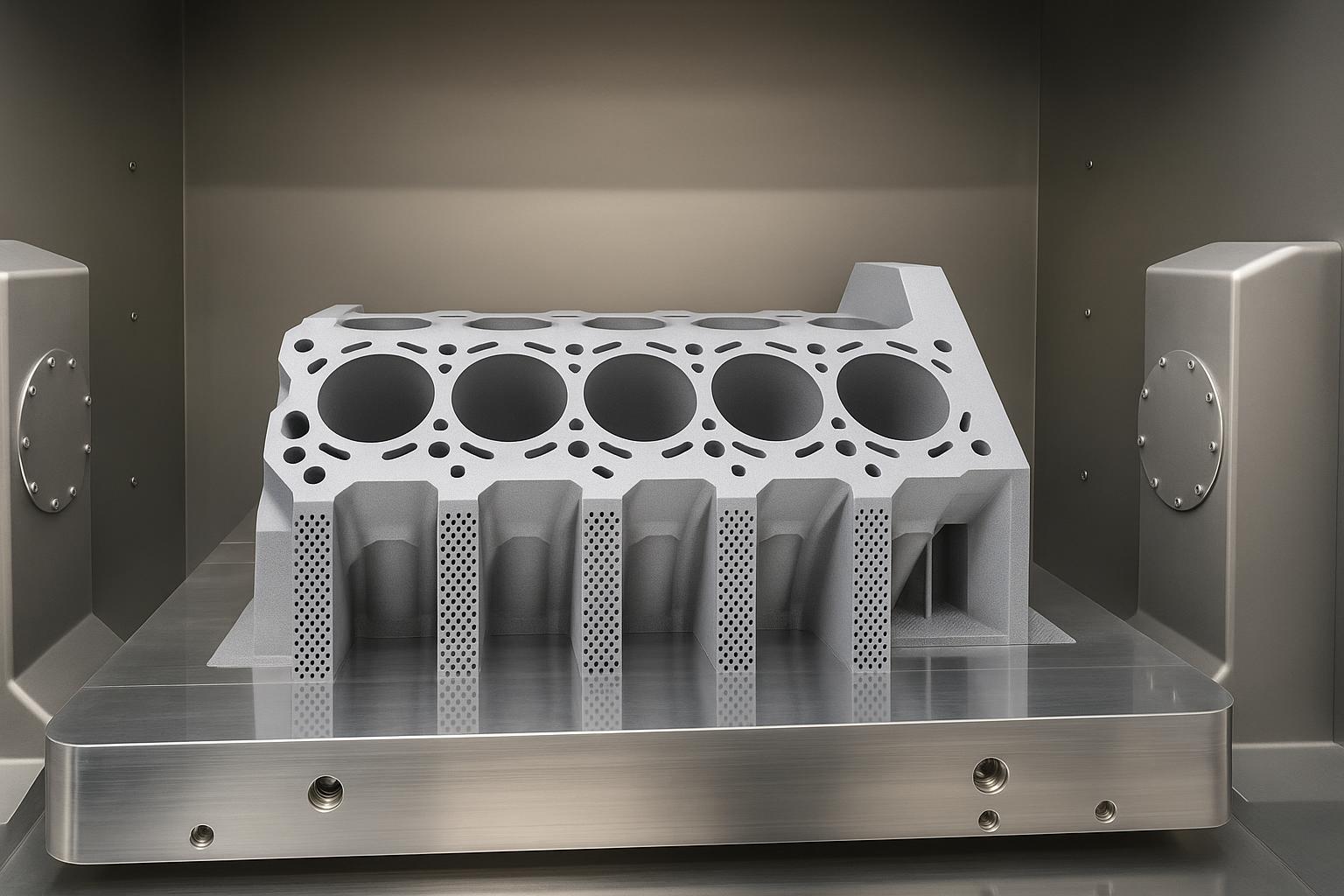
According to voxelmatters.com, the block was made in AlSi10Mg aluminum alloy and opened up possibilities for geometries that would be difficult or too expensive for casting. Among them are internal cooling channels, weight-reducing structures, and the joining of parts that, in a conventional engine, would appear separately.
This design freedom is precisely one of the strongest bets of additive manufacturing. Instead of adapting the design to the mold, the design dictates the shape of the part. This expands the field for lighter and more complex solutions, something especially valuable in high-performance engines.
Less material where it doesn’t matter, more efficiency where it does
The companies said they followed DfAM principles, the logic of designing with additive manufacturing in mind. In practice, the material was concentrated where structural analysis indicated a need and removed in less critical areas. The result, according to the released material, was a block considerably lighter than a cast equivalent, without loss of performance.
This type of gain directly interests applications in motorsport and high-performance powertrains, where every weight reduction can influence response, efficiency, and integration of the part into the assembly. The big difference is that, with 3D printing, this change does not depend on complex molds or an expensive redesign of the entire process.
Bosch brings industrial scale, Nikon SLM brings the production platform
The partnership was also presented as a response to a challenge that still hinders the expansion of additive manufacturing: moving from the laboratory to real production. Bosch contributed decades of industrial experience, while Nikon SLM Solutions provided the production platform, as well as material qualification, process parameter development, data preparation, quality assurance software, and application engineering.
For the companies, this combination is decisive when it comes to volume and reliability. It’s not enough to print a complex part; it’s necessary to ensure repeatability, control, and viability for a chain that demands automotive standards.
The weight of the supply chain in the race for 3D printing
Another data point mentioned by the companies helps to gauge the bet: they estimate that 60% to 80% of the components of a finished vehicle come from first and second-tier suppliers, not directly from the manufacturers. Therefore, the expansion of additive manufacturing does not depend solely on the development centers of car manufacturers.
In the vision advocated in the project, the technology will only truly scale if it also advances over this supplier base. This is where a large part of the parts, deadlines, and decisions that drive the automotive industry are located. The V8 block printed in a single piece does not solve everything, but it makes it clear that the race for efficiency, speed, and design freedom has already begun to change location.
If this type of production starts to advance beyond demonstrations, the automotive chain may see months of tooling turn into a much shorter and more flexible process. And you, do you think metal 3D printing is ready to move from testing to industrial lines? Comment and share your opinion.