Portuguese
  Spanish


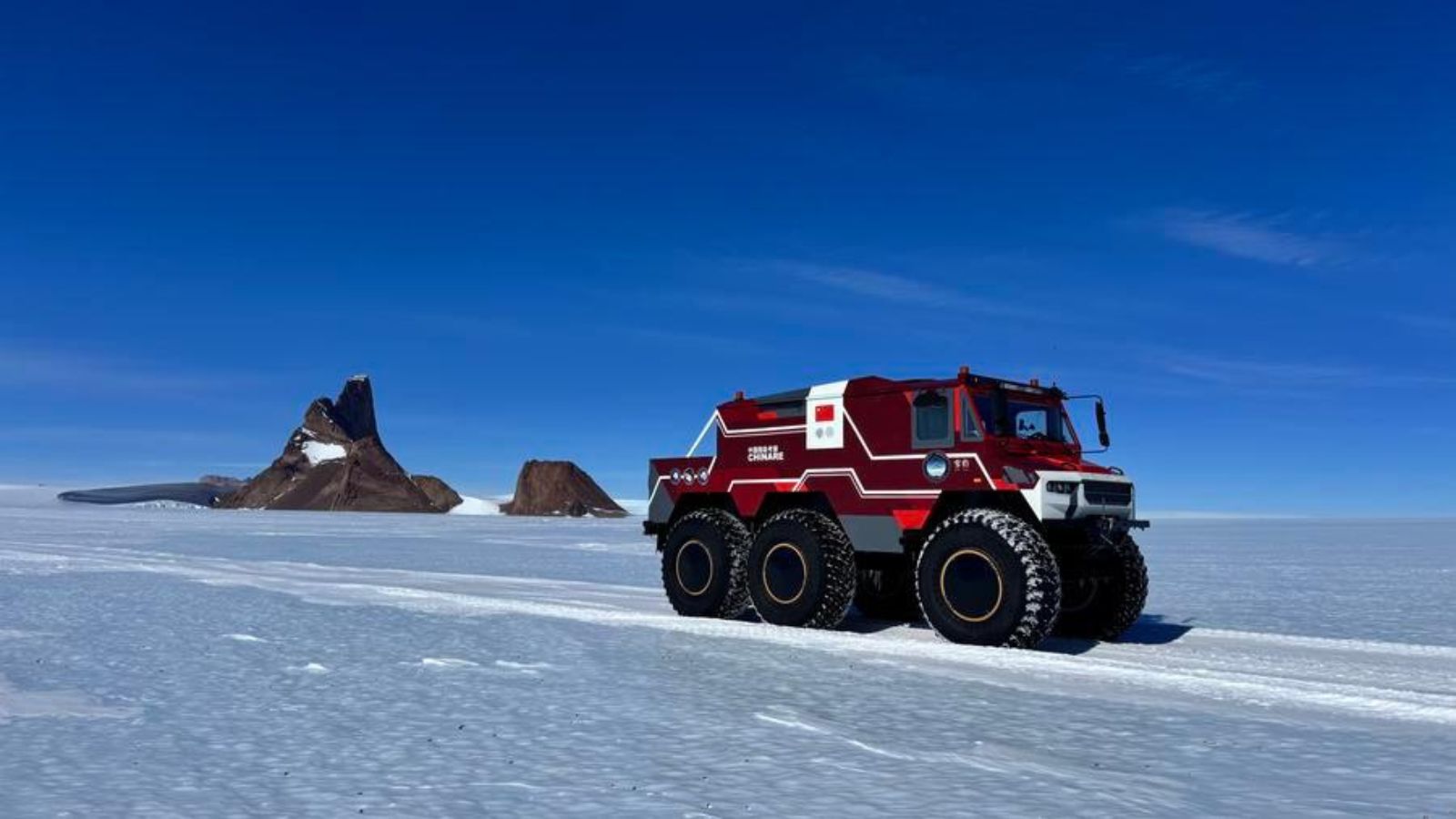

Snow Leopard 6×6 vehicle travels over 10 thousand km in Antarctica without failures and can transform scientific logistics on the continent.
According to Xinhua News Agency, the Snow Leopard 6×6 vehicle, developed in China, completed over 10,000 kilometers of testing in Antarctica without recording failures, over 75 consecutive days during the 42nd Chinese Antarctic Expedition. The mission marked a significant operational advance by demonstrating that the country now has its own land vehicle capable of continuous operation in one of the planet’s most extreme environments.
Operation in extreme conditions showed transport capacity even with reduced visibility and severe weather
During the mission, the Snow Leopard faced critical situations of extremely limited visibility, with a visual range reduced to a few meters due to intense snowstorms.
In one reported episode, aircraft and helicopters were prevented from operating, making ground transport the only viable alternative. The vehicle traveled about 263 kilometers on a round trip, operating continuously for approximately 12 hours.
-
Artist’s 15-Meter Lighthouse in the Mojave Desert, 160 km from the Sea, Intrigues Visitors with 19 km Range After Years of Bureaucracy

-
Bluetti AC70 Solar-Powered Station: Powers Fridge and Wi-Fi During Blackouts, Delivers 1,000W, 3,000 Charge Cycles, Priced at $900

-
Enormous Black Hole Phoenix A* Challenges Scientific Understanding with Mass of 100 Billion Suns, Surpassing Famous TON 618 in One of the Largest Known Galaxy Clusters
-
Say Goodbye to Storing Wine in a Regular Fridge: Midea’s Climate-Controlled Cellar Holds 34 Bottles, Maintains 5-18°C, and Uses Only Half a kWh Daily


This performance highlighted the system’s ability to maintain logistical operations even when other means of transport become unfeasible.
Development of the Snow Leopard 6×6 combines advanced automotive engineering and adaptation to the polar environment
The Snow Leopard was developed by the Suzhou Automotive Research Institute, affiliated with Tsinghua University, in collaboration with the Chinese Arctic and Antarctic Research Center.
The vehicle has a 6×6 configuration, with six driven wheels, and was specifically designed to operate in low-temperature environments and unstable terrains.
The engineering included the development of tires with special compounds capable of maintaining elasticity in extremely low temperatures, as well as traction systems adapted to snow and ice.
Wheeled vehicles challenge historical dominance of tracked systems in Antarctica
Historically, land mobility in Antarctica has been dominated by tracked vehicles, which distribute weight better and reduce the risk of sinking in soft snow.
The Snow Leopard represents a shift in this paradigm by using wheels instead of tracks, maintaining superior performance across various types of terrain. This approach allows for greater speed and operational efficiency, especially on compacted or frozen surfaces.
During the tests, the vehicle was evaluated on five types of surfaces: sea ice, gravel, soft snow, compacted snow, and solid ice.

The results indicated speeds superior to tracked vehicles in various conditions. In soft snow, it reached about 28 km/h, while traditional vehicles operate around 20 km/h. In compacted snow, it reached 42 km/h, and on solid ice, it maintained a stable speed of up to 65 km/h.
The recorded range was approximately 700 kilometers on a single tank of fuel.
Technological independence reduces dependence on imported vehicles and expands China’s scientific capacity
Before the development of the Snow Leopard, China relied on imported tracked vehicles for operations in the interior of Antarctica.
This dependence implied high maintenance costs and logistical limitations related to the supply of parts.
The introduction of an in-house system reduces these restrictions and expands operational autonomy, allowing for greater flexibility in conducting scientific research.
Land logistics define scientific capacity in the interior of Antarctica and influences research operations
The ability to move on land is one of the main factors determining the volume of research possible on the Antarctic continent.
The speed and reliability of vehicles directly influence data collection, equipment transport, and emergency response in remote areas.
In this context, logistical improvements translate into greater scientific and operational capacity.
Tests over 75 days confirm mechanical robustness with zero failures in extreme environment
The testing program for the Snow Leopard was conducted over 75 consecutive days, covering varied and demanding conditions.
During this period, the vehicle traveled over 10,000 kilometers without registering mechanical failures, operational interruptions, or the need to abandon the mission. This result demonstrates a high level of reliability for operations in extreme environments.
In addition to the tests with the vehicle, the Chinese expedition brought equipment intended for deep ice drilling.
The goal is to reach subglacial lakes located beneath ice layers that can exceed 3,000 meters in thickness.
These isolated environments are considered relevant for climate and biological studies, potentially containing historical records and possible forms of life adapted to extreme conditions.
Snow Leopard represents a strategic advance in scientific and logistical presence on the Antarctic continent
The development of the Snow Leopard is part of a broader context of strengthening scientific presence in Antarctica.
Although the Antarctic Treaty prevents territorial claims, the ability to operate on the continent directly influences the scope of the research conducted.
Vehicles with greater autonomy, speed, and reliability expand access to remote areas and increase the efficiency of missions.
Now we want to know: can vehicles like the Snow Leopard change the balance of scientific research in Antarctica?
The performance of the Snow Leopard suggests a significant change in polar logistics, with direct impacts on mobility and the execution of research.
In your view, can advances like this redefine the scientific dynamics on the continent, or do they still depend on other structural factors to generate real impact?