Portuguese
  Spanish



Autonomous naval technology gains ground in real operation in the Middle East, with unmanned vessels expanding maritime surveillance, reducing human risks, and introducing new strategies for presence and attack in high geopolitical tension areas.
The United States confirmed the use of unmanned vessels in maritime operations related to Operation Epic Fury, a military campaign initiated by the U.S. Central Command on February 28, 2026, against targets of the Iranian security apparatus.
This admission marks the first time Washington publicly acknowledges the deployment of this type of boat in an ongoing conflict, at a significant stage of incorporating autonomous systems into the naval theater.
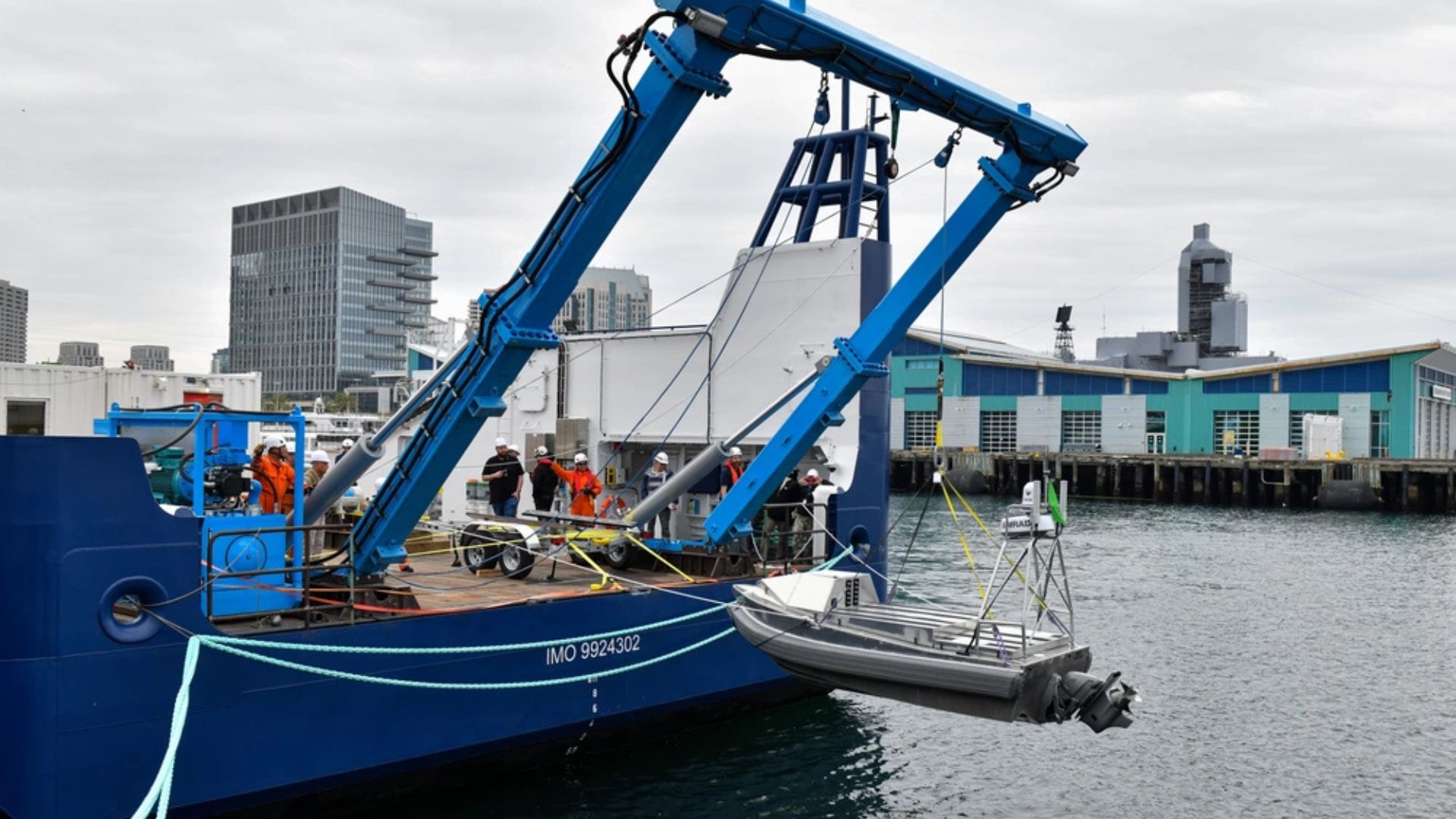
The mentioned model is the GARC, which stands for Global Autonomous Reconnaissance Craft, developed by the American company BlackSea Technologies.
-
Scientists Convert Food Waste into Aviation Fuel, Successfully Test 50% Blend with Conventional Kerosene to Cut Emissions and Promote Sustainable Flights

-
OnePlus N6 Smartphone to Launch in India with 8,000mAh Battery and 45W SuperVOOC Charging, Lasting Up to Three Days
-
Scientists Plan to Release Air Bubbles Underwater to Protect Antarctica’s “Doomsday Glacier” from Melting

-
Chinese R6000 Drone Combines Airplane and Helicopter Features, Carries Up to 12 People for Multiple Missions




According to Reuters, the platform has been used in maritime patrols supporting the operation and has already accumulated over 450 hours of navigation and more than 2,200 nautical miles traveled, numbers indicating continued use in a real environment, not just demonstrations or isolated exercises.
Naval drone GARC: how the unmanned vessel works
The confirmation alters the traditional logic of employing naval means in risk areas.

Instead of exposing crews to enemy fire or incidents in sensitive waters, these vessels operate remotely or autonomously to enhance surveillance, track routes, and reinforce military presence in strategic regions, especially in the Middle East.
The principle is similar to that observed with aerial drones: reducing direct human presence in the immediate line of confrontation.
The vessel described by Reuters measures about five meters and has a compact, angular profile with no space for sailors on board.
Although small compared to conventional ships, the system’s design aims to exploit reduced dimensions, speed, and mission repetition to increase persistence in patrols and expand coverage over high-tension maritime areas.
In BlackSea’s institutional material, the GARC appears as a platform aimed at high-speed unmanned operations in contested environments, with an architecture compatible with both remote control and onboard autonomy.
The company also claims that the system was designed for mass production and for missions such as reconnaissance, surveillance, communication relay, and other tasks related to monitoring maritime space.
Attack capability and use as a kamikaze boat
The point that attracts the most attention, however, is the operational flexibility.
According to Reuters, U.S. authorities acknowledge that the same platform can be employed in surveillance actions and also in collision attacks, kamikaze style, depending on the configuration adopted.
This versatility repositions the debate on naval warfare, as it transfers part of the offensive capability to smaller, cheaper, and potentially more numerous vectors than traditional vessels.
Maritime drones in the conflict with Iran

The adoption of this type of resource does not arise in isolation.
The very framing of the operation given by Reuters associates the use of GARCs with the increased presence of maritime drones in the regional confrontation, including after episodes where Iran resorted to such systems against oil tankers.
The advancement of these platforms also gained international visibility after the use, in other recent conflicts, of explosive boats and unmanned naval vehicles against more robust surface means.
In this context, the sea ceases to be merely a space dominated by manned ships, submarines, and anti-ship missiles.
It begins to incorporate, more clearly, a layer of autonomous means capable of monitoring, pressuring, and, in certain missions, attacking.
The change depends not only on firepower but on the ability to maintain presence for longer, at more points, and with less direct human exposure.
The U.S. Fifth Fleet, responsible for the region, already operates a structure aimed at the use of surface drones to enhance situational awareness in the waters of the Middle East.
In advocating for the use of the GARC, the Pentagon stated that the vessel integrates this fleet of unmanned systems and contributes to raising awareness about what is happening in local maritime routes.
Tests, failures, and challenges of the autonomous naval program
The announcement carries additional weight because American development in this area has been uneven.
The United States Navy has been trying for years to structure a fleet of surface autonomous vehicles and unmanned submarines as a faster and cheaper alternative to manned ships and submarines.
Still, the effort has accumulated delays, technical limitations, questions about costs, and setbacks during testing.

The trajectory of GARC itself helps explain why the novelty is received with both attention and caution at the same time.
In previous records, the platform was involved in performance and safety issues, including an incident of collision with another vessel during a military speed test.
More recently, one of these boats became inoperative during a test in the Middle East.
Even with this history, the system continued to be presented as an evolving capability, already integrated into naval units and exercises.
Strategic impact of the new generation of naval weapons
The political and military value of American recognition goes beyond the specific case of the Gulf.
By admitting that an unmanned vessel is already patrolling an ongoing conflict, Washington signals that naval automation is no longer just a laboratory promise.
Maritime warfare now openly incorporates a means capable of combining permanence, relative low cost, and lower direct risk to embarked military personnel.
This transition also alters the distribution of threats at sea.
A small unmanned boat can be replicated in greater numbers, cover extensive areas, and force rival forces to spend more resources to detect, track, and neutralize discreet targets.
In observation operations, this increases continuous surveillance over critical routes and zones.
In offensive scenarios, it enhances unpredictability alongside missiles, aerial drones, mines, and electronic warfare. The relevance of GARC is not just in its unusual format or the absence of sailors on board.
The central point is that the United States has recognized the use of such a platform in real patrols during an active military campaign, supported by an official operational structure and by a manufacturer that already presents the system as a scalable product.