






 Portuguese
  Spanish
  3 min of reading
  1 comment


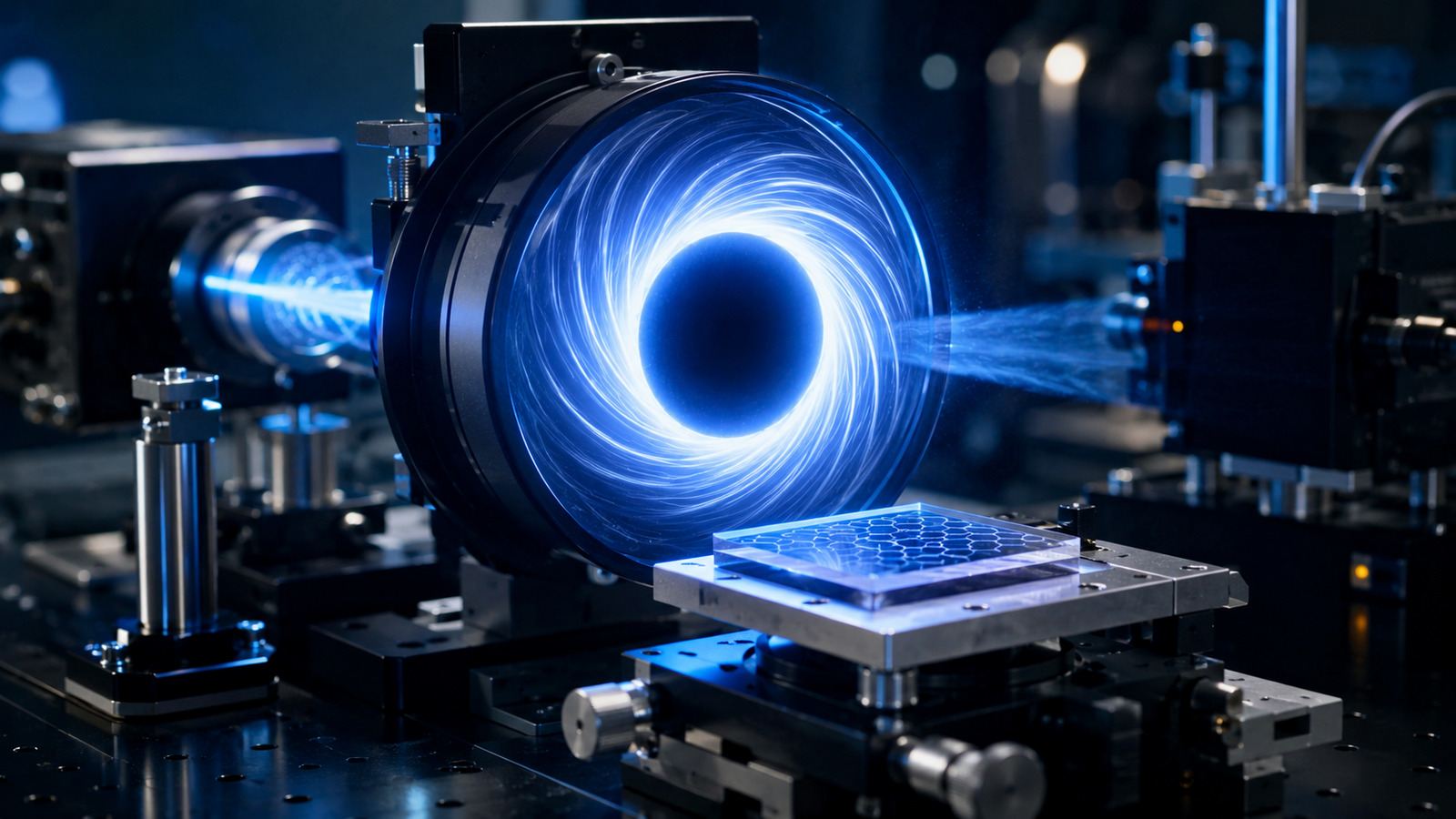


Optical vortices create dark cores within light beams that can exhibit apparent speeds above the physical limit, but without transporting energy, matter, or information faster than light
Optical vortices can create dark patterns that appear to move faster than the speed of light, about 299,792,458 meters per second in a vacuum, without violating relativity. The phenomenon occurs because what moves is an interference structure within the beam, not energy, matter, or information.


Optical vortices form dark cores within light
An optical vortex is a region of zero intensity within a light beam. It arises when the wave phase rotates around the beam axis, forming a kind of helix.
In this process, the wave crests become twisted and the destructive interference creates a dark core in the center. The visual result may resemble a ring of light with a hole in the middle.
-
Space technology used to search for water on Mars is now hunting for invisible leaks under the streets of São Paulo, using satellites, AI, and chlorine signals to help Sabesp recover up to 6.7 billion liters of water.

-
Japan sends ship to extract mud rich in rare earths at nearly 6,000 meters deep in the Pacific, attempts to lift 350 tons per day from the seabed, and transforms sediments near Minamitori Island into a strategic weapon to reduce dependence on China.
-
Venus Aerospace promises a rotating detonation hypersonic engine that takes the Stargazer to Mach 9 and crosses oceans in 1 hour, but the flight that made history barely surpassed the speed of sound.

-
Brazilian student creates a cheap formula that makes plants grow up to 90% faster and wins an award in a global scientific competition.



This dark point is not a particle. It is a consequence of how different parts of the wave combine, creating areas where the light intensity drops to zero.
Speed of light remains the limit for energy and information
The speed of light is treated as a fundamental limit because nothing that carries energy or information can exceed this value in a vacuum. Any particle with mass would require infinite energy to reach this mark.
This limit also prevents physical problems, such as the possibility of reliable signals traveling faster than light and creating paradoxes involving messages sent to the past.
Therefore, when a phenomenon appears superluminal, scientists check if there is real transport of energy, information, or matter.
In the case of optical vortices, the observed displacement is linked to a geometric pattern of darkness.

Dark pattern can change position without carrying a message
In experiments with optical vortices, what seems to move at speeds above light is the dark point created by interference.
This point can change position quickly because it depends on the combination of waves in the beam.
The energy, however, remains confined to the beam and respects the speed of light limit in the medium. There is also no message transmission associated with the movement of this dark core.
The phenomenon is comparable to the analysis of shadows or patterns that move apparently. The position can vary quickly, but that does not mean something physical traveled at that speed.
Hexagonal boron nitride helps to observe the phenomenon
Materials like hexagonal boron nitride allow studying these effects under special conditions. In this medium, light can couple to crystal lattice vibrations and form polarons.
Polarons are quasi-particles that describe the interaction of an electron with the deformation it causes in the crystal. This combination alters how electromagnetic fields propagate.
With this, the group velocity can be reduced, allowing observation of internal details of the beam at nanometric scales and ultrashort times.
Ultrafast images reconstruct the trajectory of dark points
In the laboratory, thin samples of hexagonal boron nitride can be prepared in very thin layers, sometimes with few atomic sheets. A light beam is then configured to generate optical vortices in this structure.
Sensors record the evolution of intensity and phase with femtosecond pulses. Then, algorithms reconstruct the trajectory of the dark points to measure their apparent speed.
In encounters between vortices with opposite topological charges, sections arise where the dark core seems to exceed the speed of light.
The physical interpretation remains compatible with relativity because the phenomenon does not transport energy or information above this limit.
The study of this behavior helps to expand the understanding of light in complex media and can support research in integrated photonics, structured beam communication, and ultrafast microscopy.
This article was prepared based on information from the provided source material, with data, numbers, and statements preserved as per the consulted material.


And what is it