





Billion-dollar energy infrastructure plan puts robots, artificial intelligence, and transmission grids at the center of a technological dispute that could change how major countries maintain electrical systems under pressure.
China is preparing a large-scale expansion of robot use in the operation of its power grid, in a strategy that combines automation, artificial intelligence, and the modernization of transmission and distribution infrastructure.
The initiative comes amid increasing energy consumption in the country, driven by industry, data centers, electric vehicles, and the expansion of renewable sources.
According to a report by the South China Morning Post, based on information from the Chinese outlet Jiemian, the State Grid Corporation of China has earmarked 6.8 billion yuan, about US$1 billion, to purchase AI-powered robots by 2026.
-
Pennsylvania Mine Creates Ice in Summer Heat and Melts in Winter, Turning a Mountain Crevice into a Reverse Natural Refrigerator

-
China Accelerates Global Expansion of Robotics: From Smart Vacuums to Industrial and Humanoid Machines, Millions Exported to Over 150 Markets
-
Polar Air Mass to Hit Brazil: Temperatures to Plummet in Nine States, Near Freezing in the South with Frost Risk Until Monday
-
Chinese “dark factories” produce electric cars 24/7 with minimal human intervention, as Zeekr assembles 800 units daily, raising concerns in Brazil.



The company is the main operator of the Chinese power grid and operates in 26 of the 31 provincial regions of mainland China.
Robots in the Chinese power grid
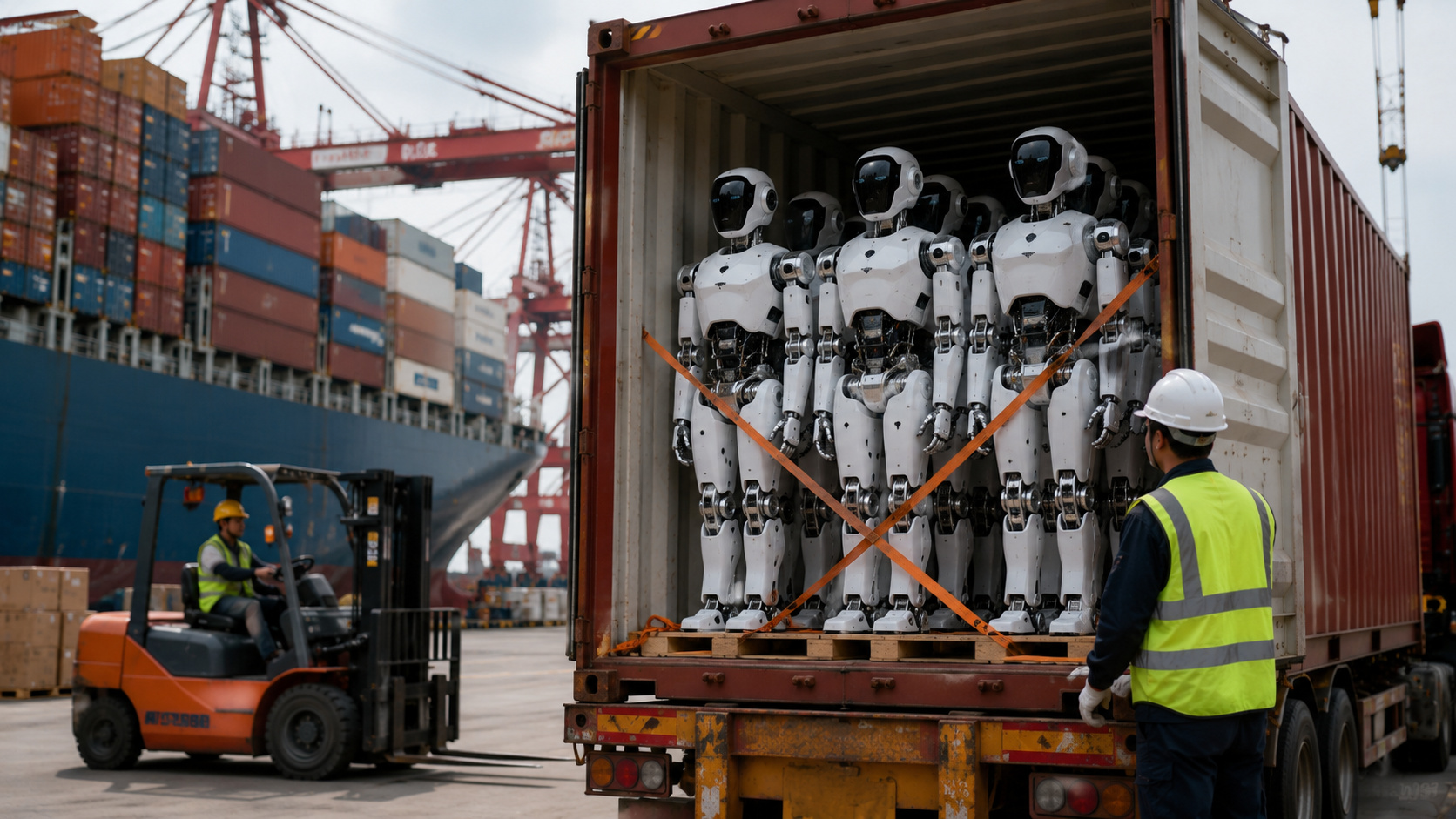
The plan foresees the acquisition of approximately 8,500 robots by State Grid in 2026.
Most will be quadruped machines, used for inspections of substations, transmission lines, and facilities located in mountainous or difficult-to-access areas.
Humanoid robots and equipment with two arms, intended for more complex tasks, are also planned.
Among the activities cited in the report are services related to the ultra-high voltage grid, field inspections, and support for operations in environments considered high-risk for human teams.
The scale of the project is directly related to the size of the Chinese electrical system.
In addition to State Grid, China Southern Power Grid serves five southern regions of the country, including Guangdong.
When the plans of other companies in the sector are considered, investments in robotics applied to the power grid could exceed 10 billion yuan by 2026, according to the same report.
In practice, robots are expected to perform inspection, monitoring, and preventive maintenance activities.
These functions are already part of the routine of utility companies and energy operators, but automation allows for expanded data collection in the field and reduces the need for human travel in certain areas.

Energy consumption grows with AI and data centers
China’s bet on robots comes at a time of strong expansion in electricity consumption.
In 2025, China’s electricity demand exceeded 10 trillion kWh for the first time, reaching 10.4 trillion kWh, a 5% increase compared to the previous year, according to data from the country’s National Energy Administration released by Xinhua news agency.
The increase was not restricted to residential consumption.
The electrification of industry, the expansion of electric vehicles, internet-related services, and high-tech manufacturing increased pressure on the grid.
In 2025, electricity consumption in the manufacturing of new energy vehicles grew by more than 20%, while the internet and related services sector saw an increase of over 30%, according to official Chinese data.
Artificial intelligence has also entered the center of this debate.
According to the International Energy Agency, global electricity demand from data centers grew by 17% in 2025.
The agency also reported that consumption by AI-focused centers advanced at a faster pace and could triple by 2030 if current trends in digital infrastructure expansion continue.
These numbers help explain why the power grid has become a strategic area for governments and energy companies.
The greater the dependence on digital systems, electrified vehicles, and energy-intensive industrial production, the greater the need for monitoring, rapid response to failures, and infrastructure reinforcement tends to be.
Investments in modernizing the power grid
The investment in robots is part of a broader program to modernize China’s grid.
In January 2025, Reuters reported that State Grid planned to invest over 650 billion yuan, about US$ 88.7 billion, in the power grid that year.
The stated goal was to optimize the system, strengthen distribution, and support renewable energy development.
For the 2026 to 2030 cycle, the company plans to invest 4 trillion yuan, equivalent to US$ 574 billion, in grid modernization.
According to Reuters, based on information from the state agency Xinhua, the amount represents a 40% increase in fixed investments compared to the previous five-year period.
Part of these resources should be directed to reinforcing long-distance transmission lines, mainly on the west-east axis.
The strategy seeks to bring electricity from less populated regions, where large renewable generation bases are located, to urban and industrial centers in the east of the country.
State Grid also aims to increase inter-provincial and inter-regional transmission capacity by 30% compared to the level recorded at the end of 2025.
This type of expansion is relevant for a country that needs to connect energy-producing areas to consumption hubs with high industrial concentration.

Renewable energy demands more flexible operation
The expansion of solar and wind sources makes the operation of the electrical system more complex, according to energy sector specialists.
Unlike conventional power plants, these sources vary according to weather conditions, solar incidence, and wind patterns.
For this reason, grids with greater renewable participation often require generation forecasting, real-time monitoring, and rapid adjustment capability.
Automation can contribute to this process by integrating sensors, data analysis systems, and equipment capable of operating in the field.
In the Chinese case, robots are part of a broader infrastructure, which includes transmission lines, substations, control software, artificial intelligence, and communication systems.
The combination of these resources allows for more detailed monitoring of grid operation and earlier identification of failures.
The use of robots in substations and transmission lines is also associated with operational safety.
Inspections at height, maintenance in energized areas, travel over difficult terrain, and operations in remote facilities involve risks that can be reduced when part of the tasks are transferred to machines.
Robotics and China’s industrial policy
In addition to the impact on the electrical sector, the purchase of thousands of robots drives supply chains linked to the high-tech industry.
Manufacturers of sensors, batteries, actuators, cameras, navigation systems, and artificial intelligence software may be in demand for such projects.
This relationship between energy, automation, and industry has been one of the hallmarks of Chinese technological policy in recent years.
The country seeks to expand the presence of robots in factories, public services, and critical infrastructure, while local companies advance in the production of industrial equipment and embedded AI systems.
In the power grid, this application has its own characteristics.
The robot does not act merely as an isolated machine, but as part of a system for collecting and processing information.
By circulating through substations or transmission areas, it records images, identifies anomalies, and sends data to technical teams or control centers.
According to companies and industry experts, this type of operation can reduce repetitive manual inspections and improve equipment monitoring.
Still, large-scale deployment depends on testing, standardization, integration with existing systems, and security protocols.


Challenges for Brazil’s Electrical Grid
For Brazil, the Chinese experience can serve as a point of comparison, but the two countries have distinct structures, scales, and regulatory models.
The Brazilian electrical system is also undergoing renewable expansion and facing challenges in transmission, storage, and operation, although there is no public confirmation of a national robot program for the grid on a scale similar to that announced in China.
Brazil’s energy matrix remains predominantly renewable.
The National Energy Balance 2025, from the Energy Research Company, reported that renewable sources accounted for 88.2% of the electricity matrix in 2024, with growth in solar photovoltaic generation and an increase in installed capacity.
This profile offers advantages from the perspective of low emissions in electricity generation but also requires planning to integrate variable sources into the system.
In Brazil, the expansion of solar and wind power occurs simultaneously with the country discussing new transmission lines, storage, system stability, and operation digitalization.
The central difference, at this moment, lies in the scale of the announced automation.
While China prepares to purchase thousands of robots for direct network operation, Brazil has not yet disclosed an equivalent national initiative.
The use of digital technologies in the Brazilian electricity sector is advancing on different fronts, but without a public operational robotics plan of comparable volume.







Really needed to 🙏 hear this
This just made my whole day brighter, thank you for sharing