






 Portuguese
  Spanish


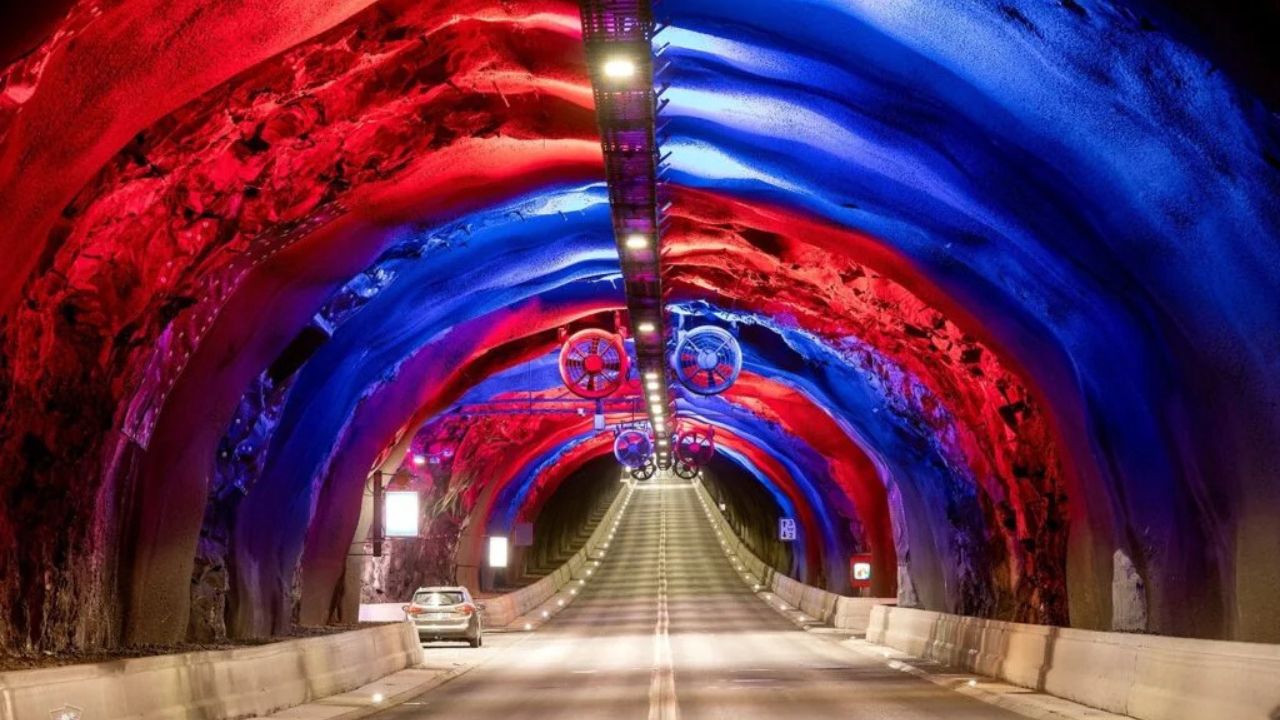


Eysturoyartunnilin Tunnel Reaches 189 Meters Below Sea Level and Houses the First Submarine Roundabout in the World in the Faroe Islands.
In December 2020, the government of the Faroe Islands, an autonomous territory of the Kingdom of Denmark located in the North Atlantic, inaugurated one of the most unusual engineering structures ever built: the Eysturoyartunnilin, a submarine tunnel that not only connects islands but also houses the first underwater roundabout in the world.
According to official information released by local authorities and the institutional tourism portal Visit Faroe Islands, the tunnel reaches about 189 meters below sea level at its deepest point, making it one of the deepest underwater road structures on the planet. The work connects the capital Tórshavn, on the island of Streymoy, to the island of Eysturoy, drastically reducing travel time between regions that previously depended on long routes or ferries.
The element that transformed the project into a global phenomenon, however, goes beyond depth. In the heart of the tunnel, hundreds of meters below the ocean, a complete, illuminated, and functional roundabout was built, something that had not existed anywhere else in the world until now.
-
Bruno Guimarães, 28, Misses Crucial Penalty Against Norway in World Cup After Replacing Vinicius Jr.

-
Inspired by a school lesson on Africa’s water crisis, a young boy raised money through chores to fund a well that transformed a Ugandan community.

-
Brazilian Construction Worker Moves to France, Earns Up to €2,500 Monthly with Home Renovations, Gains Social Media Attention

-
US Navy Sinks USS Oriskany with 230 kg of C-4, Creating World’s Largest Artificial Reef in 37 Minutes




Why Build a Tunnel at the Bottom of the North Atlantic
The Faroe Islands have an extremely fragmented geography, formed by archipelagos separated by deep fjords and rough seas. This configuration has always posed a challenge for the mobility of the local population.
Before the construction of the Eysturoyartunnilin, many trips depended on ferries or long routes around the islands. This increased travel time and made transportation more vulnerable to the severe weather conditions of the region.
The solution adopted by the government was to invest in a network of underwater tunnels to directly connect the islands, creating a more efficient and resilient infrastructure.
The Eysturoyartunnilin is part of a broader plan to completely transform mobility in the archipelago, reducing distances and integrating isolated regions.
The Roundabout at the Bottom of the Sea That Became a Symbol of the Project
The most iconic point of the Eysturoyartunnilin is its central roundabout, located inside the tunnel at great depth. This structure allows drivers to choose different directions, connecting multiple routes within the underground system.


The roundabout is not only functional but also designed with a strong visual component. In the center, there is a lit art installation that transforms the environment into a unique experience for those passing by.
The lighting has been carefully planned to create a striking visual effect, with colors and shapes that evoke the local culture and the natural landscape of the islands. This combination of engineering and art has transformed a transportation infrastructure into an international tourist attraction.
How it was possible to build the structure 189 meters deep: lit roundabout at the bottom of the Atlantic
Unlike immersed tunnels, such as those built with submerged blocks, the Eysturoyartunnilin was excavated directly into the rock beneath the seabed.
This method involves the use of controlled explosives and mechanical excavation to open galleries within the solid rock. The choice of this technique is common in regions with favorable geology, such as the Faroe Islands, where the rocky substrate provides greater structural stability.
The excavation required detailed planning to handle water pressure, ventilation, drainage, and structural safety. Advanced systems were installed to constantly monitor the behavior of the structure.
Additionally, the tunnel was lined with concrete and equipped with lighting, ventilation, and safety systems, ensuring suitable conditions for traffic.
Dimensions and technical characteristics of the lit roundabout at the bottom of the Atlantic
The Eysturoyartunnilin has about 11.2 kilometers of total length, including its branches. The structure consists of multiple tunnels that converge into the central roundabout, creating a complex underground network.
The deepest point, at 189 meters below sea level, represents a significant challenge in terms of pressure and engineering.
The tunnel was designed to support constant traffic, with appropriate lanes for light and heavy vehicles, as well as emergency systems distributed throughout the structure.
Direct impact on travel time in the Eysturoyartunnilin
One of the main objectives of the project was to reduce travel time between different parts of the archipelago. Before construction, journeys between Tórshavn and areas of Eysturoy could take over an hour, depending on conditions.

With the tunnel, this time has been reduced to about 15 to 20 minutes, transforming the local mobility dynamics.
This change has a direct impact on the quality of life of the population, access to services, and economic integration between the islands.
Eysturoyartunnilin: engineering in an extreme environment
Building a tunnel under the North Atlantic involves challenges that go beyond excavation. The region is known for its severe weather conditions, with strong winds, cold waters, and geological activity.
These factors required robust engineering solutions, including drainage systems to prevent infiltration and structures capable of withstanding constant pressure.
Furthermore, the project needed to consider emergency scenarios, with evacuation exits, safety areas, and continuous monitoring. The ability to operate safely in such an extreme environment is one of the main merits of the work.
A project that mixes infrastructure and cultural identity
One of the most interesting aspects of the Eysturoyartunnilin is the integration between engineering and local culture. The illuminated roundabout was designed not only as a functional element but as an artistic expression.
The internal design includes visual elements that reference the landscapes of the Faroe Islands, creating a connection between the underground environment and the identity of the archipelago.

This approach differentiates the project from other infrastructure works, showing that engineering can also incorporate cultural elements.
Comparison with other submarine tunnels
Although there are submarine tunnels longer in other parts of the world, the Eysturoyartunnilin stands out for its unique configuration.
The presence of a complete roundabout inside an underwater tunnel is unprecedented in previous projects. This places it in a category of its own within civil engineering. Additionally, its depth and location in an isolated environment reinforce its unique character.
The role of the work in the future of the Faroe Islands
The Eysturoyartunnilin is just a part of a larger infrastructure plan in the Faroe Islands. Other submarine tunnels have already been built or are in planning, with the aim of further connecting the archipelago.
This strategy aims to reduce dependence on maritime transport and create an integrated mobility network. The result is a structural transformation in how the islands operate, bringing together regions that were previously separated by the ocean.

Despite its benefits, the project also faces challenges. The construction cost was high, and maintaining a structure of this complexity requires ongoing investments.
Additionally, the intensive use of the tunnel may require future adaptations to handle increased traffic. Another important point is the need for constant monitoring to ensure the safety of the structure over time.
Would you cross a roundabout almost 200 meters deep in the middle of the ocean?
The Eysturoyartunnilin represents one of the most creative and bold forms of engineering applied to mobility. By transforming the seabed into a functional and visually striking road network, the project redefines what is possible in terms of infrastructure.
In light of this, do you believe that solutions like this could become common in other regions of the world, or will this type of project remain something unique?





