Portuguese
  Spanish


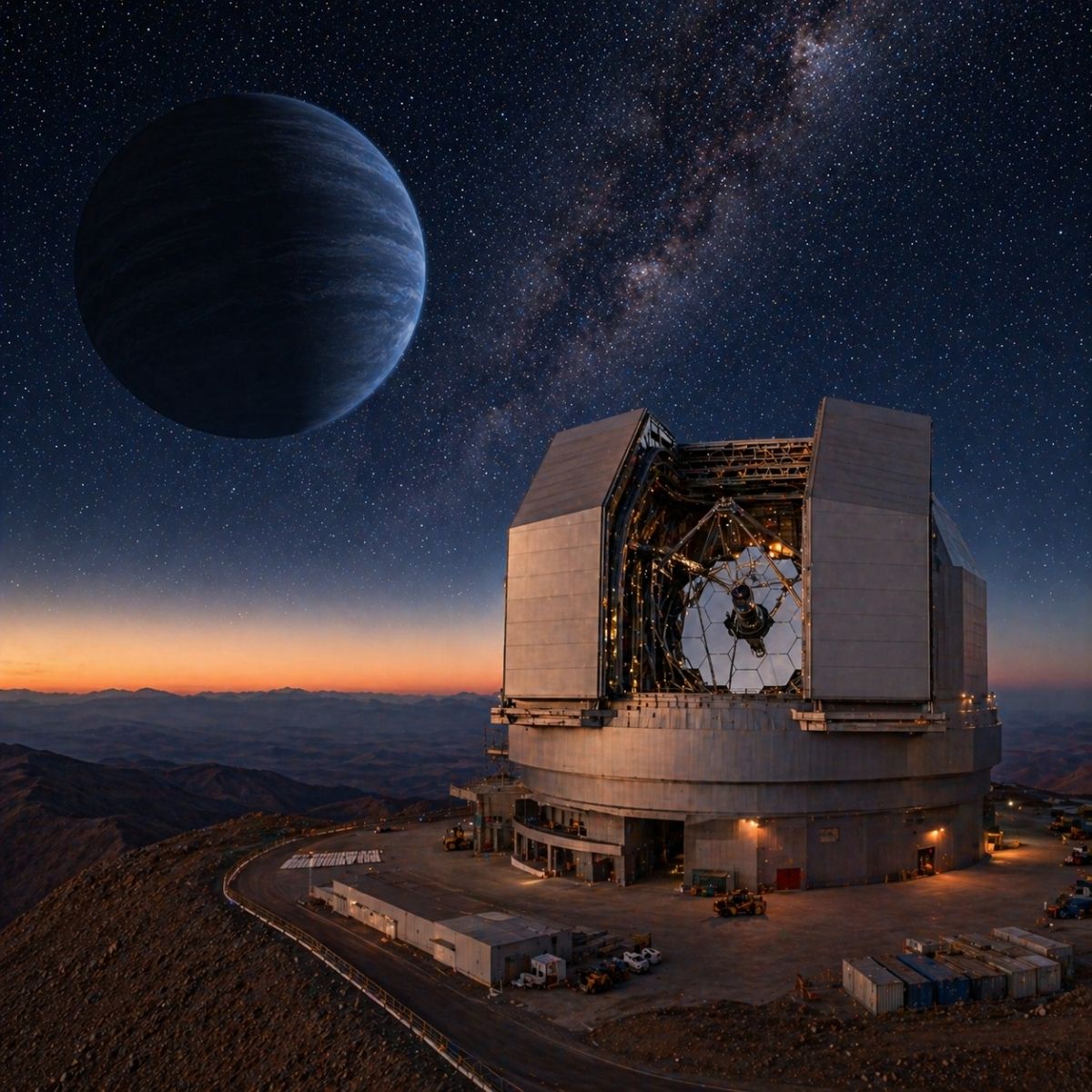

The Vera Rubin telescope, installed in Chile with the largest digital camera ever manufactured, has been scanning the southern hemisphere sky since 2025 and may locate the hypothetical ninth planet of the Solar System in the next two years, a celestial body with ten times the mass of Earth proposed by Caltech astronomers to explain anomalous orbits of trans-Neptunian objects.
The telescope that could rewrite astronomy books is already operating atop a mountain in northern Chile, and among its most ambitious tasks is the search for the planet that no one has managed to photograph in a decade of attempts. The Vera Rubin Observatory, which began its mission in June 2025, scans the entire southern hemisphere sky every few nights with enough resolution to detect extremely faint and distant objects, a capability that positions it as the main candidate to definitively resolve the debate about the existence of a ninth planet in the Solar System. Astronomers Konstantin Batygin and Michael Brown, from the California Institute of Technology (Caltech), have argued since 2016 that a celestial body about ten times the mass of Earth orbits the Sun in the system’s most remote regions, and Brown himself states that Rubin “will either find the planet directly or find virtually irrefutable evidence that it exists or does not exist.”
The ninth planet hypothesis emerged to explain a phenomenon that other theories could not resolve. Six trans-Neptunian objects (TNOs), icy bodies orbiting the Sun beyond Neptune in the region known as the Kuiper Belt, exhibit abnormally inclined and elongated orbits that suggest gravitational influence from a much larger neighbor. For Brown, the conclusion is straightforward: “If the planet doesn’t exist, we no longer have explanations for many strange events.” The Vera Rubin, with its ability to catalog billions of cosmic objects over ten years of operation, including more than 40,000 new TNOs, offers the best chance science has ever had to definitively confirm or rule out the existence of this mysterious celestial body.
Why scientists think there is a hidden planet in the Solar System

The defense of the ninth planet’s existence is based on indirect evidence that, according to its proponents, cannot be explained otherwise. The six distant TNOs analyzed by Batygin and Brown share orbital patterns that would be statistically improbable without the presence of a massive body exerting gravitational attraction on them, and computational calculations indicate that only a planet with a mass equivalent to ten Earths, in a highly elliptical and inclined orbit, would produce exactly the observed arrangement. The hypothetical planet would be, on average, about 20 times farther from the Sun than Neptune, a distance that would imply an orbit of up to 20,000 Earth years to complete a single revolution.
-
Sixth-grader in Miami wins Lemelson Young Inventor Prize for creating water-absorbing concrete using discarded oyster shells and charcoal.

-
Brazilian Researchers Develop Portable, Painless, Radiation-Free Breast Cancer Tracker Using Microwaves, Costing Around $200 and Potentially Replacing $240,000 Mammograms
-
Beer as a Vaccine? Scientist Develops Experimental Method with Live Yeasts, Tests Own Brew, and Publishes Results on Zenodo

-
Brazilian Researchers Develop ‘Rapha’ Device Using Natural Latex and LED Light to Heal Diabetic Foot Ulcers and Prevent 50,000 Annual Amputations


The most cited historical comparison is with the discovery of Neptune in 1846. The eighth planet of the Solar System had its existence mathematically predicted before it was observed, when astronomers noticed irregularities in Uranus’s orbit that could only be explained by the gravitational pull of an unknown neighbor. The calculations allowed astronomer Johann Gottfried Galle to locate Neptune in the sky, and it was later discovered that Galileo Galilei had already observed the planet in 1612 without identifying it because its movement was too slow for the telescopes of the time. The same scenario could apply to the ninth planet: it may already be in existing data, waiting to be recognized.
What the Vera Rubin Observatory can do that no other telescope has achieved

The fundamental difference between the Vera Rubin and instruments like the James Webb Space Telescope lies in their approach. While the James Webb is designed to focus on specific targets in the deep universe, producing extraordinary images of individual galaxies and nebulae, the Vera Rubin systematically scans immense areas of the sky, a strategy that makes it ideal for finding unknown objects whose exact position no one can predict. Sarah Greenstreet, an astronomer at the observatory, explains that the Rubin can detect fainter and more distant objects than any previous survey, and states categorically: “If the planet exists at the hypothesized size and location, the Rubin observatory will find it.”
The telescope’s digital camera is the largest ever built for astronomical purposes. With a resolution that allows it to record objects of extremely low luminosity, the instrument is capable of capturing the minimal fraction of sunlight that a celestial body 20 times the distance of Neptune would reflect back to us, precisely the type of signal that conventional telescopes cannot distinguish from the background noise of space. If the ninth planet has the estimated size (larger than Earth, smaller than Neptune), the Vera Rubin has enough sensitivity to identify it as a moving luminous point against the fixed stellar background, and Brown believes this could happen within one or two years.
The arguments of those who doubt the planet exists
The ninth planet hypothesis is not consensual within the scientific community. Critics point out that Batygin and Brown’s analysis may contain observational biases, as the six TNOs used as the basis of the hypothesis represent a small sample that may not reflect the real behavior of the total population of trans-Neptunian objects. The discovery in 2023 of the object named Ammonite, whose orbit does not align with those of the original six TNOs, weakened part of the argument by demonstrating that not all distant bodies share the pattern that the planet’s existence would explain.
An alternative theory proposed by astrophysicists from the German institute Forschungszentrum Jülich suggests a different explanation for the anomalous orbits. Computer simulations published in 2025 indicate that the close passage of a massive star billions of years ago could have caused enough gravitational perturbation to permanently alter the trajectories of the TNOs, a scenario that would negate the need for an additional planet. Professor Susanne Pfalzner, who led the study, admits that “the planet cannot be ruled out,” but considers the probability low. Greenstreet herself acknowledges that “the evidence for this additional planet has diminished in recent years,” although she remains optimistic about what the Vera Rubin can reveal even if the ninth planet does not exist.
What the discovery or denial of the planet would mean for science
If the Vera Rubin confirms the existence of the ninth planet, it will be the first discovery of a new member of the Solar System in 180 years. Brown highlights that the celestial body would be the fifth largest planet in the system, a position that would place it between Earth and Neptune in terms of mass, and that its detection would transform the understanding of the formation and evolution of our planetary system. Astrophysicist Malena Rice, from Yale University, observes that planets of this size are found in about half of the stellar systems studied, which makes the absence of an equivalent in the Solar System an anomaly that the discovery would resolve.
If the planet is not found even after the complete survey by the Vera Rubin, science still advances. The definitive elimination of the hypothesis would force astronomers to seek alternative explanations for the anomalous orbits of TNOs, opening lines of research that may reveal gravitational or historical phenomena about the formation of the Solar System that are still unknown. And as astronomer Greenstreet summarizes: “There is a vast region of the outer Solar System still largely unexplored. Who knows what else might be hidden there.”
And you, do you believe the ninth planet exists or do you think it’s just an effect of incomplete data? Leave your opinion in the comments.