Portuguese
  Spanish


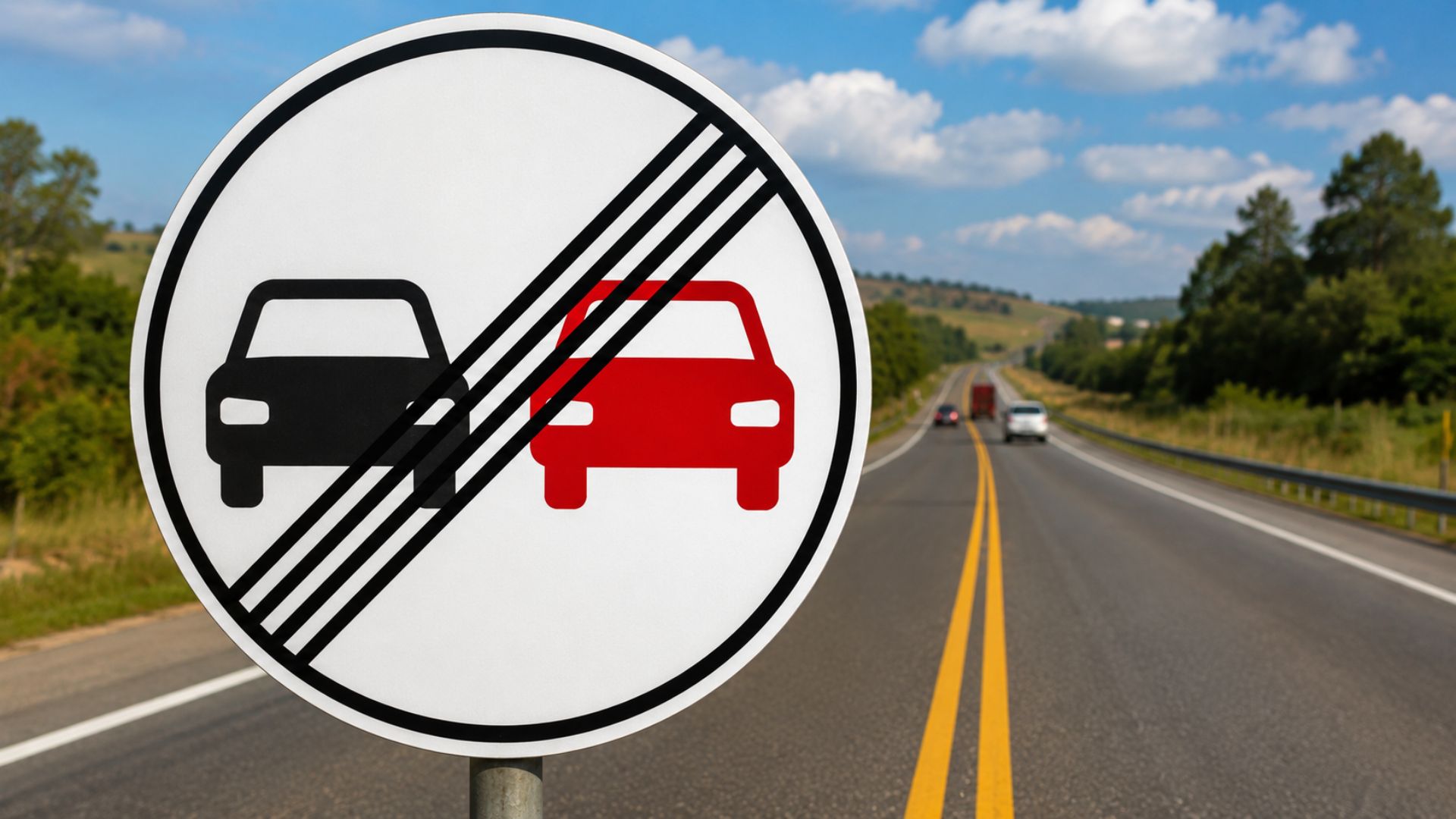

Uncommon symbol for Brazilian drivers may appear on roads and cause doubt when deciding to overtake, especially when the signage follows standards used abroad and requires joint reading of signs, road markings, and actual road conditions.
The traffic sign with two cars side by side, white background, and diagonal lines over the drawing usually indicates, in systems adopted outside Brazil, the end of an overtaking prohibition.
In practice, the sign informs that a previous restriction is no longer valid from that point, but does not automatically authorize overtaking, as the maneuver is still subject to road conditions.
The doubt arises because this symbol does not follow the model most known by Brazilian drivers.
-
Mother discovers she may have won £12 million in the lottery but faces an agonizing wait after the shopkeeper threw the ticket in the trash.

-
A couple bought a house in Sheffield and, when removing the carpet from the hallway, found a trapdoor leading to a secret 23 m² basement with a 2-meter ceiling height, a discovery that eliminated the need for an expensive extension and, according to them, added £70,000 to the property’s value.

-
A nurse bought for 20,000 a 1955 house abandoned by a hoarder in Texas, and months later, rain revealed a buried pool in the backyard valued at $160,000, which he restored himself for about $10,000, a fraction of the cost of building a new one.
-
The United Kingdom is transforming dog feces left on trails into gas to light a streetlamp through an unlikely and surprising project that shows how even one of the most rejected wastes in cities can generate energy.




In European countries, signs with vehicles and diagonal bars may mark the end of a specific rule, such as the prohibition to overtake or other circulation limitations imposed in the previous section.
Therefore, the image should not be read as unrestricted permission to change lanes, invade the opposite direction, or start overtaking immediately.
Before any decision, the driver needs to consider visibility, safe distance, traffic flow, and horizontal signage.
What the sign indicates in practice
On a road, the sign with two cars and diagonal lines usually appears after a section where overtaking was prohibited.
Its function is to inform that the specific limitation has ended, allowing the driver to reassess the maneuver according to other applicable rules at the location.
The confusion occurs because, in many countries, the end of a restriction is shown by repeating the previous symbol in a neutral tone or with diagonal lines.
For those familiar only with the Brazilian standard, the drawing may seem like a new prohibition, a danger warning, or a sign with no clear meaning.
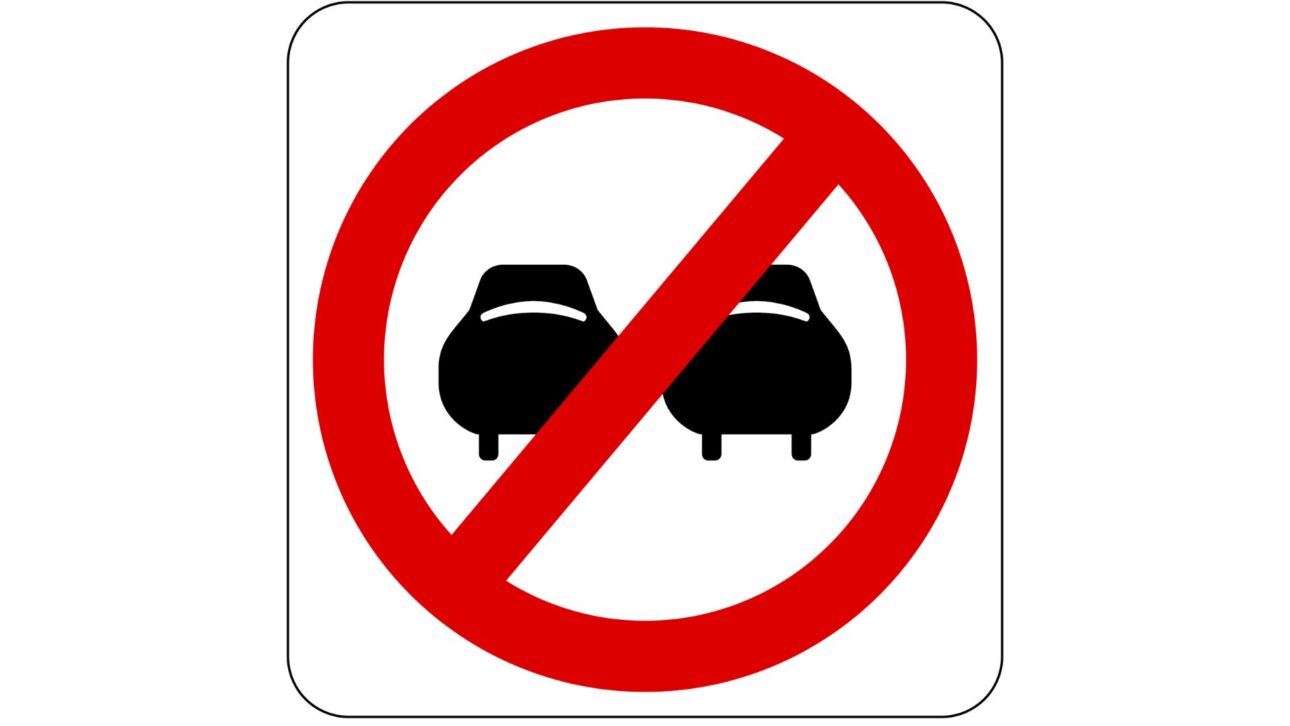
Even so, the practical effect does not eliminate a basic safety rule.
Even after the end of the vertical restriction, overtaking should only occur if the driver is sure they can complete the maneuver without putting other vehicles at risk, especially on single two-way roads.
It is also essential to observe the pavement markings, because horizontal signage can maintain the prohibition even when a previous rule seems to have ended.
If there is a continuous yellow line dividing opposing flows, overtaking remains prohibited, even if the driver has seen a sign indicating the end of the restriction.
How the Overtaking Prohibition Works in Brazil
In Brazil, the official reference for overtaking prohibition is the sign R-7, identified in the Brazilian Traffic Signage Manual as the “No Overtaking” sign.
According to Senatran, it indicates to the driver that overtaking is prohibited in the regulated section using the lane intended for the opposite direction of traffic.
The same manual advises that the R-7 sign should be used in places where visibility distance conditions or other factors make overtaking unsafe.
Additionally, the regulation provides that the sign may be accompanied by complementary information about the length of the section where the restriction remains valid.
The validity of the R-7 starts at the point where the sign is installed and continues until the location where the markings on the road indicate the possibility of overtaking.
Another form of termination occurs when there is a new R-7 sign with complementary information of “End,” which reinforces the decisive role of horizontal signage in road reading.
Whenever possible, the R-7 sign should be accompanied by a continuous yellow line dividing opposing flows, according to the manual.
In traffic routine, this combination reduces doubts because the driver receives the same message from both vertical signage and the markings painted on the asphalt.
Why Signage Can Confuse Drivers


Interpretation becomes more difficult when Brazilian drivers encounter foreign signs in videos, apps, international manuals, roads outside the country, or content shared on social media.
As each road system can adopt its own designs, colors, and formats, similar signs do not always convey identical messages.
In some places, circular signs with a red border indicate prohibition, while signs with diagonal bars may represent the end of a certain order.
In the United Kingdom, for example, official materials explain that regulatory signs are usually circular and that the red circle or ring indicates a prohibition.
This type of difference shows why an isolated image may be insufficient to guide a maneuver.
A sign only makes complete sense when observed along with the country, the local traffic code, the road design, the pavement markings, and the signs installed before and after it.
In the Brazilian case, recognizing a design similar to that used in another country is not enough to define driving behavior.
The driver must follow the standard provided by national legislation and respect the valid signage in the location where they are driving, because each system establishes its own models and application rules.
Safe overtaking depends on the road and signage
Among the maneuvers performed on highways, overtaking is one of those that require the most driver assessment.
To execute it safely, it is necessary to have space to leave the lane, gain speed, pass the vehicle ahead, and return without forcing other drivers to brake or swerve.
Curves, inclines, declines, bridges, viaducts, intersections, stretches with limited visibility, and areas with heavy traffic can make overtaking prohibited or inadvisable.
For this reason, the presence or absence of a sign never replaces the obligation to assess the real conditions of the road.
When the stretch allows overtaking, it is still up to the driver to check mirrors, signal the intention, maintain distance, observe vehicles in the opposite direction, and verify if another driver has already started the same maneuver.
The decision must be made with a safety margin, not just based on the end of a restriction.
In international travel, studying the main signs of the destination country in advance helps avoid misinterpretations.
Similar signs may have different meanings, and models unfamiliar to Brazilians may be part of the routine for local drivers.
In Brazil, correct reading follows a simple rule: the R-7 sign prohibits overtaking, and the end of this restriction depends on the markings on the road or additional signage.
When the continuous yellow line remains on the asphalt, overtaking is still prohibited, even if the driver has interpreted another sign as a release.