Portuguese
  Spanish


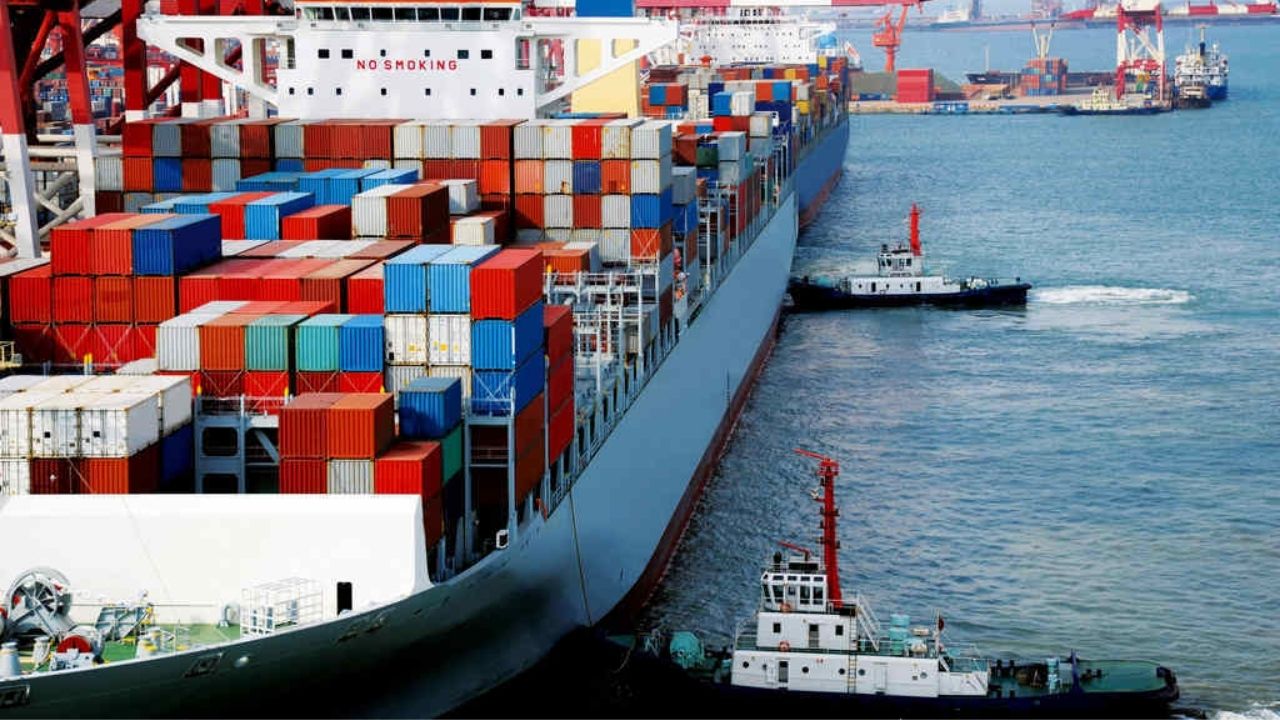
In narrow ports, giant ships rely on tugboats to face wind, current, and inertia when approaching the dock. Smaller boats push, pull, and brake cargo ships of up to 400 thousand tons, while pilot, radio, and cables try to avoid collisions, million-dollar damages, and delays in critical port operations within large ports.
The giant ships entering narrow ports rely on tugboats to overcome wind, current, and inertia during docking maneuvers. These cargo ships can weigh up to 400 thousand tons and need to be slowly guided to the dock by pilot, captain, radio, cables, and port teams.
In a video released by the Infra Bruta channel, on June 6, 2026, the operation occurs when large cargo ships enter or leave port areas surrounded by docks, cranes, other ships, and shallow channels. With wind, current, and few meters of margin for error, the maneuver depends on coordination between pilot, captain, radio, cable teams, and tugboats.
Huge ship does not stop like a common vehicle
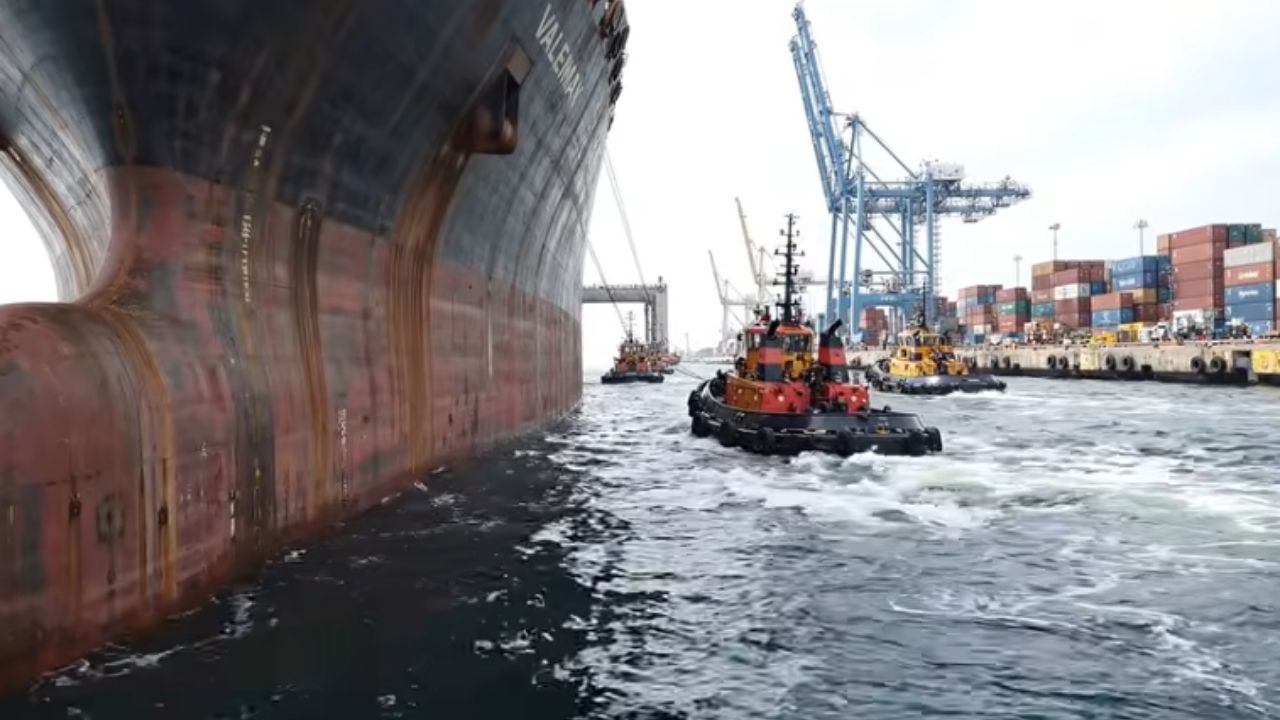
A loaded cargo ship does not respond like a car. Even with engines reduced or turned off, inertia continues to push the vessel forward, because the moving mass keeps advancing over long distances.
-
India excavates a 28 km artificial lake in the Thar Desert, lines the bottom with a giant plastic sheet to prevent 1.41 million tons of water from disappearing into the sand, and attempts to supply 5 million people throughout the year.

-
12-year-old girl develops a virtual receptionist with artificial intelligence for small businesses and demonstrates how the combination of creativity, programming, and automation can boost productivity, reduce repetitive tasks, and expand access to digital transformation.

-
A rock weighing almost 500 tons seems to defy gravity for over 11,000 years in Finland and remains balanced on a tiny base without collapsing or moving.
-
At 76 years old, a retired man reveals a subterranean labyrinth he dug by hand for 30 years under his own garden, descending 6 meters into sand dunes, erecting 1.5-meter concrete walls with calculations from his mathematician wife, and transforming a “crazy” idea into a hidden cave with a bridge and waterfall.


In open sea, this is less critical, as there is space to correct the course. Inside the port, however, every meter matters, and the lack of space turns any delay into a risk for the dock, the hull, and other ships.
Narrow ports reduce the margin of error
The entrance to a port is usually narrow, surrounded by expensive structures and areas where the bottom can become dangerous for deep-draft vessels. The ship needs to advance slowly, yet still maintain control.
This is the paradox of the maneuver. The slower the giant ships move, the less the rudder responds; but the faster they advance, the greater the risk of collision.
Tugboats step in where the ship loses control
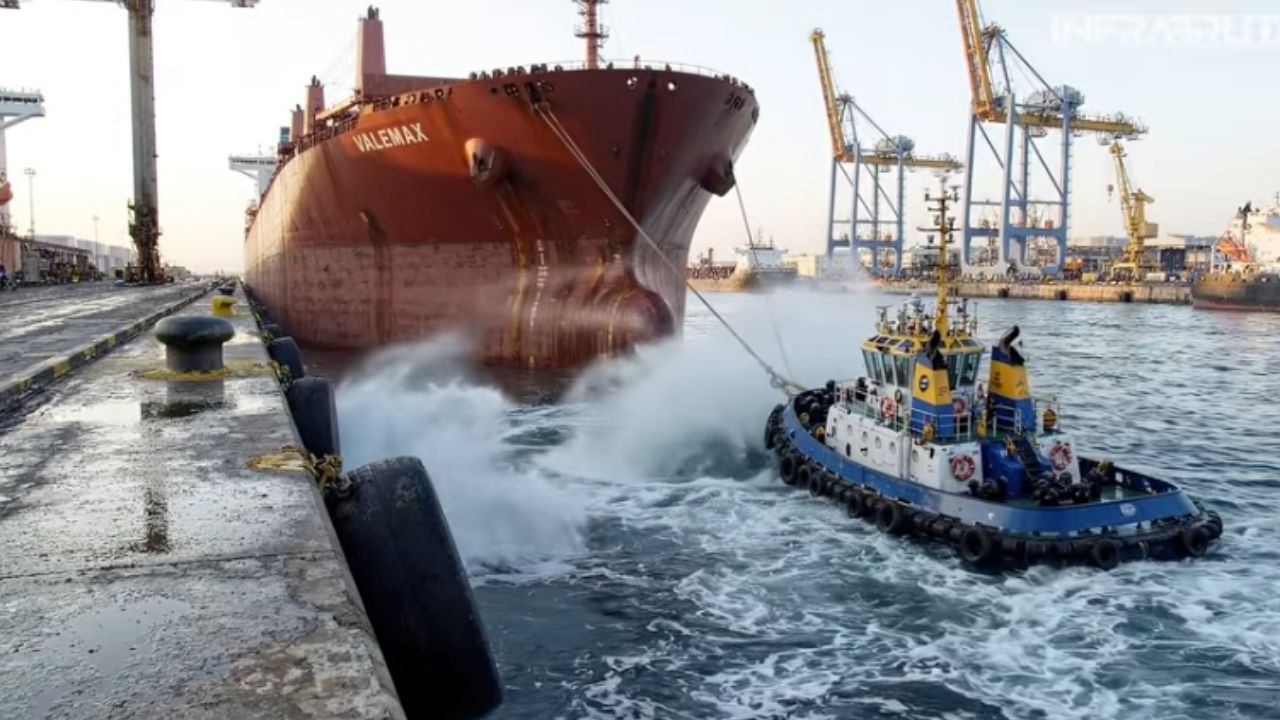
This is when tugboats play a decisive role. They may seem small next to a freighter, but they are equipped with powerful engines, reinforced hulls, rubber fenders, and propulsion systems capable of pushing in different directions.
These boats do not win by size. They win by position, angle, and the exact moment they apply force on the ship’s hull.
Brute force alone does not solve the maneuver
A modern tugboat can generate great thrust, but power without coordination would only push the ship to the wrong place. Therefore, the maneuver depends on precise commands, given at the right moment.
Before reaching the dock, the pilot boards and starts guiding the operation along with the captain. He knows the port, where the shallow bottom is, the most dangerous current, and the point where the ship needs to start turning.
Pilot coordinates captain, radio, and tugboats
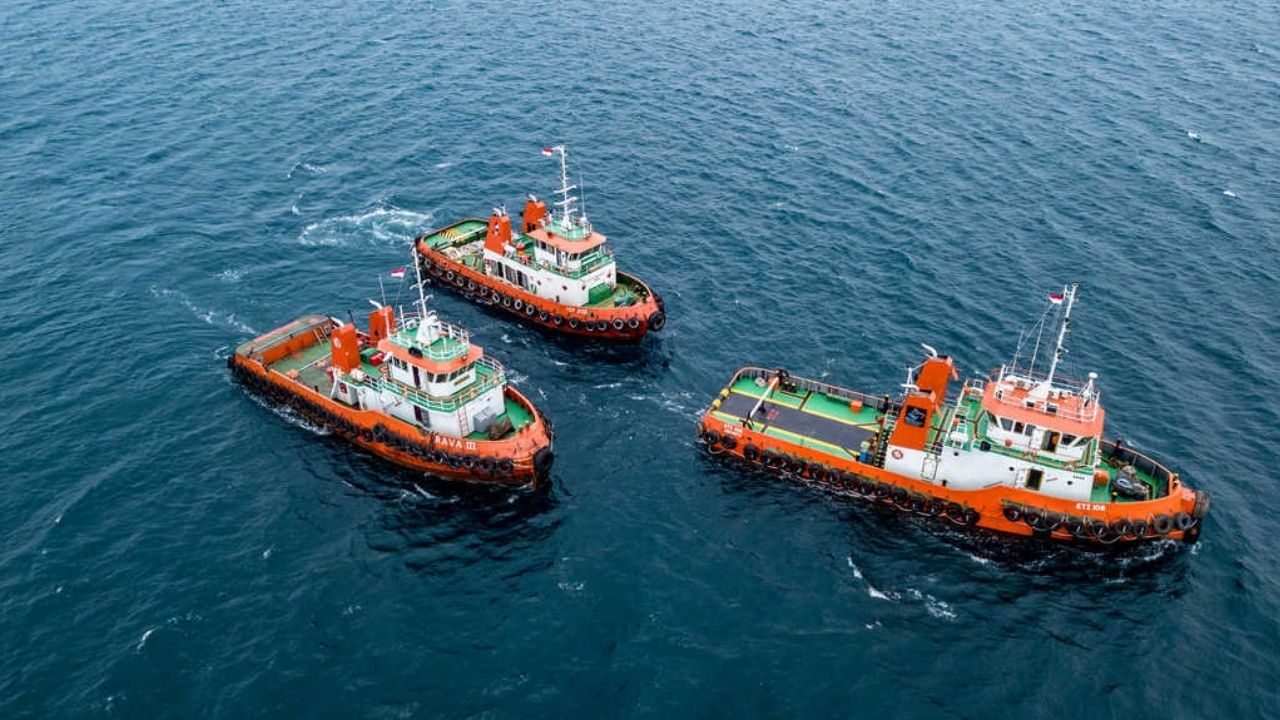
On the command bridge, the team monitors maps, instruments, and the surrounding water. By radio, each tugboat receives a specific order: push the bow, hold the stern, pull by the cable, or just maintain position.
The operation works like a human gear. Pilot, captain, crew, cable team, and tugboats need to act as a single system to make the giant obey.
How small boats move giant ships
The tugboats do not try to carry the entire ship. They apply force at strategic points on the hull, using the ship’s own physics to favor the maneuver.
When one tugboat pushes the bow and another acts on the stern, the freighter begins to slowly turn. It’s like moving a huge lever: the secret is not just in the force, but in the point where it is applied.
Bow and stern become control points
At the front, a tugboat can touch and push the ship’s nose to the side. At the back, another acts on the stern, correcting the angle and preventing the vessel from straying from the planned line.
In some cases, a third tugboat works tethered by a cable. By pulling, it helps to slow down the vessel or bring the stern closer to the dock, controlling a speed that the ship itself can no longer adjust alone.
Cables withstand extreme tension
The cables used in the maneuver connect the small boat to the huge hull. When they come under load, they become tense, vibrate, and transfer force between the tugboat and the ship.
This connection requires precision and care. Too much force can turn the ship beyond what is necessary; too little force can allow the mass to continue advancing without sufficient response.
Wind turns the hull into a wall
The wind is one of the biggest enemies of docking. The side of a large ship functions as an exposed steel wall, receiving lateral pressure even when the vessel seems almost stationary.
In giant ships, this lateral area turns moderate gusts into forces capable of displacing the hull. The tugboat needs to anticipate the drift before it grows and becomes an irreversible problem.
Current also pushes from below
While the wind acts on the hull, the current works below the waterline. It can push the vessel against the dock, against the bottom, or towards other port structures.
The difficulty increases when wind and current work in different directions. The maneuver is no longer just about bringing the ship closer to the dock and becomes a constant struggle against invisible forces.
Tugboats correct before the error grows
The most important point is anticipation. With a mass of up to 400,000 tons, a small deviation cannot be treated as a detail because it grows while the ship continues to advance.
Therefore, the tugboats do not wait for the vessel to go off course. They correct the moment the error begins, before wind, current, and inertia turn centimeters into meters.
Approach to the dock is the most critical phase
The most delicate stage happens when the ship seems almost stopped. At this low speed, the rudder responds little, and the tugboats become practically the only remaining control.
The hull approaches the dock fender slowly. The vessel needs to touch gently, because too strong an approach can damage concrete, steel, fenders, and port structure.
Last meters require extreme precision
In the final meters, orders are short and direct. One tugboat pushes lightly, another holds by the cable, another corrects the alignment to keep the hull parallel to the dock.
The tension increases because there is no second chance. An error of a few meters can turn a regular docking into a collision, operational stoppage, and million-dollar loss.
Contact needs to be almost imperceptible
When everything goes right, the hull touches the dock fender smoothly. A gigantic mass, which seemed impossible to control, is guided to touch the structure as if it were being parked.
This result does not come from luck. It is the consequence of calculated force, constant communication, and small repeated movements at the right moment.
Cables secure the giant to the dock
After contact, the mooring team springs into action. Thick cables are thrown from the ship to the dock and secured to steel bollards, holding the vessel by the bow, stern, and intermediate points.
Only when the ship is properly moored do the tugboats ease tension and move away. Their work ends when the giant stops moving and becomes part of the port’s operational routine.
After docking, another operation begins
For those watching from afar, the arrival at the dock seems like the end of the maneuver. But, at the port, it is just the beginning of another stage: cranes, trucks, conveyors, and loading teams spring into action.
The loading and unloading operation depends on this secure docking. Without the tugboats, the giant ships would not reach the exact point where the entire port infrastructure can work.
Small boats sustain global trade


The scene may seem unequal: low and compact boats pushing huge cargo ships. But this difference reveals an essential gear of maritime transport.
Modern ports depend on this combination of strength, technique, and coordination. Tugboats show that in heavy infrastructure, size isn’t everything; position, precision, and response time can be worth more than mass.
The giant only arrives because someone holds it
The giant ships that supply global trade depend on much smaller machines to enter narrow ports. Tugboats push, pull, brake, hold, and correct the hull while wind, current, and inertia try to take the vessel off course.
This operation, invisible to many passengers and consumers, prevents collisions, million-dollar damages, and delays in entire logistics chains. Did you imagine that such small boats had so much responsibility for controlling cargo ships of up to 400,000 tons? Share your opinion.