






 Portuguese
  Spanish


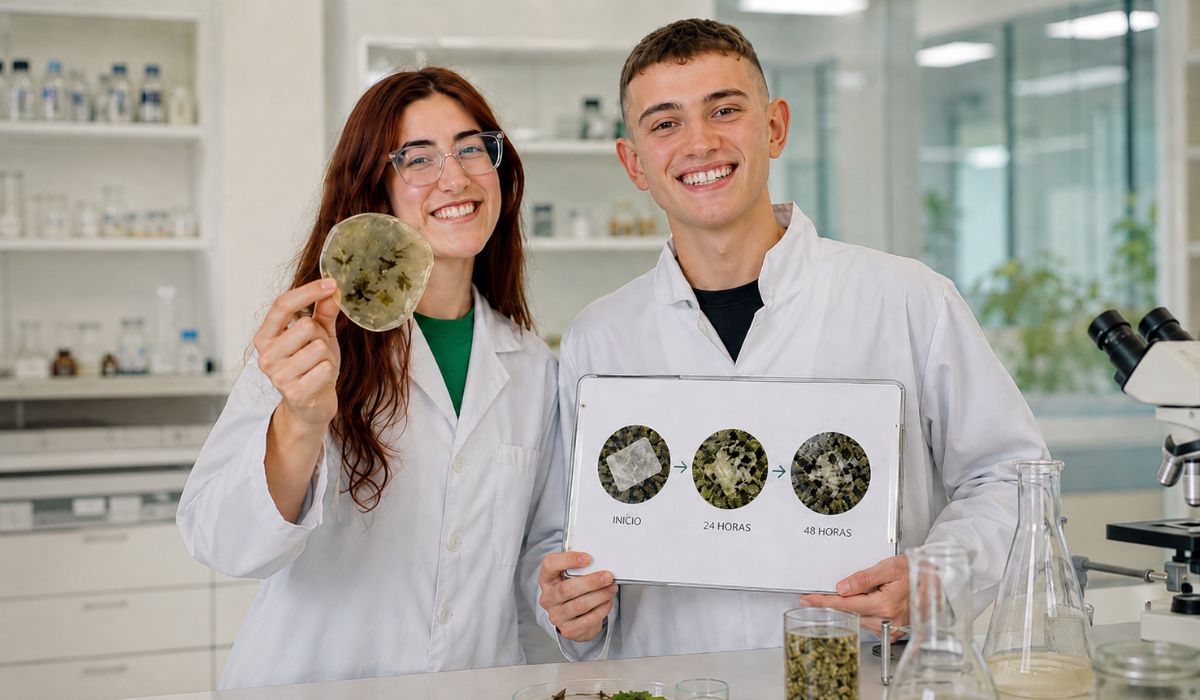

Award-winning sustainability project transforms a common first aid item into a school research with plant-based, rapid biodegradation and technical challenges before any wide commercial use.
Two 17-year-old students from Gravataí, in the Metropolitan Region of Porto Alegre, won the Central and South America stage of the The Earth Prize 2026 with a biodegradable bandage made from aloe vera and chamomile.
The project, called HADA, was developed by Bernardo Mattos Renner and Ísis Valentin to replace conventional plastic bandages and decompose in the soil within 48 hours, according to the award organization.
The proposal brings together elements of health, materials science, and sustainability.
-
China Develops Custom 140-Ton Electric Mining Truck with 770 kWh Swappable Battery, Deploys 290 Units in Xinjiang’s Largest Zinc Mine

-
Meta to Launch Arena, a New Prediction App Targeting 3.56 Billion Users, Competing with Polymarket and Kalshi

-
Scientist Challenges Famous Human Evolution Theory, Argues Homo Sapiens Evolved Gradually Over Thousands of Years
-
15-Year-Old American Builds Ocean Generator with PVC Pipe and 3D-Printed Propeller for $12, Wins National Prize, Presents at White House, and Makes Forbes 30 Under 30 List




Instead of treating the bandage just as a disposable product, the students investigated the environmental impact of an item frequently used for minor injuries and discarded shortly after use.
The recognition was announced on May 17, when HADA won the regional stage of the competition.
As a result, the duo received US$ 12,500 to continue developing the technology, an amount intended for the validation, improvement, and expansion of the biobandage tests.
Biodegradable bandage born from a problem seen on the court
The idea arose during sports activities at school, during volleyball games.
Bernardo and Ísis observed the frequent use of bandages after small cuts and injuries and began researching alternatives to reduce the disposal of materials with plastic components.
From this observation, the two sought plant-based ingredients that could provide protection for superficial wounds.
The formulation reached the combination of aloe vera, popularly known as aloe, and chamomile, plants used in products associated with skin care.
The HADA was presented as a biobandage.
According to the project description in The Earth Prize, the aim is to replace conventional plastic bandages with a biodegradable alternative while also assisting in the healing process of minor injuries.
The data released so far, however, refer to prototypes and initial tests.
There is no confirmation of regulatory approval for large-scale sale or wide medical use, a necessary step for products intended for wound care.

Aloe Vera, Chamomile and Decomposition in up to 48 Hours
One of the main technical points informed by the team is the decomposition time.
According to the award organization, the material disintegrates in the soil in up to 48 hours.
Conventional dressings, on the other hand, may contain plastics, adhesives, and other components with more complex disposal.
In the initial tests reported by the award, the HADA prototypes showed adhesion, flexibility, and antimicrobial action.
These results indicate progress in the experimental phase, but do not yet replace independent evaluations, regulatory trials, or formal authorization for commercial application.
The choice of ingredients helps explain the research line adopted by the students.
Aloe vera frequently appears in skin care formulations, while chamomile is used in products associated with a calming effect.
In the project, these elements were incorporated into a biodegradable material aimed at protecting superficial wounds.
The name of the bio-dressing also relates to the proposal.
In a Band report, the project was presented with reference to the word “hada,” of Japanese origin, associated with the idea of “skin.”
The choice reinforces the connection between the developed material and its application in minor injuries.
The Earth Prize 2026 and the Award for Gaucho Students
The Earth Prize presents itself as the world’s largest environmental competition and idea incubator aimed at young people aged 13 to 19.
In the 2026 edition, the award selected regional winners in different parts of the world, including Central and South America, North America, Europe, Africa, Asia, the Middle East, Oceania, and Southeast Asia.
Before the regional victory, HADA was already among the Brazilian projects classified in the list of students selected by the competition.
The official award page also recorded other initiatives from Brazil at this stage, showing the presence of Brazilian youths among the competitors evaluated in 2026.
In addition to the cash prize, the project gained greater visibility to seek laboratory structure, technical partnerships, and specialized support.
According to the organization of The Earth Prize, Bernardo and Ísis produced four research articles and established contact with institutions and specialists in Rio Grande do Sul to advance the development of the biocurative.
This step is considered necessary because products aimed at wounds depend on technical and regulatory processes.
To reach schools, sports centers, pharmacies, or health units, a bandage needs to undergo safety validation, production standardization, performance testing, and analysis by competent bodies.
HADA won the regional stage, but did not get the global title
After the regional victory, HADA participated in the global stage of The Earth Prize 2026 through public voting.
The final result was announced on May 29, and the world title went to Plas-Stick, a project by three students from India who developed a biodegradable tamarind powder to remove microplastics from water.
As a result, Bernardo and Ísis did not win the global prize, but they retained recognition as regional winners of Central and South America.
The result guarantees funding of US$ 12.5 thousand, in addition to the international exposure gained during the competition.
In the field of young science, the case shows how an everyday problem can lead to applied research.
A bandage used after sports activities served as a starting point to investigate alternatives with less environmental impact in disposable items related to health, hygiene, and first aid.
The advancement of HADA now depends on technical stages that usually occur after the prototype phase.
Among them are more robust tests, independent evaluation, definition of manufacturing standards, and analysis of the feasibility of large-scale production.





