Portuguese
  Spanish


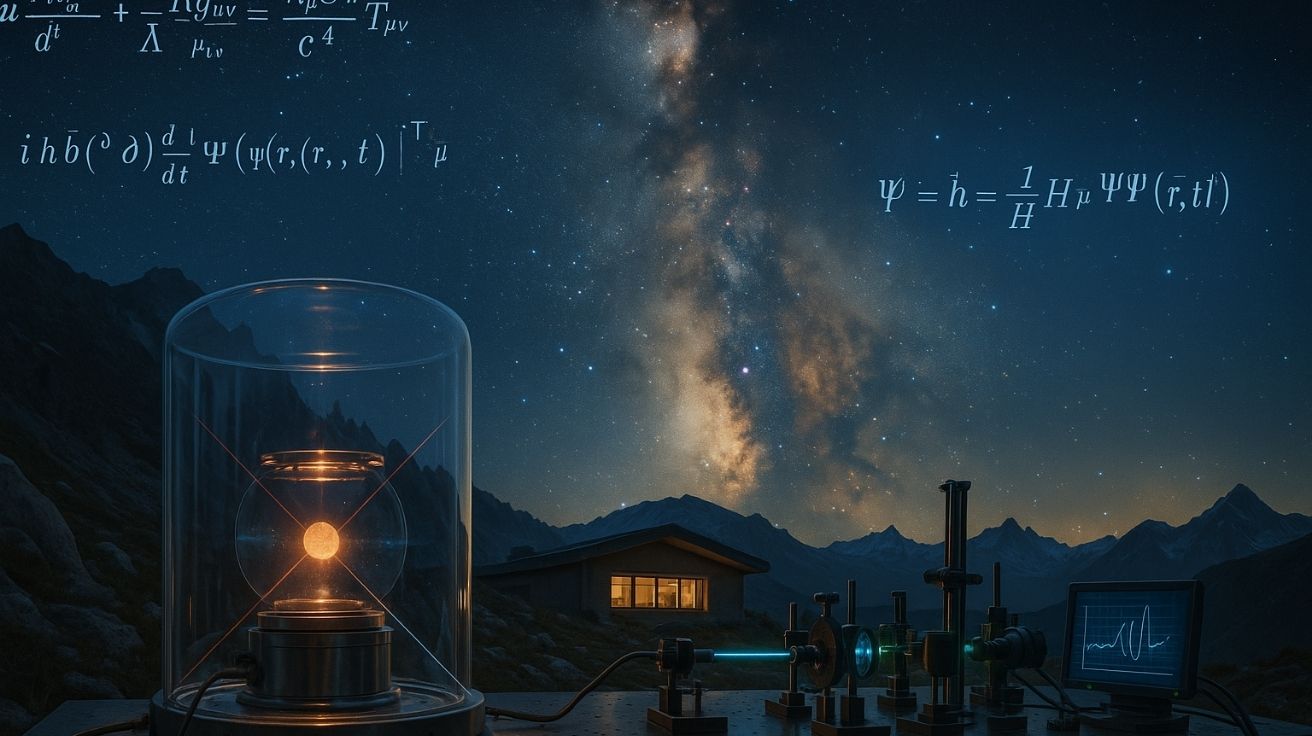


Austrian Researchers Create Unique Geometric Theory to Describe the Curvature of the Universe at Subatomic and Cosmological Scales and Test Interactions Between Gravity and Quantum Particles
While satellites orbit under Einstein’s laws and atoms behave according to quantum mechanics, physics still seeks to answer one of the deepest questions of modern science: how to unify the laws governing the very large with those controlling the very small? This quest, which mixes the invisible with the colossal, is at the center of new research conducted by the University of Vienna.
In a lengthy article published on May 28, 2025, physicist Sebastian Deiber presents the efforts of three distinct teams working in the fields of particle physics, applied mathematics, and quantum gravity. The focus is on theories about dark matter, unification of fundamental forces, and the deep geometry of spacetime.
The Puzzle of Physics: Between Invisible Particles and Forces That Don’t Fit
Since the success of the Standard Model of particle physics, which explains almost all observable non-gravitational phenomena, scientists such as Josef Pradler have been dedicated to exploring what is still hidden. Pradler, a professor at the University of Vienna, emphasizes: “The theory works, but it doesn’t explain everything. Something is missing”.
-
Sixth-grader in Miami wins Lemelson Young Inventor Prize for creating water-absorbing concrete using discarded oyster shells and charcoal.

-
Brazilian Researchers Develop Portable, Painless, Radiation-Free Breast Cancer Tracker Using Microwaves, Costing Around $200 and Potentially Replacing $240,000 Mammograms
-
Beer as a Vaccine? Scientist Develops Experimental Method with Live Yeasts, Tests Own Brew, and Publishes Results on Zenodo

-
Brazilian Researchers Develop ‘Rapha’ Device Using Natural Latex and LED Light to Heal Diabetic Foot Ulcers and Prevent 50,000 Annual Amputations


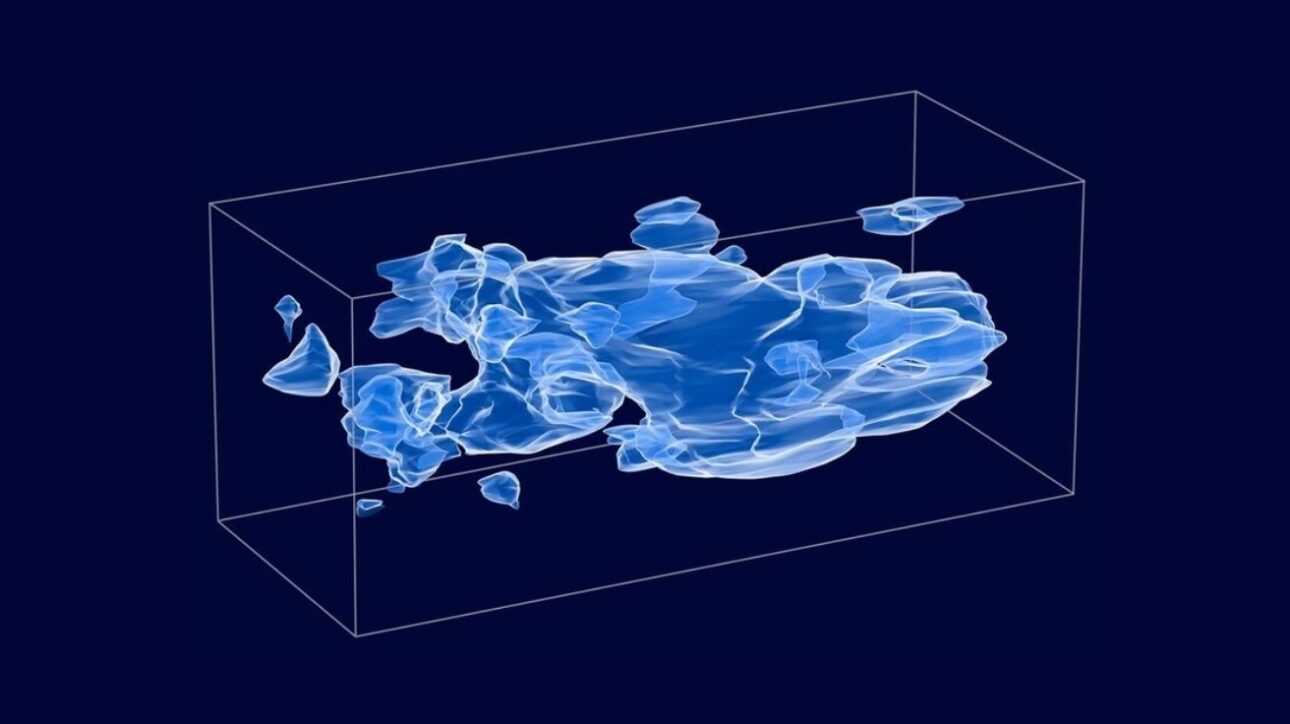
One of the greatest enigmas is dark matter. It is estimated that it represents 85% of all the matter in the universe, but it has never been directly detected. Only its gravitational effects are known, such as the bending of light in gravitational lensing phenomena or the anomalous rotation speed of galaxies.
The dominant hypothesis suggests that dark matter is composed of particles with mass and no electric charge, properties compatible with the Standard Model but requiring its extension. This is the mission of Pradler’s group: to create theoretical models and confront them with data from telescopes and underground detectors.
These studies require extreme precision. Even without directly observing these particles, scientists refine predictions and guide experiments that seek traces of their existence in controlled environments, where colliders and sensors search for the invisible.
In addition to dark matter, another challenge is the unification between gravity, currently explained by the theory of general relativity, and the other fundamental forces, which follow the quantum regime. To this day, there is no validated theory that unites these two pillars of modern physics.
To address this, Markus Aspelmeyer’s group develops extremely sensitive experiments in underground laboratories in Austria, where they attempt to put particles in quantum states subject to gravitational influence. If successful, they will prove that gravity also needs a quantum description.
This experiment is conducted with glass particles on a nanometric scale, cooled to temperatures near absolute zero and kept in absolute vacuum, avoiding any external interference that could destroy the quantum state.
Pixelated Spacetime and New Geometries for Reality
If experimental physics seeks clues, theoretical mathematics anticipates with bold models. Roland Steinbauer and his team are proposing a new geometry of spacetime, based on the idea that the universe, at its smallest scales, is not continuous but made up of “quantum points,” like pixels.
In Einstein’s general relativity, gravity is the curvature of spacetime caused by the presence of mass. However, in extreme situations, such as the collapse of a star or the interior of a black hole, this curvature ceases to be smooth and continuous.
In these cases, classical mathematics fails. This is where the new approach comes in: the geometry developed by Steinbauer is capable of dealing with “rough spacetimes,” where there are discontinuities and abrupt changes.
One of the most promising theories in this field is called Causal Set Theory, which describes the universe as a set of discrete events, causally connected. This view may be the key to unite classical physics with quantum physics.
Steinbauer’s group develops mathematical tools capable of calculating curvatures in scenarios where traditional geometry does not work, such as at the boundaries between stars and vacuum, where the density of matter changes abruptly.
With this, the new geometry promises to provide a common language for various theories candidates for quantum gravity, offering consistency between quantum and cosmic scales.
By allowing scientists to describe curvatures in both “classical spacetime” and “pixelated” models, Steinbauer’s theory represents a significant advancement towards the unification of physical models.
Although a definitive theory of quantum gravity has yet to be validated, the convergence between experiments and mathematical models at the University of Vienna indicates that we are getting closer to understanding the fundamental blocks of reality.
Share this article with your friends passionate about physics, astronomy, and cutting-edge technology. Comment below with your thoughts on the future of physics and dark matter!