Portuguese
  Spanish


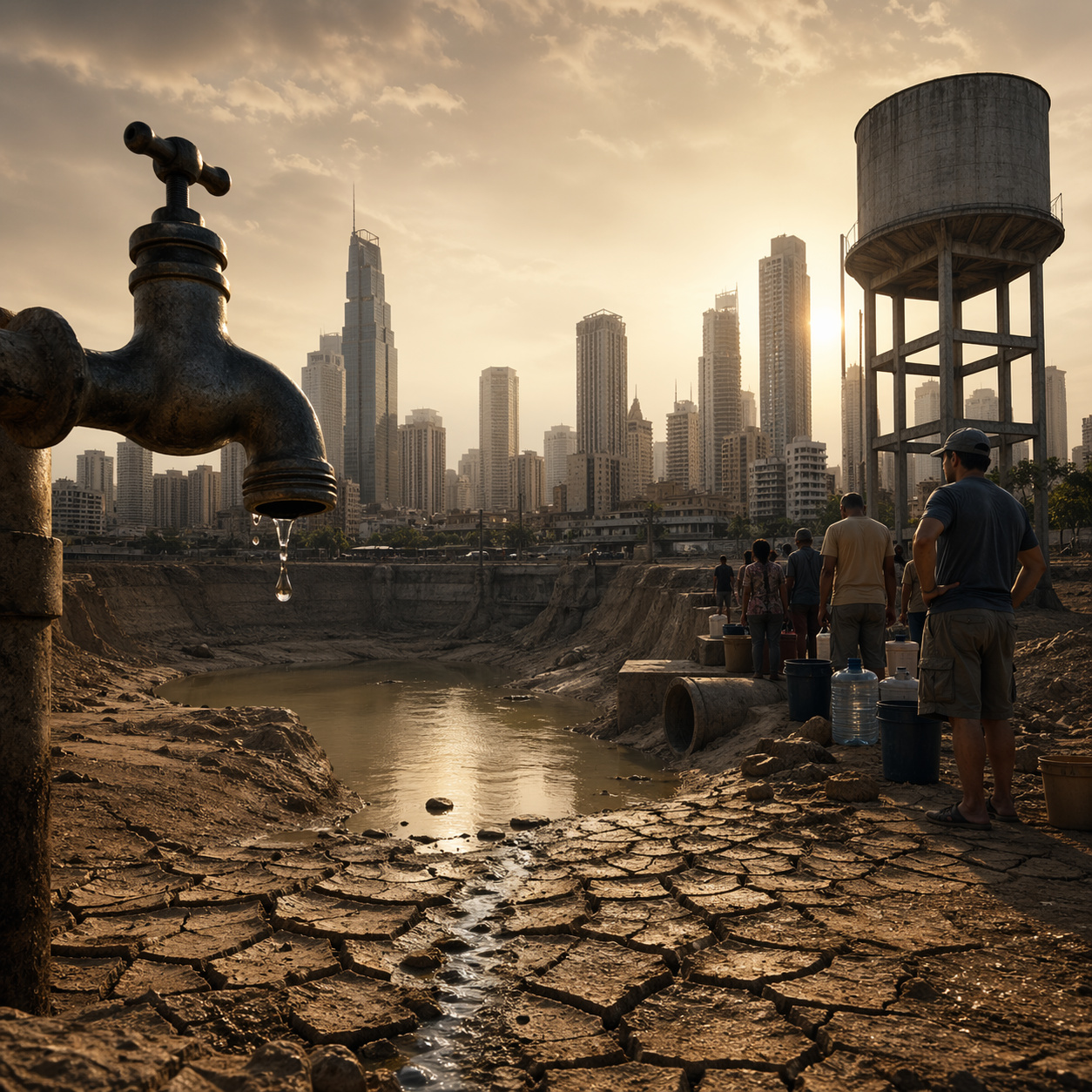

Study projects 2.4 to 5 billion people without sufficient water in cities by 2050, expanding a global water crisis already experienced by over 4 billion.
Published on August 3, 2021 in the scientific journal Nature Communications, the study “Future global urban water scarcity and potential solutions” projects a significant advance of the water crisis in cities in the coming decades. According to the authors, the urban population exposed to water scarcity could jump from 933 million people in 2016 to a range between 1.693 billion and 2.373 billion by 2050, depending on the climate and socioeconomic scenarios analyzed.
The work combines projections of water availability and demand with four scenarios that articulate climate change and socioeconomic development, allowing to map how pressure on water resources tends to evolve in the planet’s urban areas. The results indicate a growing imbalance between supply and consumption, driven mainly by the increase in urban population and water demand, with additional worsening in some scenarios due to changes in water availability.
The central finding of the research is that water scarcity in cities does not appear as an isolated or regional problem, but as a global-scale pressure. According to the study, up to almost half of the world’s urban population could live in regions with water scarcity by 2050, which increases the risk of simultaneous impacts on large urban centers across several continents.
-
Lenovo Unveils Legion Y700 Tablet with RGB Backlighting, 5G, and SIM Card Support
-
Lenovo Unveils Legion Y700 Tablet with RGB Backlighting, 5G, and SIM Card Support
-
Northern Brazilian City Prepares Task Force to Mitigate El Niño Impacts with Stockpiled Fish, Drone Monitoring, Firefighting, and Water Supply Reinforcement in Remote Areas

-
Brazil to Issue “Panda Bonds” in China, Aiming to Raise Up to 5 Billion Yuan at Lower Interest Rates Than Dollar Debt

Over 4 billion people already face water scarcity at some point in the year
The scenario projected for 2050 becomes even more concerning when compared to the current reality. Previous research has already indicated that over 4 billion people live under conditions of water scarcity for at least one month per year, a widely cited figure in global water resource studies.
This means that the problem is not a future one, but is already underway. The difference is that, in the coming decades, it may become more intense, frequent, and widespread.
The combination of an already high baseline of scarcity and projected urban growth creates a scenario of continuous pressure on water systems.
Population growth and urbanization accelerate water demand in cities
One of the main drivers of the urban water crisis is population growth, especially in urban areas.
As cities expand, the demand for water for domestic consumption, industry, services, and energy generation increases. In many cases, this expansion occurs more rapidly than the capacity for infrastructure development.

Regions in Asia and Africa concentrate much of this growth, with megacities already facing difficulties in supplying their populations.
The result is an accelerated increase in demand in places where supply is already limited, increasing the risk of scarcity.
Climate change reduces water availability and alters rainfall patterns
In addition to growing demand, water availability is being affected by climate change.
The increase in global temperature alters the hydrological cycle, influencing the distribution and intensity of rainfall. Some regions begin to face more frequent and prolonged droughts, while others experience more intense but less regular rainfall.

This behavior makes water storage and management difficult, especially in urban systems. Irregularity in supply, combined with increased demand, creates a structural imbalance.
Urban water crisis could impact food, energy, and global economy
Water scarcity in cities doesn’t just affect direct consumption. Food production depends on water, as does energy generation in hydroelectric plants and industrial processes. In scarcity scenarios, these sectors are also impacted.
This means that the water crisis can spread across different areas of the economy, affecting supply chains, prices, and market stability. The problem ceases to be merely environmental and begins to have broad economic implications.
Insufficient infrastructure worsens scenario in developing countries
The ability to face water scarcity directly depends on the available infrastructure. In many developing countries, supply systems are limited, with significant losses during distribution and unequal access to water.

Furthermore, urban expansion often occurs without adequate planning, which hinders the implementation of efficient solutions.
Without structural investments, increasing scarcity tends to translate into more severe impacts for the population.
Most vulnerable regions concentrate higher risk of extreme scarcity
The study indicates that the impact will be more intense in already vulnerable regions. Areas with semi-arid climates or high climatic variability, such as parts of Africa, South Asia, and the Middle East, present a higher risk of facing severe scarcity.
However, cities in developed countries can also be affected, especially those already facing water stress. The urban water crisis has the potential to affect different regions, but with unequal intensity.
Water scarcity can generate disputes between different sectors and regions. As availability decreases, governments and communities need to decide how to allocate limited resources among human consumption, agriculture, and industry.
This process can generate conflicts, both at local and international levels. Water, in this context, ceases to be merely a natural resource and becomes a strategic element.
Solutions demand efficient management, technology, and international cooperation
Experts point out that the water crisis can be mitigated with a combination of measures. This includes improving water use efficiency, reducing losses in distribution systems, water reuse, and developing new desalination technologies.
International cooperation is also considered essential, especially in regions that share river basins. The response to the problem depends on coordinated actions at different levels.
Projections indicate that water scarcity in cities could become one of the main challenges of the coming decades.
With up to 2.4 billion people potentially affected by 2050, the central issue is not just understanding the problem, but preparing adequate responses.
If demand continues to grow and supply becomes more uncertain, the inevitable question arises: are the world’s cities truly prepared to face a water crisis of this magnitude?