






 Portuguese
  Spanish


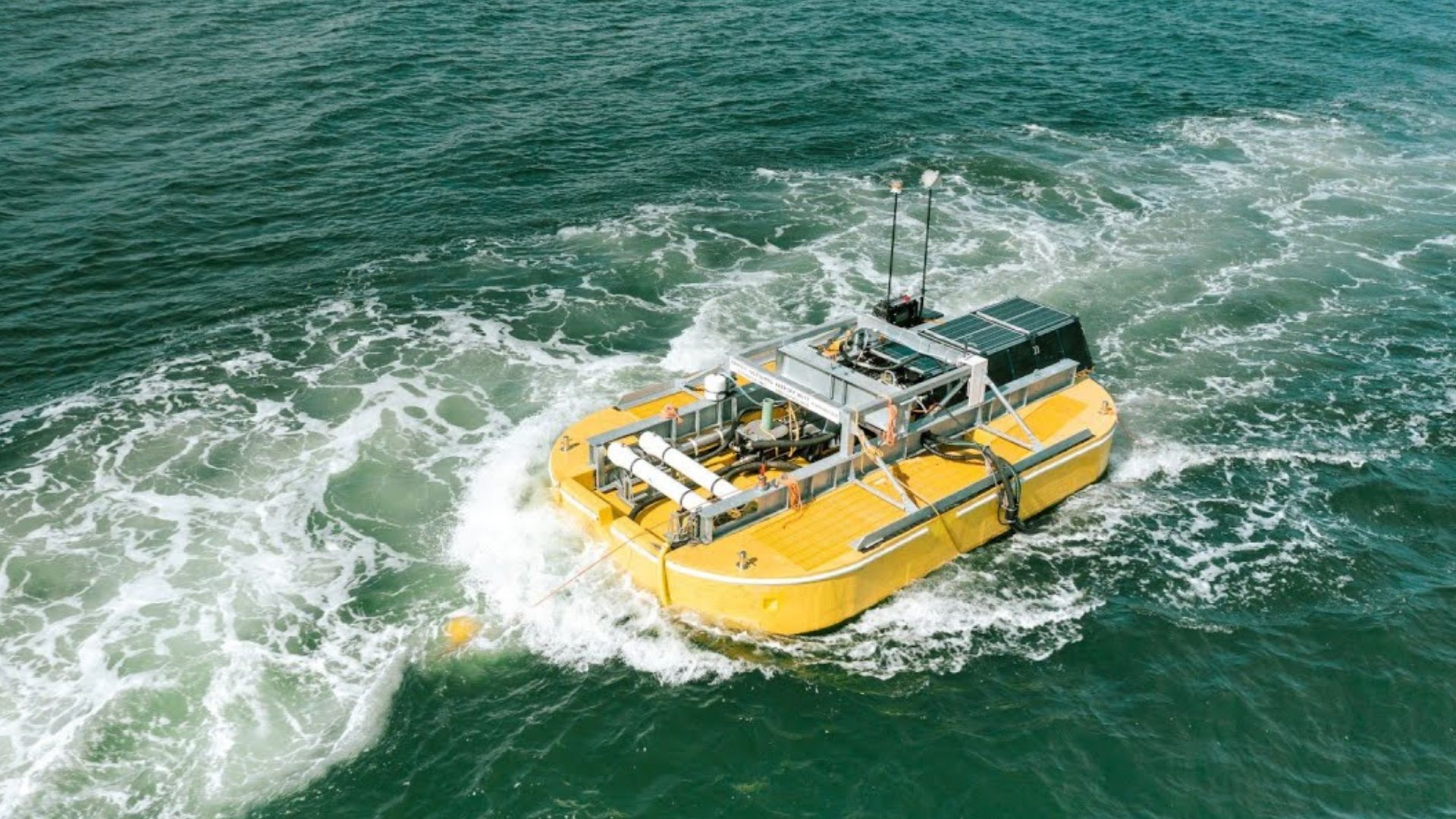


Floating system uses wave power to desalinate seawater and produce up to 50,000 liters of fresh water per day without an electricity grid.
While countries invest billions in land-based desalination plants, Canadian Oneka Technologies, from Sherbrooke, decided to test a different approach to produce drinking water in the ocean. Instead of relying on large industrial facilities powered by conventional electricity, the company developed floating buoys that use wave energy to pressurize seawater and transform it into fresh water, a technology described by Oneka itself as a desalination system powered by the natural movement of the ocean.
The project gained momentum in California with the partnership between the company and the city of Fort Bragg, presented on July 23, 2023 as the state’s first wave-powered desalination demonstration site.
The system uses an Iceberg-class desalination buoy platform, installed directly in the sea, capable of producing an average of 13,200 gallons of fresh water per day, equivalent to approximately 50,000 liters daily, according to the city of Fort Bragg pilot project and the technical letter from the California environmental agency published on August 29, 2025. The most important differential is that the buoy reduces dependence on land-based electricity in the desalination process, using the constant force of waves to pump and pressurize saltwater, in a 12-month test that may indicate whether this floating model has the scale to reinforce the supply for coastal communities vulnerable to drought.
-
China Develops Custom 140-Ton Electric Mining Truck with 770 kWh Swappable Battery, Deploys 290 Units in Xinjiang’s Largest Zinc Mine

-
Meta to Launch Arena, a New Prediction App Targeting 3.56 Billion Users, Competing with Polymarket and Kalshi

-
Scientist Challenges Famous Human Evolution Theory, Argues Homo Sapiens Evolved Gradually Over Thousands of Years
-
15-Year-Old American Builds Ocean Generator with PVC Pipe and 3D-Printed Propeller for $12, Wins National Prize, Presents at White House, and Makes Forbes 30 Under 30 List




Desalination buoys use the ocean’s own force to produce fresh water
The operation of Oneka’s buoys is based on a relatively simple principle, but little explored on a large scale. Instead of using giant electric motors to push seawater through industrial membranes, the system uses the natural movement of waves to generate hydraulic pressure.
When waves move the buoy up and down, internal mechanisms convert this mechanical displacement into pumping energy. This pressure forces saltwater through reverse osmosis membranes, separating the salt and producing fresh water ready for distribution.


The ocean itself simultaneously provides the raw material and the energy needed for the process, eliminating part of the electrical infrastructure normally required by large land-based desalination plants.
Floating system can produce up to 50,000 liters per day
According to data released by the company and local California authorities, the Iceberg-class buoy has an estimated capacity of approximately 13,200 gallons of desalinated water daily. Converting the numbers, this represents about 50,000 liters of fresh water produced per day under ideal operating conditions.
Although this volume is still much smaller than large industrial plants in the Middle East, it would already be sufficient to supply small coastal communities, isolated facilities, or regions vulnerable to water scarcity.

Furthermore, Oneka works with a modular concept. This means that several buoys can operate together, forming true “floating desalination farms.” The idea is to expand production simply by adding new units to the marine system without the need to build enormous industrial plants on land.
Technology aims to reduce the enormous energy consumption of traditional desalination
Today, conventional desalination primarily relies on large-scale electricity-powered reverse osmosis systems. In many countries, these plants represent one of the largest energy consumers within the national water infrastructure.
The process requires extremely powerful pumps to generate enough pressure to force saltwater through microscopic membranes. This makes the production of desalinated water remain relatively expensive in many parts of the world.

Oneka’s proposal aims to tackle precisely this problem. By using the mechanical energy of waves instead of land-based electricity, the company seeks to drastically reduce operational costs and the energy footprint of potable water production.
Buoys are installed directly in the ocean without occupying giant coastal areas
Another important differential involves the location of the infrastructure. Traditional plants normally occupy enormous coastal areas and require complex water intake and disposal works.
Oneka’s buoys operate directly at sea, reducing the need for large land-based structures. Desalinated water can be sent ashore through relatively compact submarine pipelines.
According to the company, this reduces visual impact and simplifies part of the coastal licensing process. The system was also designed to withstand severe marine conditions and operate continuously in open sea.
In practice, the project attempts to transform parts of the ocean into autonomous freshwater production stations scattered along the coast.
System uses reverse osmosis like large industrial plants
Despite the innovative format, the core desalination technology remains reverse osmosis. The process uses special membranes capable of blocking salt molecules while allowing water to pass through.
The big difference lies in the origin of the hydraulic pressure. Instead of industrial electric motors, the pressure comes directly from the mechanical movement of ocean waves.

According to Oneka, this allows combining already consolidated desalination technology with a practically continuous renewable energy source in coastal regions.
The system attempts to unite ocean engineering and desalination in a single floating infrastructure with low energy consumption.
California became a laboratory for a new generation of maritime desalination
Iceberg-class tests began to attract attention especially in California due to the increasing water pressure faced by the state in recent years. Prolonged droughts and population growth led local authorities to seek alternatives to reinforce water supply.
According to Mendocino Voice, the system began testing near the city of Fort Bragg in an approximately 12-month pilot project. The objective is to evaluate the technology’s real performance under continuous ocean conditions.

California already operates some of the largest desalination plants in the United States. Even so, new solutions continue to be studied due to the growth in water demand in the state.
The test transformed the Californian coast into a real laboratory for desalination systems powered by the sea’s own waves.
Desalination became a strategic priority in various parts of the planet
The advancement of water scarcity has made desalination gain increasing strategic importance in recent decades. Countries like Saudi Arabia, the United Arab Emirates, and Israel already heavily rely on seawater transformed into potable water.
In some regions of the Middle East, a large part of the urban water supply already comes from desalination plants. The problem remains high energy cost and the need for gigantic infrastructure.
This has spurred an international race for cheaper, more efficient, and sustainable models. Oneka’s buoys appear precisely within this new generation of technologies attempting to reinvent global freshwater production.
Ocean waves can become an invisible energy source for drinking water
Oceans store an enormous amount of mechanical energy in the form of continuous waves. For decades, engineers have tried to transform this movement into usable electricity or hydraulic power.
Oneka decided to apply this concept directly to drinking water production. Instead of first converting waves into electricity, the system uses the maritime movement directly to pressurize saltwater.
This reduces intermediate energy losses and simplifies part of the infrastructure. The natural movement of the sea itself now functions as an “invisible engine” for floating desalination.
Project shows how water infrastructure can migrate to the ocean
Much of modern water infrastructure has been built on land. Reservoirs, pumping stations, and plants occupy enormous urban and industrial areas.
Oneka’s buoys point to a different possibility: shifting part of water production directly to the ocean using autonomous and decentralized structures.

If systems of this type evolve, coastal regions may in the future operate entire networks of floating platforms continuously producing fresh water.
The Canadian project suggests that the ocean may cease to be merely a source of saltwater and begin to function as an active platform for global water production in the coming decades.
Given this type of technology, do you believe that wave-powered floating systems will be able to compete with large traditional desalination plants in the future, or will land-based megastructures continue to dominate global drinking water production?







