






 Portuguese
  Spanish
  6 min of reading
  4 comments


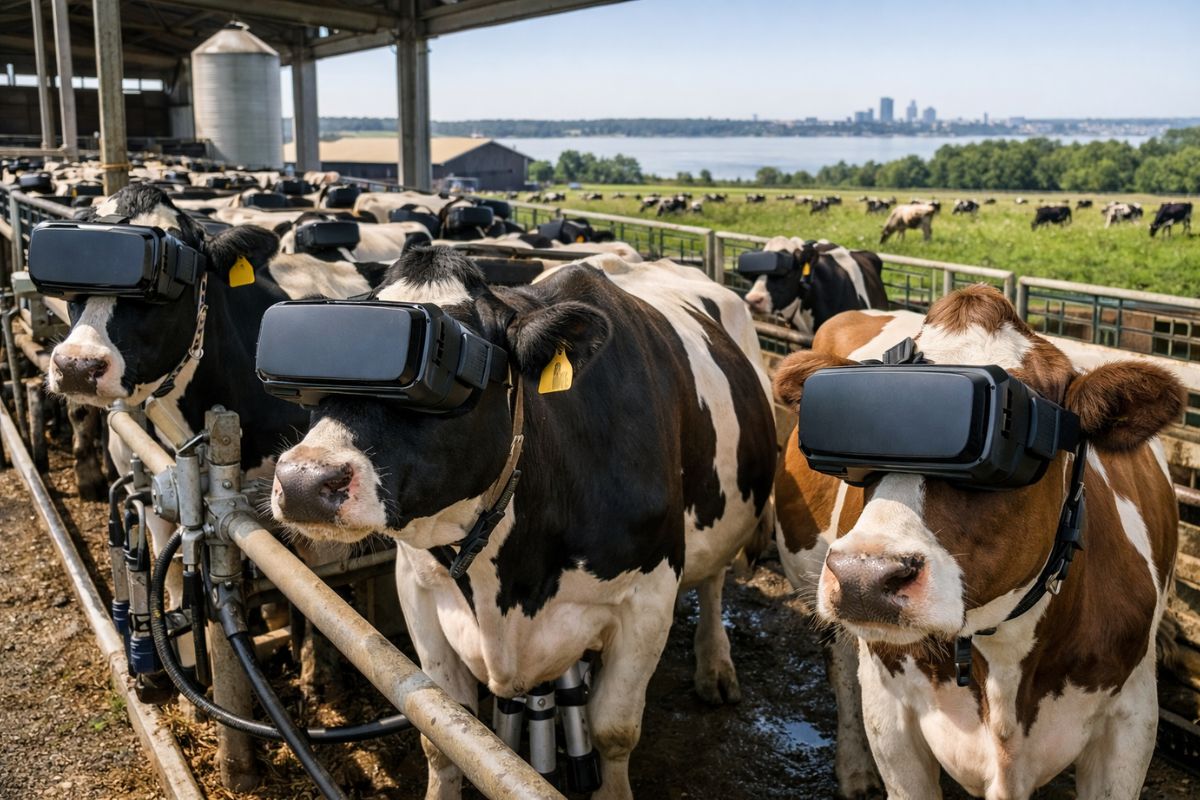


In Dairy Farms, Cows Wear Virtual Reality Glasses to Improve Animal Welfare, Boost Milk Production and Show How Virtual Reality in the Field is Already Part of Everyday Life.
Cows wear virtual reality glasses on farms in Turkey and Russia, and at first glance, the scene seems like a joke or internet prank. But behind the curious images is a real experiment, with concrete numbers: a cow that produced 22 liters per day began delivering 27 liters of milk after starting to wear the equipment, with green pastures projected before their eyes.
The goal is both simple and ambitious. By making cows wear virtual reality glasses and see a more pleasant scenario than the real environment, producers aim to reduce stress, improve well-being and consequently increase milk production and product quality. The technology transforms what was once mere curiosity into a new frontier for dairy farms.
Why Cows Wear Virtual Reality Glasses on Farms

The idea that cows wear virtual reality glasses was born from a combination of science, economic necessity, and technological boldness. Producers and researchers started from a known point: the environment directly affects the health, mood, and productivity of dairy cows.
-
Helicopter Drops 180 Tons of Sand and Gravel on Swedish River to Revive Ecosystem Damaged by Decades of Exploitation

-
Brazilian Company Launches Retro Smartphone with 48 MP Camera, T9 Keyboard, and Privacy Features for Social Media-Free Use

-
Self-Taught Chinese Farmer Builds 5-Ton Submarine from Scrap, Launches It in Anhui River
-
Invisible Induction Technology Enables Wireless Power for Blenders, Coffee Makers, and Air Fryers, Reducing Countertop Cables



Studies conducted by a university in the Netherlands reinforce this relationship between environmental conditions, well-being, and herd performance. Pleasant pastures, milder weather, less noise, and careful management tend to reduce stress and increase both the volume and quality of milk.
From this, the question arises: if the real environment cannot always be perfect, why not create a more comfortable virtual environment for the animals? This is precisely where the technology comes in that makes cows wear special glasses designed to display images of green fields, open skies, and vast landscapes, even when the day is overcast or the physical space is limited.
From Russia to Turkey: When the Experiment Becomes Practice
The use of virtual reality in dairy cattle gained attention from an experiment conducted near Moscow, Russia, in 2019. There, technicians and veterinarians began testing adapted glasses for cattle, with images designed for the way cows perceive colors and depth.
The experiment inspired other producers. In Turkey, farmer Izzet Kocak decided to bring the idea to his property, where he takes care of over 180 dairy cows in a family that has been in agriculture for three generations.
Instead of just observing from afar, he put the concept into practice and began testing in his own routine what happens when cows wear virtual reality glasses.
Initially, Kocak applied the experiment to only two cows from the herd. The animals began to use the glasses to see wide, peaceful pastures while remaining in the barn.
With the first positive results, the producer stated that he intends to acquire more devices to expand the test, investing in at least ten more glasses in the future.
What the Glasses Are Like and What the Cows See
The devices used when cows wear virtual reality glasses are not hurriedly adapted human versions.
They are custom-designed for the shape of the bovine head, with support at specific points and adjustments that prevent discomfort and accidents.
Developers worked together with production consultants and veterinarians to ensure that the equipment was safe and functional.
One of the central points was to respect how cows perceive colors. These animals distinguish certain shades better, especially certain ranges of red, than greens and blues.
With this in mind, virtual reality specialists created a specific field simulation program for bovines, with contrasts, depth, and tones designed to create the sensation of an open and pleasant environment.
When cows wear glasses of this type, they start to see a calm, well-lit, and green pasture, even though in practice they are in a closed stable, on a gray day, surrounded by other animals.
Well-Being, Classical Music, and Controlled Environment
Izzet Kocak’s strategy goes beyond the simple fact that cows wear technological glasses. On the Turkish farm, virtual reality is combined with other resources to create a more relaxing environment.
One of these is the use of classical music as a soundtrack in the barn, an increasingly common practice on properties that focus on animal well-being.
The logic is clear: the less stress, the better the cow’s physiological response, which includes feeding, resting, rumination, and ultimately, milk production.
By combining visually pleasant stimuli provided by the glasses with softer sounds and a controlled environment, the producer tries to create a complete comfort package.
In this context, when cows wear glasses and interact with this sensory environment, the goal is not to “deceive” the animal but to create an experience closer to an ideal pasture even in less favorable climatic or structural conditions.
For the producer, it is a way to bring technology and well-being closer, without compromising economic results.
How Much More Milk? The Results Measured on the Farm

The question every producer asks is straightforward: besides seeming something futuristic, what happens in practice when cows wear virtual reality glasses? In Kocak’s farm, the initial numbers are striking.
One of the cows in the experiment produced an average of 22 liters of milk per day before using the glasses. After adopting virtual reality, the same cow began to deliver 27 liters daily, an increase of 5 liters in production. In addition to the greater volume, the producer reports reduced stress and perceived improvement in milk quality.
These results reinforce the scientific basis linking environment, well-being, and productivity. The Russian Ministry of Agriculture and Food itself cited research pointing out the connection between the cow’s emotional experience and its productive performance.
In other words, calmer cows tend to produce more and better, and virtual reality emerges as an additional tool in this effort.
It is important to remember that the test still involves only two cows in a herd of 180 animals. Nonetheless, the positive performance helps explain why more and more people are talking about farms where cows wear glasses as part of daily management.
Limits, Questions, and the Future of Dairy Farms
Although the idea of cows wearing virtual reality glasses is exciting, it also raises questions. The equipment has costs, requires maintenance, software adjustments, and constant monitoring by veterinarians and technicians.
It is necessary to assess whether the productivity gains justify the investment in the long term.
Moreover, ethical and practical debates still exist. To what extent is it healthy to continuously alter the animal’s visual perception?
How many hours a day can or should cows wear the glasses? How can we ensure that all devices are properly adjusted and cleaned to avoid irritations or accidents?
What seems clear is that the integration between technology and agriculture is likely to deepen in the coming decades.
The experience of cows wearing virtual reality glasses is just one example of how innovation, science of animal welfare, and data management are beginning to reshape dairy farms.
This bold step towards a more technological livestock farming was highlighted in a report on the site Compre Rural, which presented details of the experiment, numerical results, and the producer’s perspective.
The initiative shows that, increasingly, dairy farms can become true laboratories of innovation.
And you, producer or consumer, what do you think of the idea that cows wear virtual reality glasses to see green pastures and produce more milk: necessary technology for the future or exaggeration in the quest for productivity?




E um absurdo isso uma judiaria com animais cada vez mais o povo pede a noção com os animais cadê os protetores dos animais e uma judiaria sem noção usem vcs os óculos pra dizer que estão comendo
Isso parece falso e IA
As duas primeiras vacas tem as testemunhas na frente.
Eeeee IA!