






 Portuguese
  Spanish


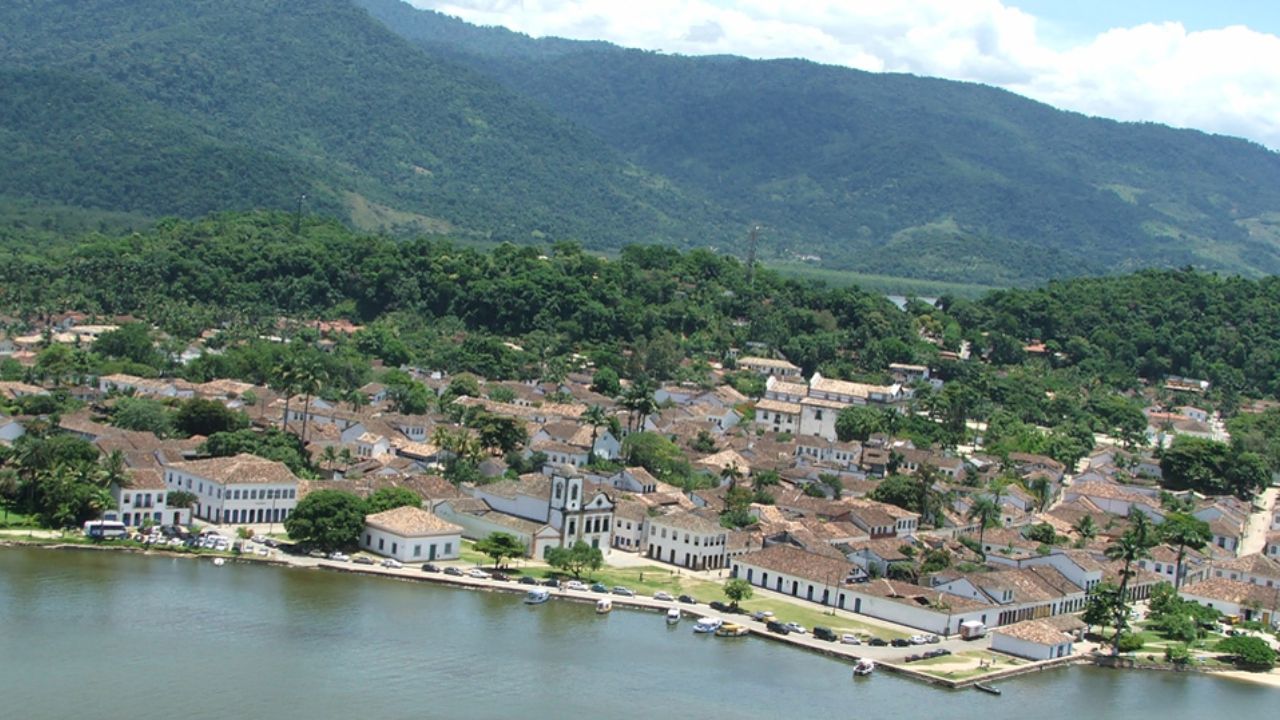


Discover How the Car Ban and Colonial-Style Lighting Transformed This Colonial Town into an Authentic Journey to the 18th Century, Uniquely Preserving Its History.
Crossing the boundaries that define the Historic Center of Paraty is like crossing an invisible portal to the heart of a unique colonial town. The buzz of the modern world recedes, replaced by the soft and irregular percussion of footsteps on ancient stones, the famous “cobblestone floor”. This is not a town to be visited in haste; it imposes its own rhythm, a leisurely cadence that invites contemplation, where the experience quickly becomes a complete sensory immersion.
During the day, the tropical light enhances the white of the walls and the vibrant colors of the doors and windows. At night, a magical transformation occurs. The sunset gives way not to glaring electric lights, but to a warm and flickering glow emanating from colonial-style lanterns. This light casts long, dancing shadows that preserve an ambiance of centuries past. Paraty is not a place to merely see; it is an atmosphere to inhabit, an authentic journey through time made possible by a rare combination of history, geography, and a collective desire for preservation.
An Open-Air Museum: Architecture and Lighting
The illusion of time travel in Paraty is not by chance, but the result of a deliberate design, both historic and contemporary. The urban layout, an almost perfect chessboard, creates a fascinating contrast with the organic curves of the bay and the mountains of the Serra do Mar. The cobblestone pavement itself, with its irregular stones, enforces a slower and more conscious rhythm, sharpening the perception of the surroundings and tuning the visitor into a more contemplative era.
-
Billionaire says the most valuable skill will help overcome job elimination caused by AI, following Bill Gates’ fears

-
A Dutchman created a ‘box’ that makes trees grow in the desert almost without water and without irrigation: the invention has already brought seedlings to dozens of countries and achieves up to 90% survival where common planting did not exceed 10%.

-
Abandoned warehouse hid a giant collection of rare computers, with over 2,000 artifacts from the 1930s to the 1980s.
-
Scientists warn that melting ice is triggering an alarming chemical transformation in preserved areas, and the first signs are already concerning researchers worldwide.




The element that completes this atmosphere is its lighting design. As detailed in the technical article “Paraty, RJ: The Light in Its Right Place” by Lume Arquitetura, the initiative started in 2000 aimed to eradicate the “visual pollution” of modernity. Poles, overhead wiring, and transformers were removed and replaced with an underground electrical network. This invisible infrastructure feeds the colonial-style lanterns that today define the night landscape. The result, according to the source, is a soft, yellowish light that highlights the texture of the pavement and bathes the historic facades in a warm glow, evoking the pre-electric era and making the time travel illusion much more powerful.
The Paradox of Paraty: How Isolation Ensured Preservation
To understand why Paraty is as it is, one must dive into its history of rise, fall, and rebirth. With the discovery of gold in Minas Gerais in the late 17th century, the town became the nerve center of the Gold Road, the official route through which Brazil’s vast wealth flowed to Portugal. It was this torrent of gold that financed the construction of the imposing mansions and baroque churches that still define its landscape today.
Prosperity, however, was fleeting. In the mid-18th century, the Portuguese Crown opened a new route to Rio de Janeiro, and the town fell into decline. This trajectory is detailed by the portal Paraty.com.br in the article “Paraty: From Trading Post to World Heritage Site.” The source explains that the construction of railways and the Abolition of Slavery in the 19th century deepened the crisis, causing the population to plummet. Paradoxically, this economic ruin was its salvation. Without resources and external interest, there was no modernization. The town became frozen in time, perfectly preserved in its abandonment, which, ironically, would become its greatest asset in the age of tourism.
Living Culture: The Pulsating Heart of the City


The soul of Paraty lies not only in its stones but in the vibrant culture that pulses in its streets. The four main colonial churches in the Historic Center tell the story of the rigid social stratification of the time, with distinct temples for the white elite, free mulattoes, women of the aristocracy, and the enslaved. This heritage is manifested today in a world-class cultural calendar, ranging from the traditional Feast of the Holy Spirit to the internationally acclaimed Bourbon Festival Paraty.
The highlight event is undoubtedly the International Literary Festival of Paraty (FLIP), which has established itself as one of the most important literary festivals in the world since 2002. Besides its cultural impact, FLIP is a vital economic engine for the region. This cultural effervescence, combined with the richness of local gastronomy and the traditions of the caiçara communities, makes the experience in the town even deeper and more authentic, connecting visitors not only to the architectural past but also to a culturally rich and dynamic present.
World Heritage: The Pact Between Man and Nature
The unique atmosphere of Paraty is the result of a continuous pact to protect its exceptional character. In 2019, the city and the Ilha Grande region received the highest honor of global preservation, being inscribed on the UNESCO World Heritage List as a “Mixed Site”, recognized for both its cultural and natural values. According to IPHAN (National Historical and Artistic Heritage Institute), what makes this designation special is the recognition of an “exceptional and continuous interaction between human culture and the environment”.
IPHAN emphasizes that, unlike other sites, the value of Paraty lies in its “living culture”, represented by traditional indigenous, quilombola, and caiçara communities that coexist in harmony with the preserved Atlantic Forest. This protection materializes in policies such as the strict ban on vehicle traffic in the Historic Center, a measure that preserves the pavement, reduces pollution, and ensures sensory immersion. It is proof that the past, when well-managed, can be the greatest economic and cultural asset for the future.
Paraty is an example of how rigorous preservation can become the greatest attraction of a city. But what is your opinion on this experience? Have you ever visited a place that transported you back in time like this? Share your story in the comments and share your impression of this gem of Brazil!





