






 Portuguese
  Spanish
  3 min of reading
  0 comments


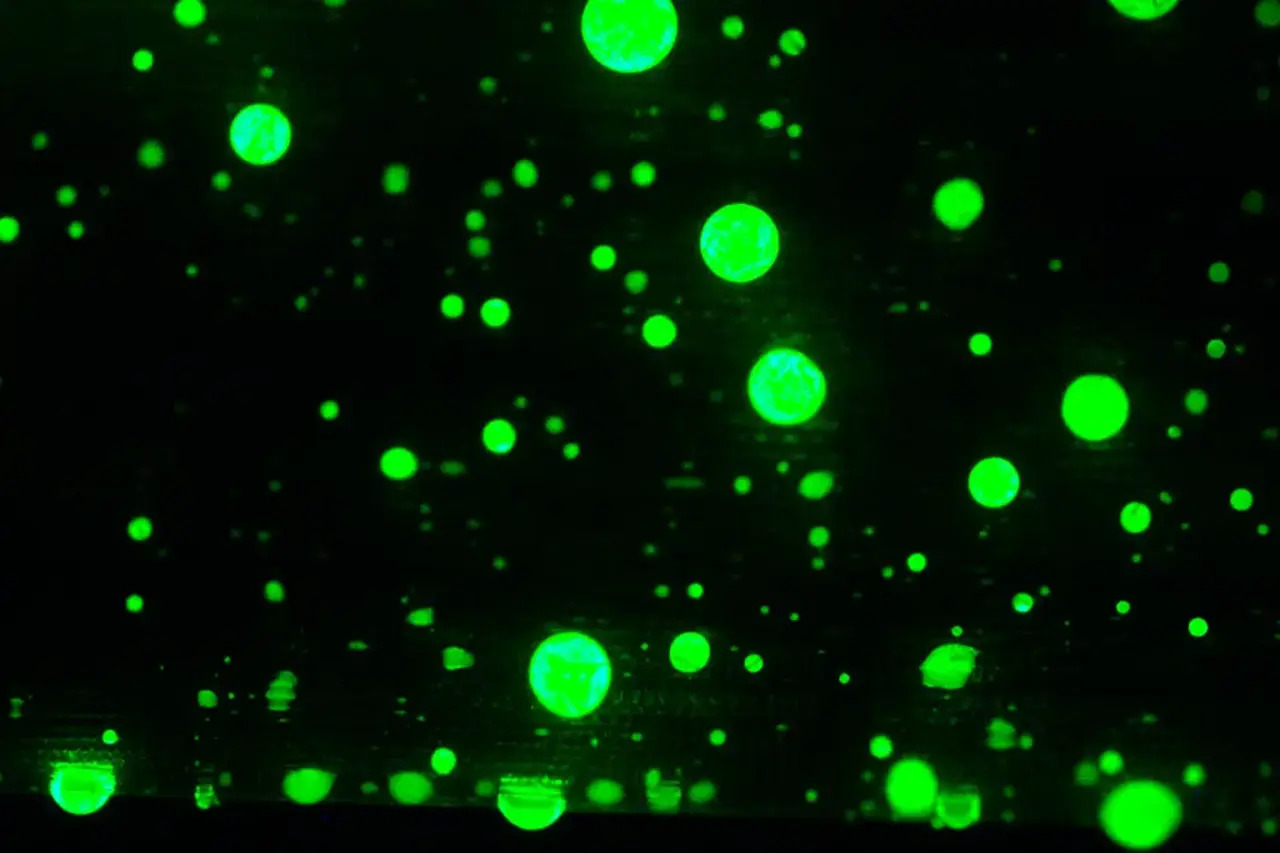
Scientists Create Edible Laser Using Kitchen Oil Drops to Monitor Food and Medicine Safely and Innovatively
Scientists from Greece and Slovenia have created a laser made from kitchen oil. Yes, the same oil we use for frying potatoes or dressing salads.
The innovation, published in the journal Advanced Optical Materials, represents a curious and practical advancement. The goal? To create edible sensors that can be used to monitor properties of food and medicine.
The basis of the laser is simple: small drops of edible oils act as light chambers. And that’s all a laser needs to function. In this case, the scientists tested oils such as sunflower and olive oil.
-
Helicopter Drops 180 Tons of Sand and Gravel on Swedish River to Revive Ecosystem Damaged by Decades of Exploitation

-
Brazilian Company Launches Retro Smartphone with 48 MP Camera, T9 Keyboard, and Privacy Features for Social Media-Free Use

-
Self-Taught Chinese Farmer Builds 5-Ton Submarine from Scrap, Launches It in Anhui River
-
Invisible Induction Technology Enables Wireless Power for Blenders, Coffee Makers, and Air Fryers, Reducing Countertop Cables



How It Works
The operation of the laser begins with atoms. When they receive energy, their electrons jump to a higher level.
Then, they relax and return to the initial level, releasing photons – particles of light. This process can repeat several times.
If we place the atoms in a chamber with mirrors, the back and forth of the photons grows until it forms a strong, concentrated beam of light.
This beam is what we call a laser. By the way, the word “laser” is an acronym in English: light amplification by stimulated emission of radiation.
In common devices, such as red laser pens, the materials used to form the chamber include aluminum, gallium, and arsenic.
But the scientists wanted something that could be ingested safely. Therefore, they used edible materials.
Edible Experiments
The team led by Abdur Rehman Anwar tested more than ten edible ingredients. The goal was to see which could form mini reflective chambers. In one of the tests, they shone purple light on drops of olive oil.
The result was surprising: the chlorophyll molecules present in the olive oil responded by emitting photons. And thus, an edible laser was created.
The key was in the oil drops. The size and density of each drop directly influenced the behavior of the laser. This opened up new applications.
What Is This Laser For?
The researchers tested the laser on food. By inserting oil drops into products, they were able to measure how the light changed.
This allowed them to detect acidity, sugar concentration, the presence of microorganisms, and even whether the food had been exposed to high temperatures.
In other words, the laser can be an analytical tool within the food itself. And best of all: it can be ingested along with the product, without causing harm.
Edible Code
In addition to measuring properties, the edible lasers were also used to encode information. The scientists used drops of oil with different sizes to create a kind of barcode.
In the final test, they placed these drops in a jar of peach compote. Each drop was less than 100 microns in diameter.
With this, they encoded the date “April 26, 2017,” marking the first International Day of Action Against Food Waste.
The experiment shows that it is also possible to store data in food, using only oil and light.
With information from Super Interessante.




-

-

2 people reacted to this.