






 Portuguese
  Spanish
  3 min of reading
  1 comment


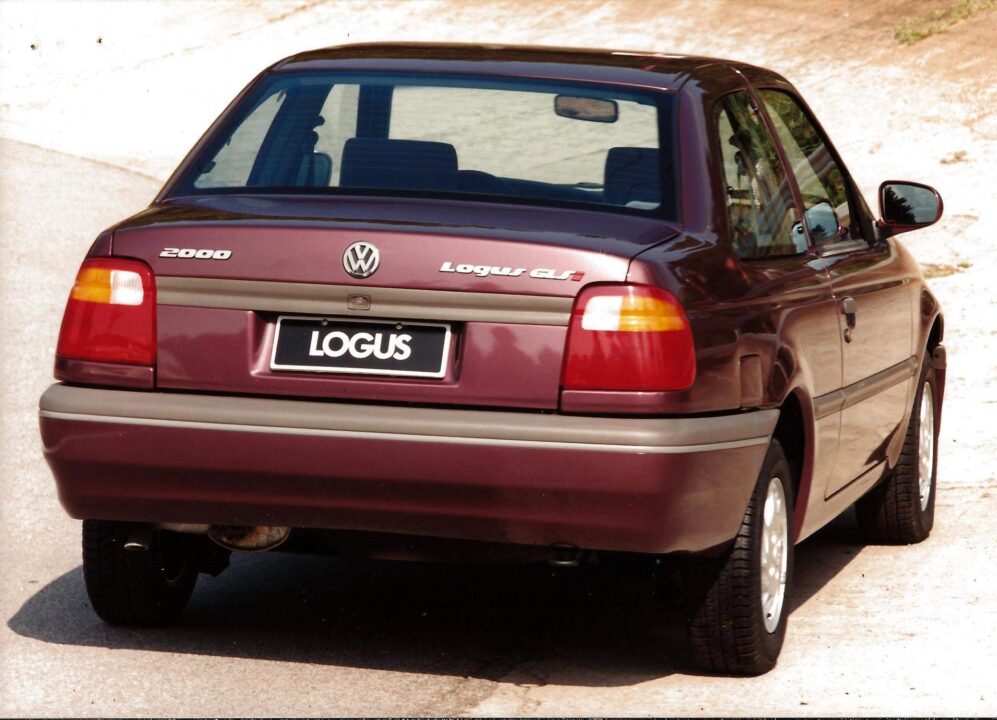

Meet the VW Logus CL 1.6, an affordable car by VW in partnership with Ford that still impresses. The VW Logus conquers drivers by achieving up to 16 km per liter.
Autolatina was a joint venture that emerged in the 1980s focused on integrating the operations of Ford and Volkswagen, sharing costs and leveraging each other’s strengths. This partnership brought some interesting products under the Ford or VW brands in both Brazil and Argentina, among them the VW Logus, a mid-size affordable car that replaced the Apollo, which, in essence, was a Ford.
How Did the VW Logus CL 1.6 Come About?
The Volkswagen Apollo debuted in 1990 as a fraternal twin of the Ford Verona. It’s true that the Ford was launched a little earlier, in late 1989, and while the VW had its differences, they were so minor that they went unnoticed by the less attentive eyes.


In 1992, it was discontinued, making way for a success designed on the same platform as the Ford Verona/Escort, but now of the fifth generation: it was the Logus. Being larger, more attractive, and more modern than the Apollo, the affordable car found favor with consumers, who had the option of a mid-size sedan with the feel and space of a large car.
-
Uber Faces Shareholder Scrutiny as Board Accused of Ignoring Safety, Compliance, and Harassment Warnings Amid Over 3,500 U.S. Lawsuits

-
Ferrari’s First Electric Car Divides Fans, Priced at $630,000, Amid Concerns Over Limited Editions; Brand Clarifies It’s Not Just for Future Perks
-
BYD Dolphin Mini: The Electric Car That Defies Depreciation, Losing Only 3.58% in a Year and Becoming the Best-Selling Retail Model Under $22,000

-
Electric Car JAC E-JS4 Loses $19,000 in Value in One Year, Leading Record Depreciation of Used Cars in Brazil Due to Expensive Battery and New Models


Launched in 1993, the VW Logus reached stores in the CL 1.6 or 1.8 and GLS 1.8 versions, boasting a good dose of comfort and fuel economy in all of them. With engines positioned transversely, the affordable car offered plenty of interior space, both for those traveling in the front and in the back seat, and its low front and high rear evoked the best imports of the time. Even sharing the mechanical base with the Escort, the VW Logus CL 1.6 had its own personality and strong selling points, such as a trunk capacity of 416 liters.
VW Logus CL 1.6 Delivered Up to 16.4 km/l
In the simpler CL version, the sedan came standard with the AE-1600 engine, of Ford origin, better known as CHT. The engine was available only in the gasoline variant: thus, it had a dual-barrel carburetor and provided 73.4 hp at 5,600 RPM with 11.9 kgfm of torque at 3,400 RPM, managing to take the Logus from 0 to 100 km/h in 16.5 s, reaching up to 157 km/h.
Remarkably, the fuel consumption reached 9.7 km/l in the city and 16.4 km/l on the highway, allowing a maximum range of an impressive 1,050 km thanks to its 64-liter tank.
The poorer cousin of the more luxurious versions, the VW Logus CL 1.6 had the same design but with a spartan appearance. The wheels were stamped steel with plastic center hubcaps and 175/70R13 tires (no alloys or fancy hubcaps). Electric locks, mirrors, or windows and power steering were not available, even as options, although there was already the “luxury” of sound installation included as standard.
Affordable Car Offered Great Interior
Even being simple, the VW Logus CL 1.6 offered comfort, with front seats adjustable for distance and backrest angle, made with a very ergonomic structure and pleasant-to-touch fabrics. These fabrics were also found in part of the door trims, a luxury nowadays. The glove compartment had cup holders, and its rear seat had a reclining backrest.
With the same foam steering wheel as the other models in the line, the piece had a great grip, while a modern instrument panel offered a speedometer, engine temperature gauges, and fuel level, along with an analog clock. The front seatbelts had height adjustment on the pillar, while the mirrors came with internal adjustment.





Tive um desse muito bom. Mais atualmente a manutenção dele e muito caro e suspensão não e aquelas coisas