






 Portuguese
  Spanish
  5 min of reading
  0 comments


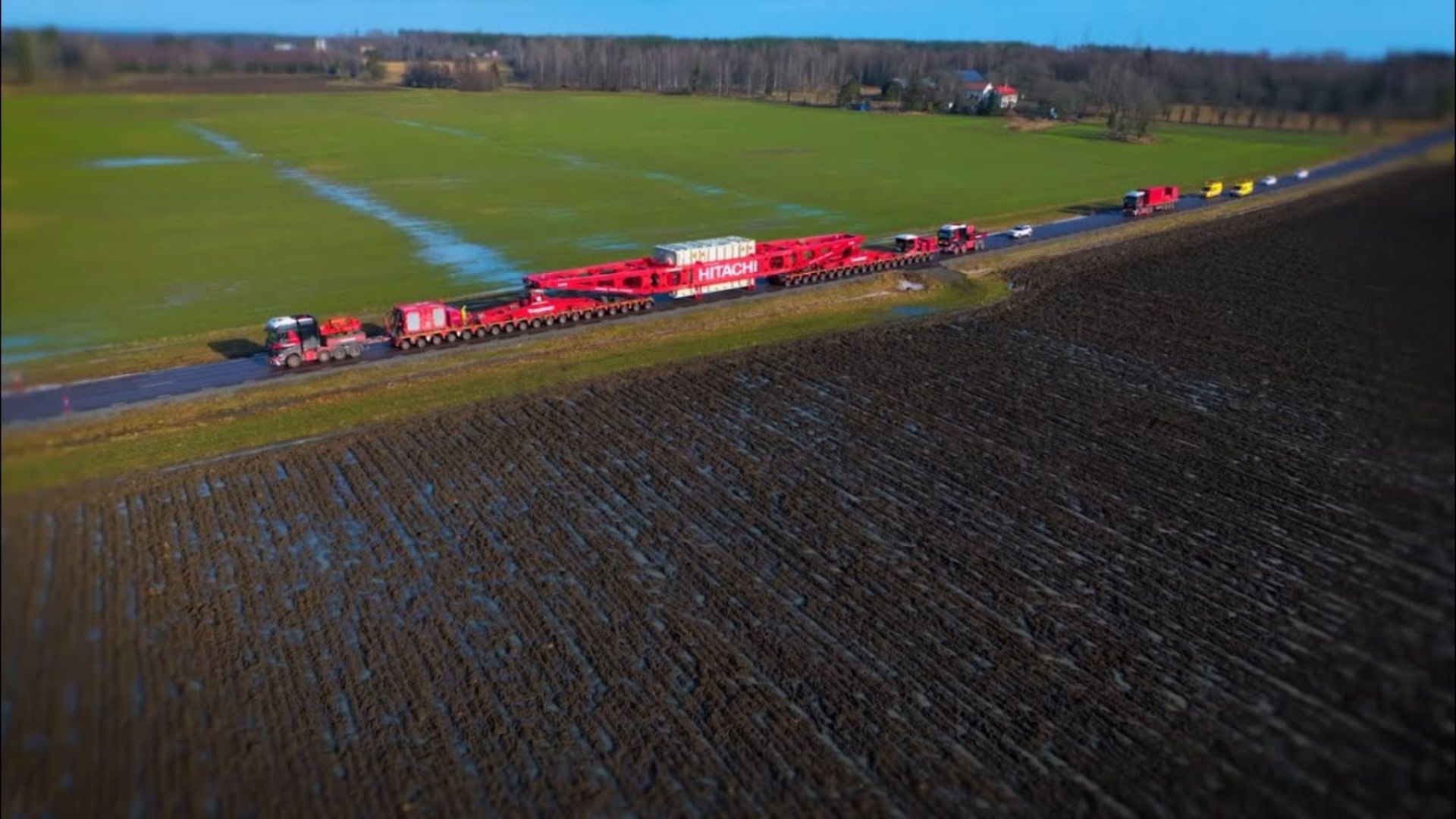
To remove the giant from the factory and take it to the port, it was necessary to assemble a train almost 100 meters long on dozens of axles. The destination is one of the most advanced energy lines on the planet, which will carry solar and wind energy from the Chinese desert to coastal cities, thousands of kilometers away.
Weighing 820 tons in transport, the largest direct current transformer ever manufactured in the world left Sweden for China. According to the manufacturer, the equipment left the Hitachi Energy factory in the city of Ludvika, in the heaviest shipment ever carried out by the unit, and will equip a transmission line that will carry renewable energy for more than 2,300 kilometers within Chinese territory, connecting desert-producing regions to major consumer centers.
The departure was celebrated by the company in May 2026, ending a manufacturing stage that, according to Hitachi Energy, marked a milestone in its history. A technical clarification is worth mentioning right from the start: the 820 tons refer to the total weight of the transport, adding the transformer and the entire vehicle structure used to move it, and the title of “largest in the world” refers to a specific category of this type of equipment, the high-voltage direct current converter transformer with VSC technology, as we will detail below.
What is this giant transformer
Behind the record is a piece of equipment of extremely high technological complexity.
-
Survivor of 1966 SS Daniel J. Morrell Shipwreck in Lake Huron Recounts 38-Hour Ordeal in Extreme Cold

-
The Greatest Hoax in World Cup History? The Film That Denied Brazil’s 1958 Victory and Exposed How Fake Evidence Can Seem Convincing on TV
-
Fake South Korean Online Stores Offer Shopping Thrill Without Spending Money or Receiving Products
-
The War of Jenkins’ Ear: How a Severed Ear Sparked One of the 18th Century’s Most Unusual Conflicts


It is the largest high-voltage direct current converter transformer with VSC technology ever built, with a capacity of 750 MVA and designed to operate at a voltage of about 800 kV, which, according to Hitachi Energy, makes it incomparable in power, size, and weight within its category.
This type of transformer is a key component in high-voltage direct current transmission systems, known by the acronym HVDC, which allow large amounts of energy to be transported over long distances with reduced losses.
According to the engineering team responsible, consisting of 16 people, the new equipment is about twice as powerful and has 60% more voltage than the last transformers of its kind delivered by the factory, highlighting the technological leap involved.
A transport that became a record
If building the transformer was already a challenge, taking it to the port was a separate operation.
With a total weight of 820 tons, including the vehicle, this was the heaviest transport to leave the Ludvika factory, requiring a combination of equipment that reached about 100 meters in length to navigate the narrow and winding road to the Swedish coast, on a carefully planned route.
To manage the tight turns and travel on narrow roads, the team had to adapt the transport solution, redistributing the load over dozens of special axles.
The transformer traveled by land to a port in Sweden and from there embarked on a ship bound for Shanghai, China.
The company itself highlighted that the success of the operation depended on collaboration between different teams and logistics partners, a compliment that, coming from the manufacturer’s material, should be read with the appropriate context.
The destination: one of the most advanced lines in the world


The transformer is not traveling by chance: it has a strategic destination.
The equipment will be part of the Gansu-Zhejiang project, a transmission line of about 800 kV and approximately 2,370 km in length, designed and built by the Chinese state-owned State Grid Corporation of China to deliver energy from the desert regions in the northwest of the country to the Zhejiang province in the east, where millions of consumers are concentrated.
The main goal of the project is to harness the enormous solar and wind energy potential of arid areas like the Gobi Desert, transporting this clean electricity over thousands of kilometers to urban and industrial centers.
According to the released information, the line is expected to deliver more than 36 billion kWh per year to Zhejiang, enough to meet the annual demand of about 10 million households, being pointed out as the first project of its kind to use VSC technology at both ends.
Why this technology matters for the energy transition
The case illustrates one of the biggest challenges of clean energy worldwide.
The best renewable energy sources, such as large solar and wind farms, are often located in remote regions far from cities, and this is precisely where high-voltage direct current transmission lines come in, capable of delivering this energy over thousands of kilometers with much lower losses than conventional lines.
The VSC technology mentioned in the project allows for precise control of the energy flow and helps stabilize the electrical grid in the face of typical fluctuations of solar and wind generation.
Not by chance, there is currently a strong global demand for this type of equipment, driven by the energy transition and the growth of sectors such as data centers, which has even led to a worldwide shortage of large transformers, according to the industry itself.
What this has to do with Brazil
Although the project is in China, the technology is well known to Brazilians.
Brazil is one of the world references in the use of high-voltage direct current transmission, precisely because it has the same Chinese challenge: generating energy far from major centers, such as in the Amazon hydroelectric plants, and needing to transport it thousands of kilometers to the consumer Southeast, as happens in the lines that carry the energy from Belo Monte.
Therefore, following advances like this record transformer helps to understand the future of electrical infrastructure here as well.
As the country expands its renewable generation, especially solar and wind in the Northeast, efficient transmission solutions become increasingly strategic to bring this clean energy to the entire national territory, connecting the abundance of resources in one region to the needs of another.
The journey of the largest direct current transformer ever manufactured in the world, from Sweden to China, is one of those stories that unite cutting-edge engineering, bold logistics, and the global effort for the energy transition.
More than a record of weight and size, the equipment symbolizes the challenge of delivering renewable energy over long distances, a problem Brazil knows well.
Meanwhile, as the world rushes to electrify everything with clean sources, colossal pieces like this show that behind every outlet, there is a gigantic and invisible engineering working to keep the lights on.
And you, did you ever imagine the size of the equipment behind the power lines that supply the cities? What did you think of this engineering and transport feat? Leave your comment, tell us what impressed you the most in this story, and share the article with those interested in energy, technology, and major infrastructure works.





Be the first to react!