
Understand when Antarctica was ice-free, how CO2 influenced freezing, and what this indicates about the global climatic future
Antarctica has not always been covered in ice, and this fact has drawn the attention of scientists for decades.
Currently, the continent is dominated by an extensive ice sheet several kilometers thick.
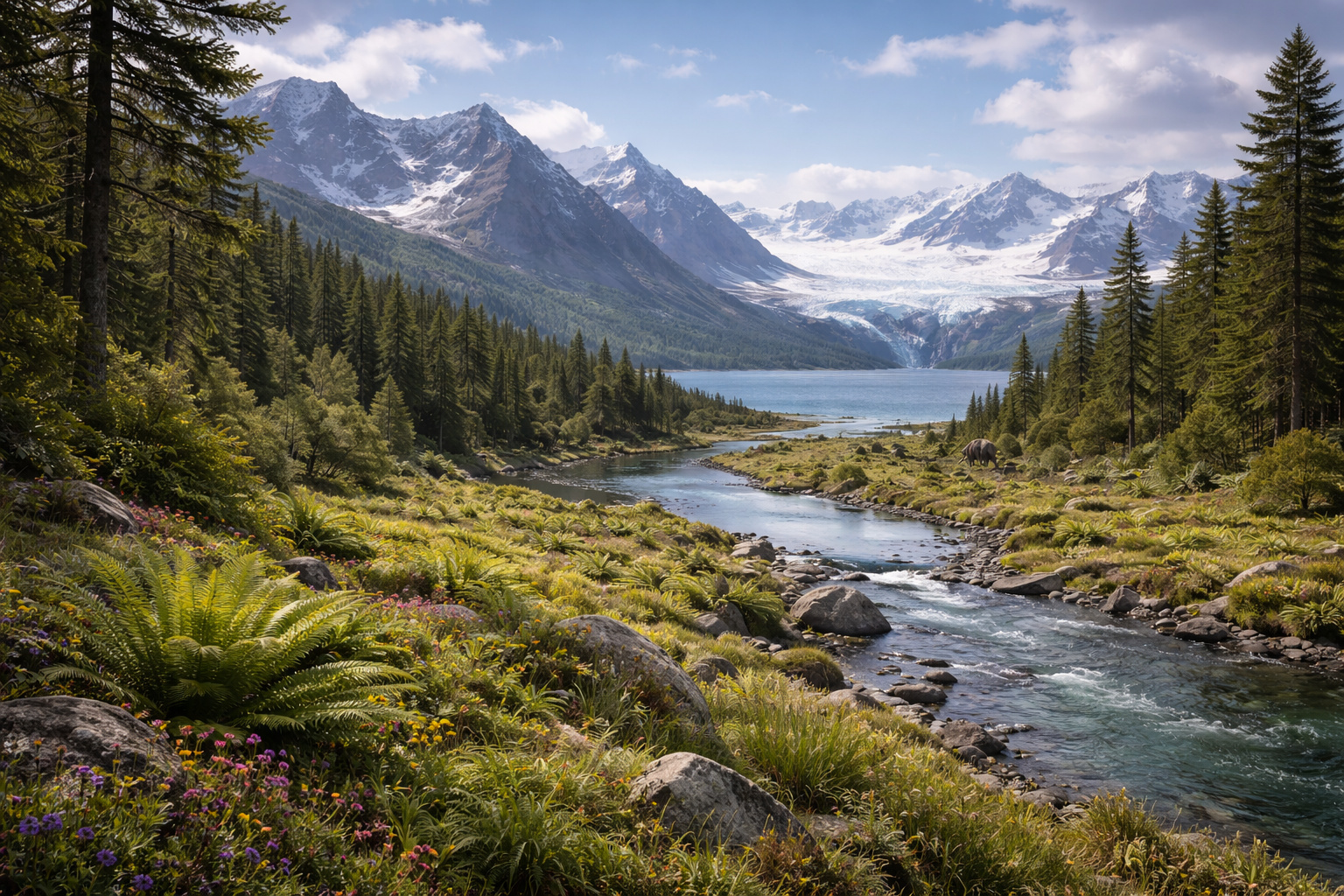
However, geological records analyzed by institutions such as British Antarctic Survey and NASA show that forests, exposed soils, and cold-adapted vegetation once existed in the region.
-
Australia deploys poisoned sausages and uses traps, shooting, and fences in a battle against invasive cats that kill over 1.5 billion native animals annually, threatening more than 200 species.

-
NASA Rover Captures “Tired Face” on Mars, Highlighting Human Brain’s Tendency to See Faces in Rock Formations

-
Ancient Stone City in the Desert, Once Home to 30,000, Puzzles Scientists with Nabateans’ Water Mastery 2,000 Years Ago

-
Ancient Creature Thought Extinct Since Dinosaur Era Reappears, Baffling Scientists



This transformation over millions of years helps explain how Earth’s climate evolves.
Furthermore, this data is essential for understanding the role of carbon dioxide (CO2) in the climate system.
Climate transition marked the end of ice-free Antarctica
The last time Antarctica was mostly free of ice was about 34.4 million years ago, during the transition between the Eocene and Oligocene.
Before this period, the planet had higher temperatures and did not have large permanent ice sheets.
Consequently, Antarctica exhibited landscapes similar to tundras and cold forests of the Northern Hemisphere.
In this context, diverse ecosystems developed, with species that are now extinct.
Thus, the continent had characteristics very different from today.


CO2 levels were decisive for freezing
Carbon dioxide played a fundamental role in the formation of ice sheets.
Between 60 and 50 million years ago, CO2 levels were significantly higher than today.
As a result, the natural greenhouse effect was intensified, keeping the planet warm.
Over time, natural processes reduced these CO2 levels.
As a result, a progressive global cooling occurred.
According to climate studies, several factors were decisive in this process:
- Gradual decrease of CO2 associated with the weathering of rocks
- Reflection of solar radiation by snow-covered surfaces
- Expansion of glaciers, altering sea level
- Release of coastal carbon, influencing climate balance
Thus, the planet entered a colder phase, favoring the formation of ice.
Drake Passage changed ocean dynamics
In addition to CO2, the position of the continents played an important role in this transformation.
The separation between South America and Antarctica gave rise to the Drake Passage.
This event allowed for the formation of the Antarctic Circumpolar Current, as described by oceanographic studies.
This current acts as a ring of cold water around the continent.
Thus, it prevents the entry of warm waters from lower regions.
As a consequence, thermal isolation intensifies the cold and favors ice.
Among the main observed effects are:
- Thermal isolation of Antarctica
- Blocking of warm air and humidity
- Ideal conditions for ice expansion
- Changes in the carbon cycle
Therefore, the reorganization of the oceans was essential in this process.
Will Antarctica be ice-free in the future?
From a geological perspective, Antarctica may become ice-free again in a very distant future.
In the past, Earth had CO2 levels higher than current levels.
Under those conditions, the climate was warmer and there was no permanent ice at the poles.
Today, part of this possibility is related to human emissions of greenhouse gases.
However, climate models indicate that the complete melting of the Antarctic ice sheet is not expected to occur in a few centuries.
Still, partial losses would already be sufficient to raise sea levels by several meters.
Therefore, the past of Antarctica serves as an important natural record.
This data helps scientists understand the sensitivity of glaciers to temperature changes.
Moreover, it guides limits to reduce future risks in the 21st century.
In light of this climatic history, how much can small current changes influence the future of the planet’s major glaciers?