Portuguese
  Spanish


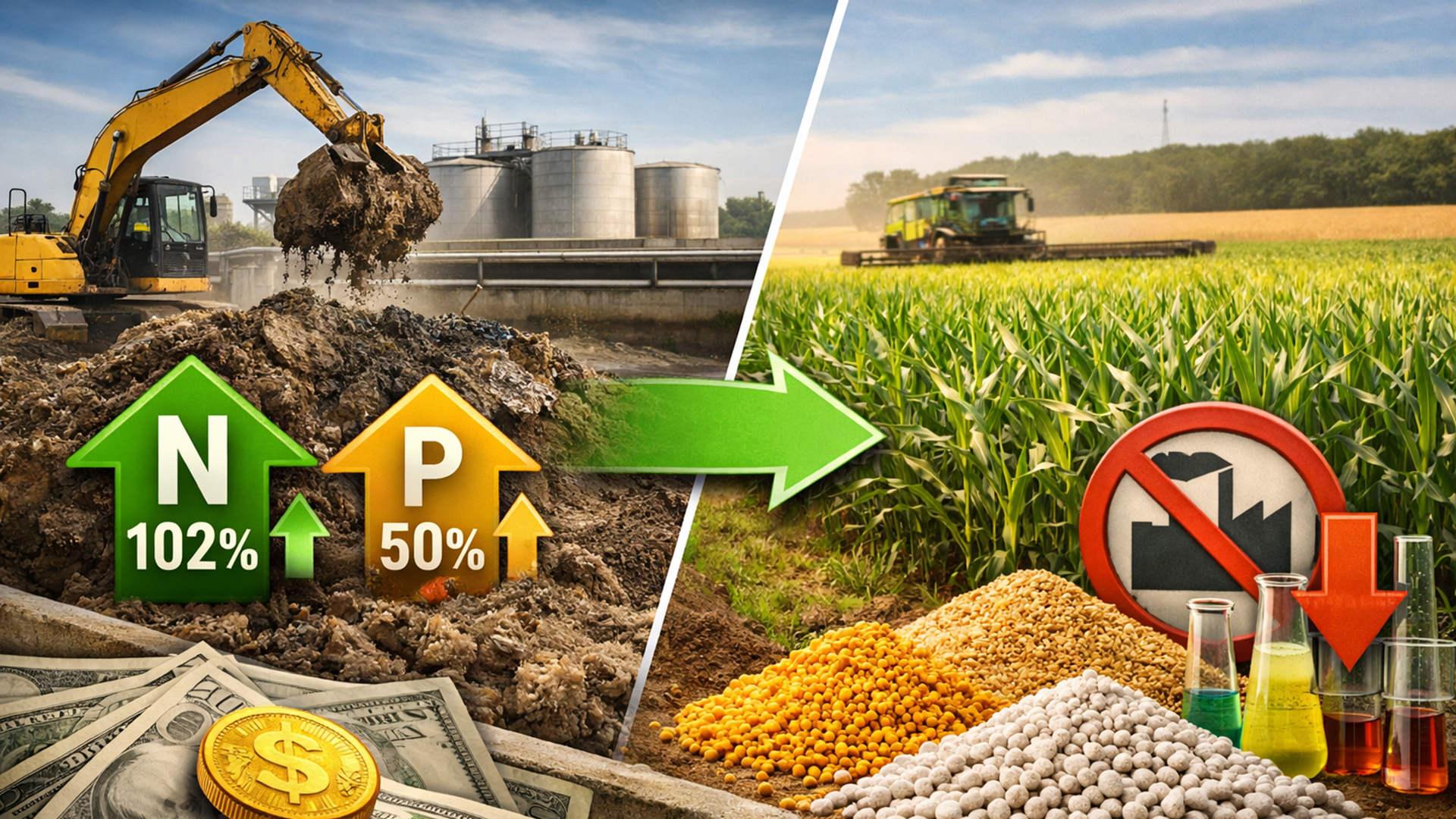

Cornell University study indicates that human and animal waste in the United States concentrates agricultural nutrients valued at an estimated US$ 5.7 billion, a volume that could supply 102% of the nitrogen and 50% of the phosphorus required for the country’s agricultural production
A Cornell University study indicates that human and animal waste in the United States concentrates enough agricultural nutrients to theoretically replace a significant portion of the synthetic fertilizers used in the country. At current prices, this unexplored volume of waste represents an estimated economic potential of US$ 5.7 billion.
The research concluded that this waste could provide 102% of the nitrogen and 50% of the phosphorus necessary to supply the entire North American agricultural industry. The result reinforces the possibility of reducing dependence on synthetic inputs, the production of which requires high energy consumption and generates greenhouse gas emissions.
Partially replacing these fertilizers could also help stabilize supply chains affected by international conflicts. Chuan Liao, the corresponding author of the study and an assistant professor, stated that the excessive use of synthetic fertilizers contributes to water pollution, while their manufacturing is an emission-intensive process.
-
A fossil kept for years in a small museum in Montreal concealed 450-million-year-old soft tissue, a discovery that has only happened once before in history.

-
Three teenagers transform cut cardboard into Japanese origami-style packaging that promises to retire styrofoam and bubble wrap, win a $12,500 prize, and target giants like Amazon, FedEx, and Home Depot after a robot motor arrived broken.

-
The large jar blender has a rival: Oster Ultra Power bets on 1,000 W, six stainless steel blades, and two portable cups with leak-proof lids.

-
Tesla injected an additional $250 million into the German factory, doubled the battery cell target, and opened its own production line for startups.



He also associated the vulnerability of the current system with food insecurity in the face of external tensions. For the researcher, recent problems in supply chains show how dependence on this model can amplify risks for agricultural production.
Geography of waste and nutrients
Human and animal waste are rich in the three main nutrients required by plants to grow: nitrogen, phosphorus, and potassium. Despite the abundance of the resource, the study identified that the biggest obstacle lies in the geographical distribution between the generation sites and the areas where these nutrients are most needed.
The production of waste is concentrated in densely populated cities and large animal farming centers. Meanwhile, agricultural demand is more present in regions like the Midwest and the Great Plains, creating a mismatch between supply and need.
Liao stated that the central problem is coordination, not resource scarcity. In his assessment, even with real-world limitations, there is still a substantial amount of nutrients that can be economically redistributed to meet crop needs.
The largest surpluses appear in the dense urban corridors of the Northeast and in the major livestock hubs of the West. At the same time, the Midwest, described as the nation’s breadbasket, continues to have a strong nutrient deficit and relies on expensive, energy-intensive synthetic fertilizers imported from abroad.
To locate these inequalities, the study used high-resolution mapping focused on 10-kilometer blocks. The results showed a detailed picture of the distribution of nutrients and the differences between areas with excess and regions with shortages.
Environmental inequality linked to waste
The maps produced by the research revealed that nutritional inequality often accompanies social maps. Socioeconomically disadvantaged municipalities frequently appear within this scenario, accumulating an environmental burden on two fronts.
In regions with excess, the leakage of waste into local watercourses promotes toxic blooms. In areas with deficiency, reliance on synthetic chemical products can harm soil health over time.
Liao assessed that nutrient inequality largely reflects social inequality. For him, correcting the flow of these nutrients can create space for advancements in environmental justice.
This scenario amplifies the relevance of waste reuse beyond economic gain. A more balanced redistribution could reduce local damage caused by waste accumulation while simultaneously alleviating dependence on external inputs in strategic agricultural areas.
Decentralized solution to recover waste
The study emphasizes that raw waste cannot simply be applied to fields. The presence of pathogens and the high water content prevent this direct use, requiring processing before any agricultural utilization.
In light of this, experts advocate for a decentralized system. The proposal is for local centers to transform waste into concentrated dry granules or liquids that are easier and cheaper to transport to nearby farms, rather than moving large liquid volumes over long distances.
The research showed that this localized approach can be highly efficient. Almost 37% of nitrogen and 46% of phosphorus could be recovered and used practically in the same place where they are generated.
Regarding the remaining surplus, the team found that more than half can be redistributed to neighboring regions with minimal economic or environmental impact. The result indicates that most of these nutrients present in waste can return to the soil without requiring a massive long-distance transport system.
Economic potential and implementation challenges
The study presents a strategic plan to recover the value currently wasted in human and animal waste. The proposal offers a sustainable alternative to synthetic fertilizers and can simultaneously strengthen national food security.
The adoption of this model would also reduce the environmental damage associated with the conventional manufacturing of these inputs. Still, researchers point out that the success of this transition depends less on new technological inventions and more on the creation of governance and infrastructure capable of integrating agriculture, waste, and energy.
The technology needed for this utilization already exists, but coordination between sectors is still the decisive point. The research results were published on April 15 in the journal Nature Sustainability, consolidating waste as a large-scale agricultural asset that is still underexplored.