






 Portuguese
  Spanish


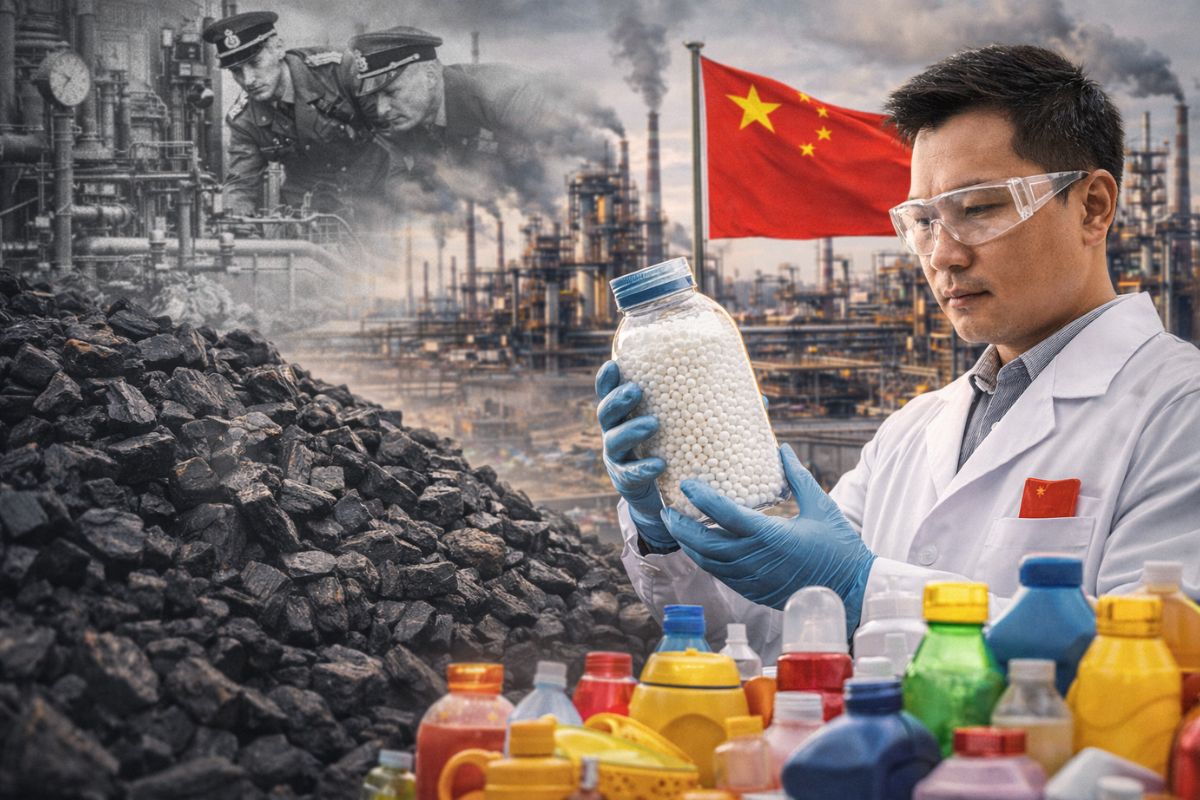

China has converted the Fischer-Tropsch process, created by Germany during World War II, into an industrial operation that manufactures plastic from coal instead of oil, supported by an innovation from Peking University that reduced CO₂ emissions to almost zero and already surpasses the total coal consumption of the United States.
Much is said about China as a global leader in solar energy and electric cars, but little is mentioned about the industrial move that may be the most ambitious of all: mass-producing plastic and petrochemical products using coal as a raw material. The operation relies on the Fischer-Tropsch process, a synthesis technique that Nazi Germany developed to keep its industry running when it lost access to oil during World War II. Beijing did not just copy the method. Its scientists transformed it to the point of making it viable on scales that no other country has even attempted to reproduce.
The preparation was not improvised. A report from The New York Times indicates that China began building this industrial independence during the first Trump administration, when Xi Jinping imposed total autonomy from foreign supply chains as a national guideline. The armed conflict in Iran, which caused oil prices to soar in global markets, served as a proof of concept: while traditional Asian refineries saw their costs explode, China continued producing with domestic coal at decreasing costs.
The scientific innovation that made coal-based plastic viable in China

The original Fischer-Tropsch process had a serious flaw that prevented its large-scale use: the brutal amount of CO₂ released during conversion. Scientists at Peking University solved this limitation with a minimal adjustment to the catalytic process, as reported by the Xinhua agency.
-
Astronaut from Artemis II steps down after mission to the Moon and decision surprises after a record of 406,771 km, a historic 10-day journey, and an unprecedented achievement for Canada.

-
A fossil kept for years in a small museum in Montreal concealed 450-million-year-old soft tissue, a discovery that has only happened once before in history.

-
Three teenagers transform cut cardboard into Japanese origami-style packaging that promises to retire styrofoam and bubble wrap, win a $12,500 prize, and target giants like Amazon, FedEx, and Home Depot after a robot motor arrived broken.

-
The large jar blender has a rival: Oster Ultra Power bets on 1,000 W, six stainless steel blades, and two portable cups with leak-proof lids.


The inclusion of methyl bromide at a concentration of just five parts per million selectively blocks the reaction that generates carbon dioxide. The result: the emission rate plummeted from around 30% to below 1%.
With this gain, the path was cleared to scale up production via Fischer-Tropsch. The conversion transforms synthesis gas extracted from coal into olefins, which are the basic building blocks from which plastic is made.
In addition, research published by ACS Sustainable Chemistry & Engineering investigates how to apply the same principle to chemically recycle plastic waste, converting it into synthesis gas and then back into light olefins, which would create a partially closed recycling loop.
The numbers that show the size of China’s bet on coal
The scale of this operation has grown at a pace that has surprised even specialized analysts. According to data from The New York Times, the volume of coal destined for chemical manufacturing in the country was 155 million tons in 2020; four years later, in 2024, the number had already escalated to 276 million.
In 2025, there was another advance of 15%, which caused the coal consumed by the Chinese chemical industry alone to surpass the total amount that the United States burns annually of the mineral.
On the investment side, Bloomberg revealed that China Shenhua Energy, the country’s leading mining company, shrank its overall budget by 16%, but increased the resources allocated to chemical conversion from 2.5 billion yuan to 4.1 billion by 2026.
The CREA research center estimates that coal use in the chemical sector advanced 20% year-on-year in just the first six months of 2025. In Xinjiang, according to the South China Morning Post, the largest unit in the world aimed at transforming coal into ethylene glycol is under construction, with a projected production of 2.4 million tons annually.
Expensive oil validated China’s strategy
The war in Iran served as a real-time test. With oil prices soaring, Rongsheng Petrochemical, one of the largest refineries in Asia, lost up to 27% in market value, according to Reuters.
In contrast, Ningxia Baofeng Energy, which operates millions of tons in chemical conversion capacity from the mineral, saw its shares rise 30% since the conflict began.
The reason is structural: while oil became more expensive for the entire planet, the coal mined within China’s borders remained cheap. Analyses compiled by Carbon Brief show that the Chinese state media repeats a single message: in a real crisis situation, coal remains the resource over which the country exercises absolute control.
A concrete example of this independence is the fertilizer sector: 80% of all nitrogen fertilizer produced in China, a share that accounts for a third of the global supply, already comes from factories that operate with coal instead of petroleum and gas derivatives. The final cost is less than half of what is practiced internationally.
The environmental price that China accepted to pay
The industrial offensive incurs a considerable climate cost. The draft of the 15th Five-Year Plan (2026-2030) set a goal to cut carbon intensity by 17%, a level that CREA and Financial Times experts considered insufficient.
In practice, this margin allows the country’s actual emissions to rise between 3% and 6% over the five-year period.
The plan replaces the old promise of a gradual reduction in coal use with a concept of stabilizing consumption, explicitly protecting the petrochemical expansion based on the mineral. Only chemical projects with construction planned until 2029 can add 2% to the country’s annual CO₂ emissions.
The final goal, according to Bloomberg, is for China to achieve 85% autonomy in advanced materials and chemicals by 2030, minimizing any external dependence on oil or derivatives.
The influx of cheap products and the impact on the rest of the world
The Chinese domestic market, with consumers still cautious since the pandemic, does not have the capacity to absorb all this additional production of plastics and chemicals.
The European think tank MERICS warns that Chinese factories are dumping their surpluses into international trade with price margins that no Western competitor can match. The country’s trade surplus hit $1.2 trillion in 2025, partly fueled by this petrochemical wave.
The consequences for other countries are severe. According to MERICS, the European Union is losing up to 500 industrial jobs per day because it cannot compete with the prices set by China. Chinese companies sustain negative margins because they operate with protected lines of credit and subsidies from local and central governments.
Experts classify the phenomenon as a crisis of overproduction with the potential to reshape entire manufacturing chains around the globe.
The duality that defines 21st century China
Beijing operates two simultaneous strategies that, at first glance, seem contradictory. On the global stage, China is setting records in renewable energy installation and exporting millions of electric vehicles.
Behind the scenes, it has consolidated its industrial base on the same raw material that the world is trying to abandon: coal. The coexistence of these two faces is deliberate and functional.
The conflict in the Gulf and the escalation of the trade war with Washington have only reinforced Xi Jinping’s strategic conviction. The rest of the world may face an energy collapse with oil shortages, but China has already secured, within its own mines, the raw material necessary for the largest industrial park on the planet to continue operating.
The Fischer-Tropsch process, born in 1930s Germany, found in 21st century Chinese coal its most ambitious and controversial version.
And you, do you think China’s strategy of swapping oil for coal is industrial genius or climate irresponsibility? Should other countries follow the same path? Leave your opinion in the comments.


