Portuguese
  Spanish


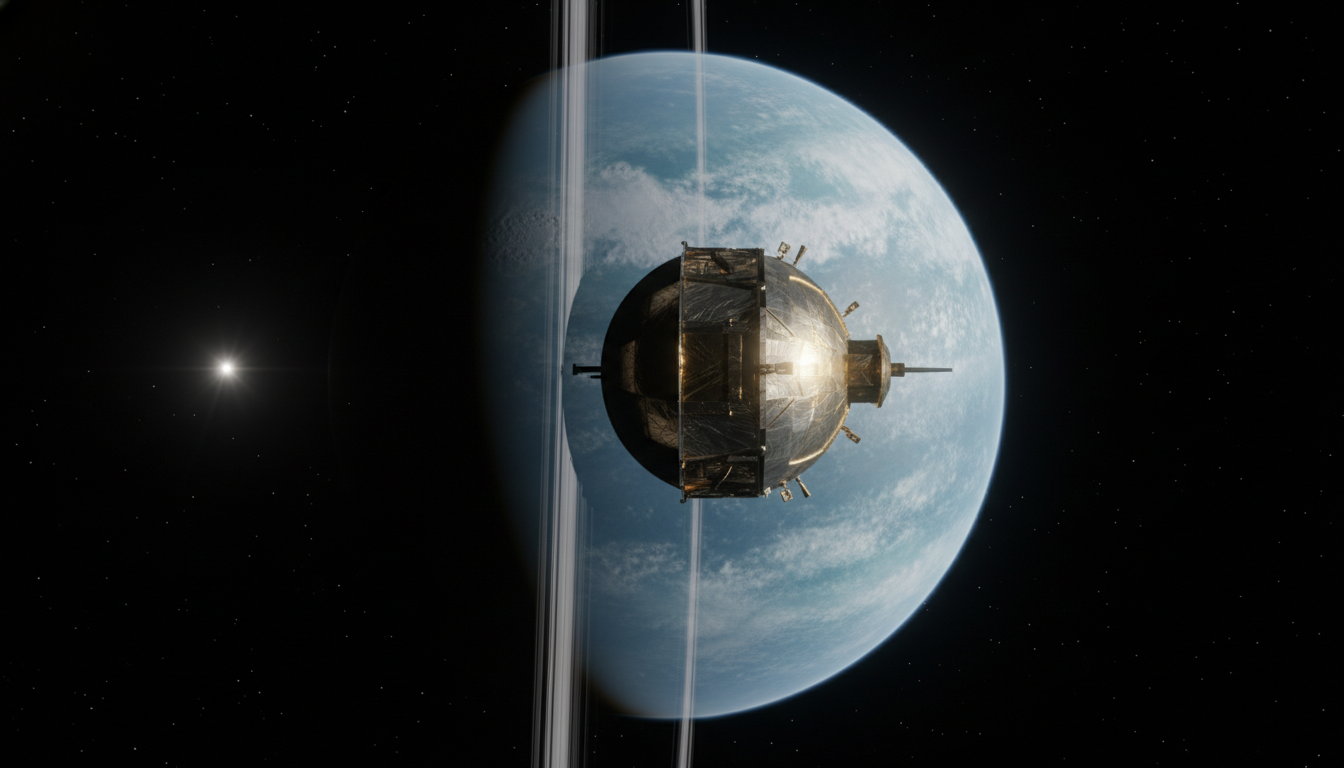

Without solar panels, project led by L3Harris will power the first probe dedicated to the ice giant nearly 3 billion km from the Sun for two decades.
At 19 astronomical units from the Sun, photovoltaic panels lose their purpose. Therefore, the new NASA nuclear generator being developed by L3Harris Defense Technologies has just passed the critical design review.
On May 14, 2026, in an editorial titled “Getting into the Space Nuclear Power Game“, the company confirmed that the Next-Gen RTG is ready to enter production.
According to World Nuclear News, the information was released in the same week. The device delivers approximately 250 electrical watts of useful output.
-
Berries, Strawberries, and Blueberries Could Transform Agriculture in Northeastern Brazil, New Tests Reveal

-
Danish Resident Discovers Six Viking Gold Bracelets Weighing 762.5 Grams, Third Largest Gold Treasure in Denmark

-
Over 200 Cities in Southern Brazil on Storm Alert as Cyclone Near Uruguay Brings Heavy Rain, Hail, and Winds Up to 100 km/h

-
Archaeologists Discover 2,300-Year-Old Beer in Sealed Bronze Vessel from Ancient Chinese Tomb




According to the company, the fuel is the decay of plutonium-238. It is enough energy to keep radios, cameras, and instruments operating for over 20 years in deep space.
Moreover, NASA is putting back on the table a mission that had been on paper since the 1980s. Now, with nuclear hardware ready, it can finally emerge from the budget limbo.
Therefore, the urgency has an institutional face. The Decadal Survey 2023-2032 of the National Academies ranked the Uranus Orbiter and Probe as the top priority of American planetary science.
Why solar panels do not work where NASA’s nuclear generator will operate
To understand why the agency is resorting to the new device, just look at the equation of sunlight. The intensity of radiation decreases with the inverse square of the distance.
According to the basic data of the Solar System:
- Jupiter receives about 25 times less sunlight than Earth
- Saturn receives approximately 100 times less solar radiation
- Uranus is 19 astronomical units away, receiving only 1/361 of Earth’s solar irradiation
- Panels equivalent to those of the ISS would need an almost impractical area

In practice, solar panels would have to be absurdly large to generate 250 watts at that distance. According to a study by the Outer Planets Assessment Group, solar arrays would be mechanically unfeasible on small probes.
Therefore, the agency has relied on plutonium-238 as deep space fuel since the 1960s. Subsequently, this cycle continued with Voyager 1, launched in 1977.
Even so, Voyager 1 transmits data from interstellar space after 48 years. Each probe carries three old RTGs that still operate with reduced power.
What changes in L3Harris’s Next-Gen RTG
According to the L3Harris editorial, the Next-Gen RTG was designed in partnership with the Idaho National Laboratory of the U.S. Department of Energy. This laboratory is responsible for resuming domestic production of plutonium-238.
The DOE confirms that national laboratories have resumed manufacturing Pu-238 at scale. Thus, ending the dependence on stocks inherited from the Cold War.

The design delivers about 250 electrical watts at the start of its useful life. In comparison, the Multi-Mission RTG used by the Curiosity and Perseverance rovers delivers about 110 watts.
This means that each new unit practically doubles the available power compared to the previous standard. Additionally, the system was optimized to last over 20 years.
On the other hand, the set is modular. It can be combined in pairs or trios for missions that require more energy. It can also be scaled down for smaller probes.
Mission to Uranus: the last neglected giant
The National Academies report of 2022 classified the probe as the flagship mission priority of the next decade.
According to the technical document from NASA itself, Uranus is the only one of the four giant planets that has never received a dedicated mission.
Voyager 2 made a single flyby in 1986, and since then there has been no other visit. Saturn had Cassini-Huygens. Jupiter receives Juno. Neptune awaits a future mission.

On the other hand, the scientific relevance goes beyond curiosity. For exoplanets, ice giants are extremely common in the galaxy.
Therefore, studying Uranus up close means understanding how similar worlds form and evolve in other star systems. In other words, it is applied exoplanetology.
NASA’s nuclear generator schedule tightens the window
The document indicates that the ideal launch window uses a gravitational flyby at Jupiter, available in 2031 and 2032. Missing this window, the journey could take almost twice as long.
Therefore, L3Harris’s schedule is tight. The flight units of the Next-Gen RTG must be ready in the early 2030s.
In a statement, the company said that the Critical Design Review authorizes the construction of the first units. The final vibration and vacuum tests are expected to occur in 2027.
What Brazil can learn
Brazil does not operate space nuclear reactors. However, the learning curve is valuable for any national exploration program.
The Brazilian tradition in nuclear generation, with Angra 1 and 2, historically depends on imported enriched fuel. Thus, replicating an RTG would require a Pu-238 supply chain that no South American country possesses.

On the other hand, learning in high-reliability autonomous systems is directly applicable to sectors like pre-salt. FPSO platforms operate for 25 years in a hostile environment.
As researchers follow long-duration technologies, the quality standard that NASA applies to an RTG is the same that defines critical offshore equipment.
What could go wrong
Despite the progress, there are concrete risks. First, the budget. NASA estimates that the Uranus Orbiter and Probe could cost more than US$ 4 billion.
Therefore, budget cuts or competing priorities could delay the launch, missing the gravitational window. Still, there is another risk: the Pu-238 supply is limited.
The DOE’s production rate is on the order of a few hundred grams per year. Each Next-Gen RTG, in turn, requires several kilograms. There will be a waiting list among missions.
Finally, there are safety reservations. The NASA RPS program maintains strict containment protocols. Previous RTGs met this standard.
However, any public failure would delay the entire American space nuclear agenda for years. It is worth remembering that radiological safety is the Achilles’ heel of the program.
If humanity can already build small nuclear generators to power probes for 20 years, why can’t we achieve the same on solid ground?
Scientific bases, isolated hospitals, or offshore platforms could use the same technology. The limit has never been technical — it has always been political will.