






 Portuguese
  Spanish
  5 min of reading
  0 comments


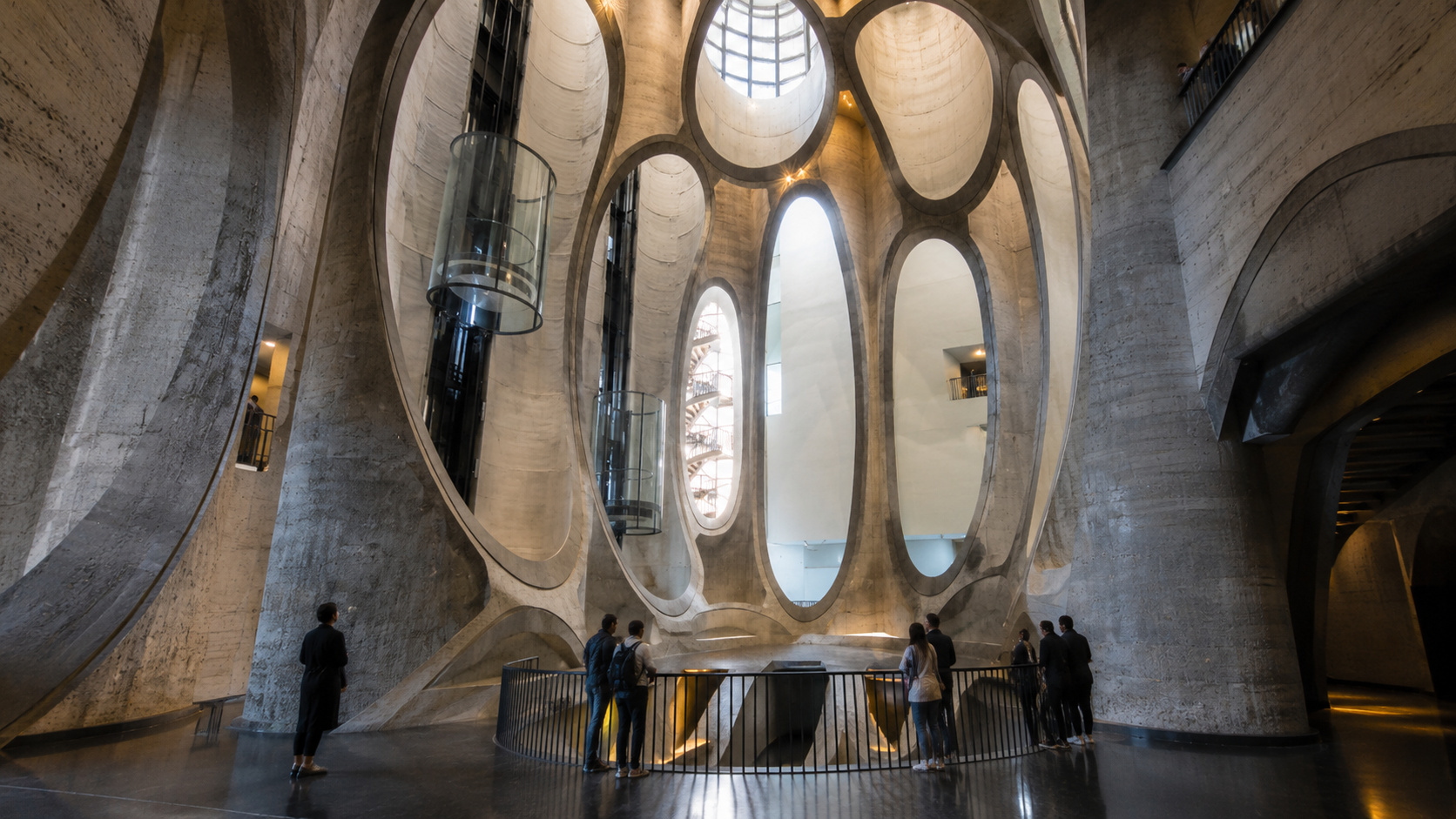
The Zeitz MOCAA transformed an old grain silo in Cape Town into an African contemporary art museum, preserving concrete tubes, creating a monumental atrium, and showing how the reuse of industrial buildings can change the urban landscape without erasing the memory of the place
The museum was not built from scratch; it was sculpted inside a silo. In Cape Town, South Africa, an old complex used to store grains was cut from the inside and became the Zeitz MOCAA, an African contemporary art museum housed in an industrial structure with great visual impact.
The information was released by Zeitz MOCAA, African contemporary art museum in Cape Town. The building opened to the public on September 22, 2017 and began to gather 9,500 m² of customized space over nine floors.
What draws attention is not just the change of function. The old silo retained its heavy concrete presence but gained a central atrium reminiscent of a cathedral, internal galleries, and a new relationship with the city’s waterfront.
-
Farmer transformed a lettuce plantation into a giant Brazilian flag, took 9 days to design the tribute to his newborn grandson and the National Team, and went viral by showing how a simple garden turned into a visual spectacle during the World Cup in Brumadinho, MG.

-
While in Brazil millions face problems with sanitation, transportation, and security, the “favelas” of Switzerland are impressive for offering quality of life, infrastructure, and public services that surpass even the upscale neighborhoods of many cities around the world.

-
Are you going to decorate the car to support Brazil in the World Cup? Stickers on the windows, poorly attached flags, and color changes can result in a fine of R$ 195.23, five points on the driver’s license, and even vehicle impoundment.
-
John and David sold their company for $1.5 billion, then bought it back for just $450 million and turned a memory company into a billion-dollar empire driven by AI.


How 42 concrete tubes became galleries inside an old grain silo
The old silo was part of the V&A Waterfront grain complex, a well-known area in Cape Town. The construction had vertical concrete tubes, created to store grains on a large scale.


In its new use, part of this structure ceased to be a depot and became a cultural space. The main core of the museum was born from the excavation of 42 concrete tubes, which were cut and adapted to accommodate visitors, artworks, and internal circulation.
The change required a different interpretation of the building. Instead of hiding the industrial past, the project left the tubes visible and transformed the old concrete into part of the museum experience.
Thus, the visitor does not enter a common building. They enter an old grain storage machine, now converted into an African contemporary art museum.
The central atrium transformed the silo into an experience similar to a concrete cathedral
The most striking part of the Zeitz MOCAA is the large open void inside the silo. The central space reveals cuts in the concrete tubes and creates a sense of height, weight, and movement.
This atrium was designed based on the shape of an enlarged corn kernel. The reference connects the new museum to the building’s former function, which was part of the grain storage chain.
The result is strong because the concrete does not disappear. It remains there, with curves, cuts, and marks that show the industrial origin of the construction.
The transformation makes the museum easy to understand even for those unfamiliar with architecture. It was a silo, became art, but still looks like a silo inside.
Why cutting old concrete is a much more difficult task than a common renovation
Cutting a concrete silo is not like opening a wall in a house. In a structure like this, the tubes help support the whole, and any intervention needs to keep the building safe.
Therefore, transforming the old silo required more than just new finishes. The concrete needed to be cut, reinforced, and sculpted to create wide spaces without destroying the original structure.
This is the difference between renovating and deeply repurposing. A common renovation changes the appearance. At Zeitz MOCAA, the structure itself became part of the project.
The museum shows that old constructions can gain new functions without losing their identity. In this case, the industrial past became the main visual element of the space.
Zeitz MOCAA preserved the old structure and created 100 galleries of African art
Zeitz MOCAA, a museum of contemporary African art in Cape Town, reported that the space includes 6,500 m² of exhibition area and 100 galleries. These numbers help to show the scale of the transformation.
The building also houses areas for exhibitions, circulation, and visitation across nine floors. The former function of storing grains gave way to a broad cultural program focused on contemporary art from Africa and its diaspora.
The most important point is that the museum did not erase the old structure. The concrete tubes remain present and help tell the building’s story.
This choice makes Zeitz MOCAA different from many modern museums. It does not rely solely on a striking facade. The impact is inside, in the cut of the concrete and the radical change of use.
The connection with The Silo Hotel reinforced the transformation of Cape Town’s waterfront
The former industrial complex also became connected with The Silo Hotel, located at the top of the complex. This combination gave the building new uses and increased its presence in the V&A Waterfront landscape.
With the museum and the hotel, the old silo ceased to be just a structure linked to the industrial past. It began to function as a point of culture, tourism, and architecture on Cape Town’s waterfront.
This change helps explain why the project attracts so much attention. The building was not treated as a ruin or an urban obstacle. It became a central piece of renewal.
For cities with empty warehouses, silos, and factories, the case shows a clear alternative. Not every old building needs to fall to make way for the new.
The difference between demolishing and transforming changed the meaning of the old silo
The Zeitz MOCAA shows that an old building can gain strength precisely when its history remains visible. The 42 excavated concrete tubes did not become a hidden detail, but the center of the architectural experience.
The transformation of the silo into a museum of contemporary African art combined industrial memory, structural reuse, and urban impact. Instead of replacing the past with a new construction, Cape Town gained a museum within the very structure that once stored grain.
If old silos and factories in Brazil could become cultural spaces of this magnitude, which cities would benefit more from this change? Comment and share this idea with those who love architecture, history, and urban transformation.







Be the first to react!