






 Portuguese
  Spanish


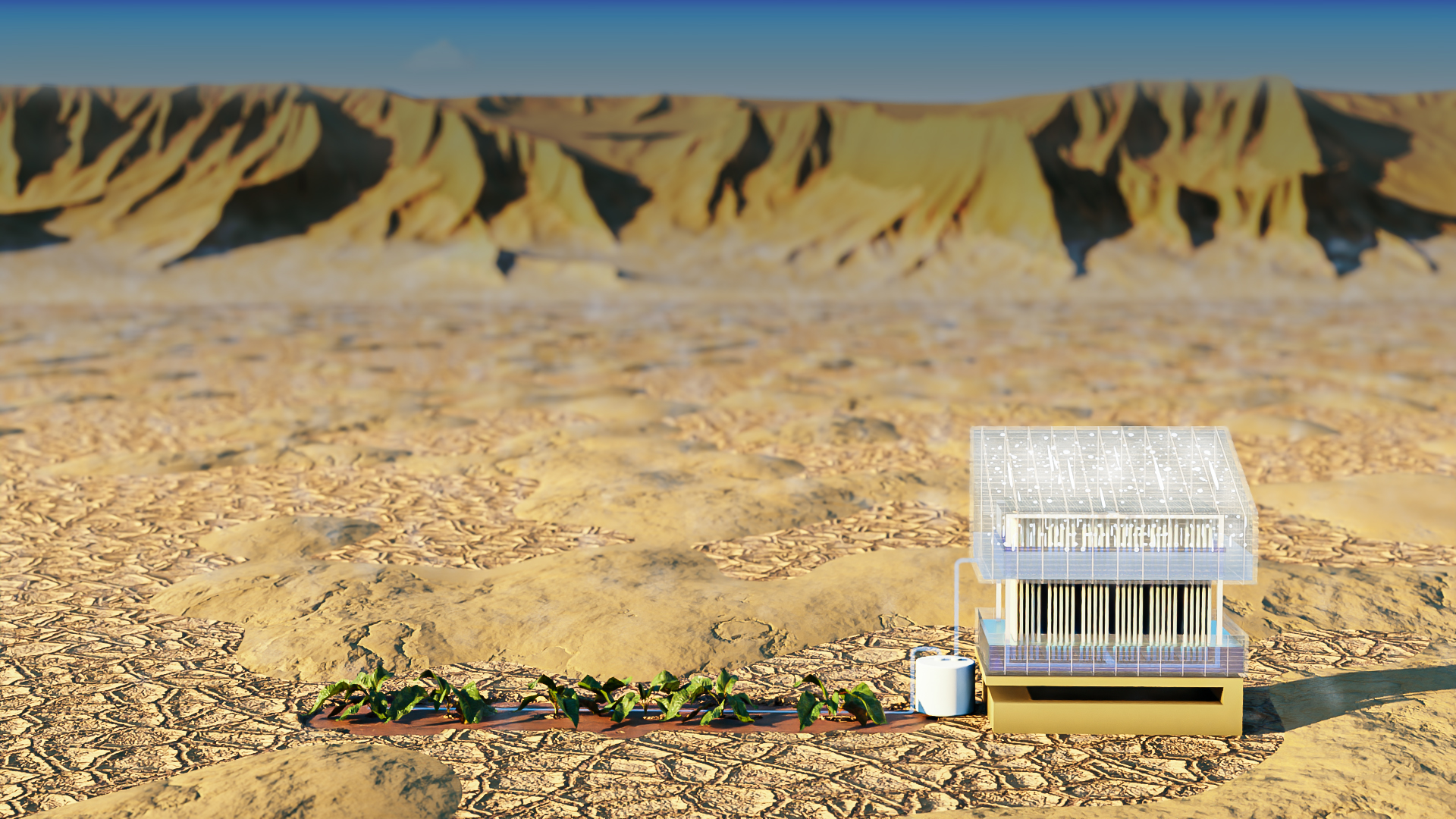


KAUST researchers develop solar collector that extracts water from the air in arid regions and also irrigates plants without external power.
In 2024, researchers from King Abdullah University of Science and Technology (KAUST), in Thuwal, Saudi Arabia, presented a technology that attempts to transform dry air itself into a water source for agriculture and supply in arid regions. The system, described in a study published in Nature Communications on July 24, 2024, uses a solar-powered atmospheric collector capable of capturing vapor from the air and producing liquid water passively, without grid electricity and without constant manual maintenance.
Field tests were conducted in Thuwal, an arid coastal region near the Red Sea, where intense heat and water scarcity make agriculture more challenging. According to the study and KAUST Discovery itself, in a publication on July 29, 2024, the system produced 2 to 3 liters of water per square meter per day in the summer and 1 to 2.8 liters per square meter per day in the autumn, in addition to demonstrating direct use in irrigating Chinese cabbage cultivated in an arid environment.
Atmospheric collection system uses solar energy to produce water in arid regions
The technology developed by KAUST belongs to the category known as Atmospheric Water Harvesting. The central principle consists of capturing vapor present in the air and transforming it into usable liquid water without relying on conventional sources such as deep wells or industrial desalination.
-
China Develops Custom 140-Ton Electric Mining Truck with 770 kWh Swappable Battery, Deploys 290 Units in Xinjiang’s Largest Zinc Mine

-
Meta to Launch Arena, a New Prediction App Targeting 3.56 Billion Users, Competing with Polymarket and Kalshi

-
Scientist Challenges Famous Human Evolution Theory, Argues Homo Sapiens Evolved Gradually Over Thousands of Years
-
15-Year-Old American Builds Ocean Generator with PVC Pipe and 3D-Printed Propeller for $12, Wins National Prize, Presents at White House, and Makes Forbes 30 Under 30 List




The system works by utilizing hygroscopic materials capable of absorbing atmospheric moisture during cooler, more humid periods of the night. When the sun rises, the natural heat generated by solar radiation warms the material and releases the accumulated water, allowing for condensation and storage in internal reservoirs.
The project’s differential lies in its fully passive operation, as the equipment does not rely on external power grids, industrial pumps, or complex mechanical systems to operate in desert regions.
Solar collector managed to produce up to 3 liters of water per square meter
The results obtained during the tests drew attention mainly due to the efficiency achieved in an extremely dry environment. According to the study published in Nature Communications, the equipment produced between 2 and 3 liters of water per square meter per day during the summer in Thuwal.

During autumn, when atmospheric conditions partially changed, production varied between 1 and 2.8 liters per square meter daily.
Although the volume is still small for large-scale urban supply, researchers highlighted that the system was designed to operate in regions where any additional water availability holds immense agricultural and human importance.
The numbers are impressive because they were obtained in one of the hottest and most arid regions of the Middle East, where conventional agriculture typically relies on intensive irrigation or expensive desalination.
Water extracted from the air was used to irrigate plants in the desert
In addition to producing water, researchers decided to test the system’s practical application in experimental agriculture. The team used the water captured by the atmospheric collector to irrigate cabbage plants cultivated directly in an arid environment.
Tests demonstrated that the water produced was sufficient to sustain plant growth during the experiment. The system operated practically on its own, using only natural cycles of temperature and solar radiation to capture and release water daily.


According to scientists, the goal was to demonstrate that atmospheric capture technologies can function not only as a laboratory curiosity but also as a practical tool for agriculture in regions with severe water stress. The experiment showed that even extremely dry environments still have enough moisture to sustain plant production when the correct materials are put into action.
Hygroscopic material absorbs atmospheric vapor during the night
The system’s operation primarily depends on so-called hygroscopic materials. These compounds have a natural ability to attract and absorb water molecules present in atmospheric air, even when relative humidity is relatively low.
During the night, when temperatures decrease and humidity partially rises, the material begins to capture invisible vapor from the atmosphere. At dawn, solar radiation heats the system and causes the accumulated water to be released for condensation inside the equipment.
The structure uses relatively simple principles of thermal physics and moisture transfer. The system transforms natural day-night differences into an automatic water production mechanism without conventional energy consumption.
KAUST attempts to create an alternative for regions dependent on deep wells
Much of the planet’s arid regions depend on underground aquifers increasingly pressured by human and agricultural consumption. In several countries in the Middle East and North Africa, farmers need to drill deeper and deeper wells to find usable water.

The problem is that many aquifers show a gradual reduction in volume due to overexploitation and low natural recharge. Furthermore, traditional desalination requires gigantic infrastructure and high energy consumption, making operation extremely expensive for poor or isolated regions.
KAUST’s proposal is to explore an almost invisible alternative source: the water already present in the atmosphere, even in environments considered extremely dry.
Technology works without electricity grid or constant maintenance
Another point highlighted by the researchers involves the operational simplicity of the equipment. The atmospheric collector was designed to function without the need for connection to the conventional electricity grid.
The system also does not depend on permanent operators or intense daily maintenance. This expands its potential for use in remote communities, isolated agricultural areas, and regions without robust energy infrastructure.
Scientists state that reducing operational complexity is essential to make this type of technology viable outside university laboratories. The fewer moving parts and the less need for maintenance, the greater the chance of adoption in regions vulnerable to water scarcity.
Atmospheric water capture has become a global race among universities and startups
In recent years, dozens of universities and companies have begun to compete for Atmospheric Water Harvesting technologies. Researchers are working with hydrogels, metal-organic frameworks, nanoporous materials, and thermal systems capable of extracting water directly from the air.
The advance of the global water crisis has accelerated interest in this sector. Regions affected by severe droughts have begun to seek solutions capable of complementing supply without relying exclusively on rivers, reservoirs, or groundwater.
KAUST is among the most active research centers in this area due to the extreme climatic conditions of Saudi Arabia. The desert has transformed into a natural laboratory for technologies that attempt to produce water in environments where it practically does not exist on the surface.
System attempts to transform walls and structures into “water collectors”
Researchers state that future versions of the technology could be expanded for integration into greenhouses, agricultural facades, and larger water production structures.
As the system primarily uses sunlight and absorbent materials, there is potential for large-scale modular construction. In theory, entire surfaces could eventually act as atmospheric water collectors in arid regions.
This opens up possibilities for new forms of decentralized agriculture in locations considered hostile for conventional cultivation. The central idea is to transform the dry environment itself into a continuous source of water using only atmospheric physics and materials engineering.







