






 Portuguese
  Spanish
  6 min of reading
  0 comments


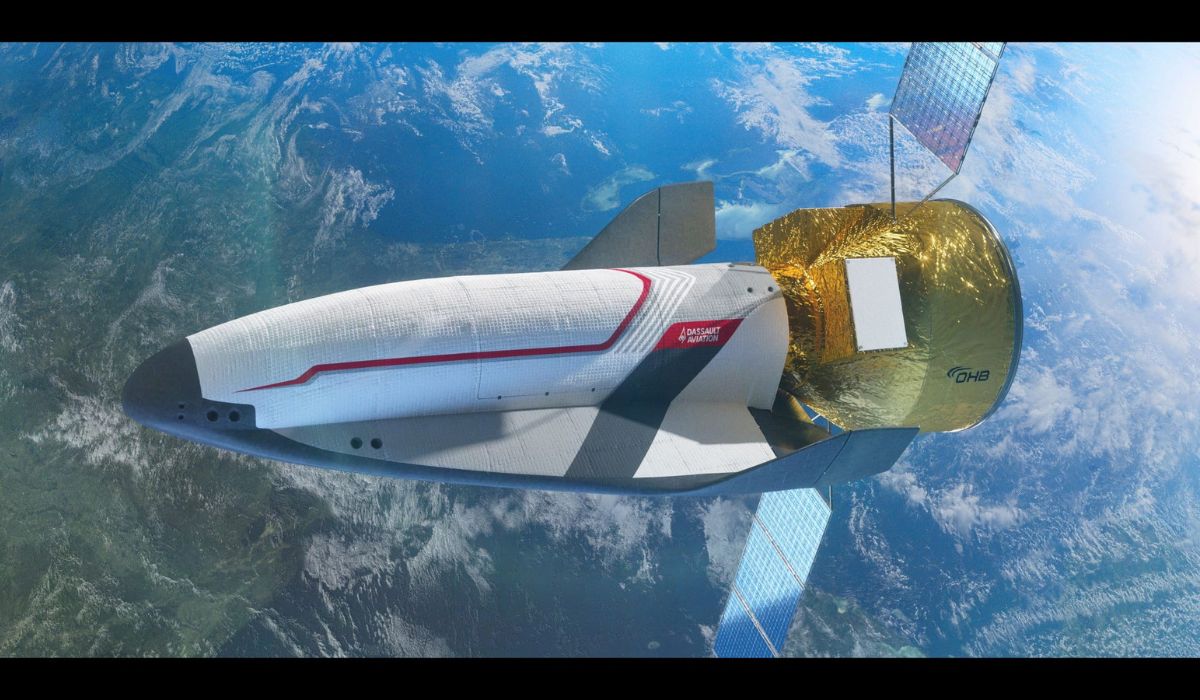
European proposal for a reusable space plane targets orbital operations, controlled return to Earth, and new scientific applications, at a time of technological competition between space powers and private companies.
The French Dassault Aviation and the German OHB presented to the European Space Agency a proposal for a reusable space plane called VORTEX-S, designed to operate in orbit, serve future space stations, and return to Earth for new flights.
The announcement, made in May 2026, places the project in European discussions on autonomy in the space sector and on the use of reusable vehicles in scientific, commercial, and institutional missions.
The proposal describes a vehicle different from traditional space capsules.
-
Helicopter Drops 180 Tons of Sand and Gravel on Swedish River to Revive Ecosystem Damaged by Decades of Exploitation

-
Brazilian Company Launches Retro Smartphone with 48 MP Camera, T9 Keyboard, and Privacy Features for Social Media-Free Use

-
Self-Taught Chinese Farmer Builds 5-Ton Submarine from Scrap, Launches It in Anhui River
-
Invisible Induction Technology Enables Wireless Power for Blenders, Coffee Makers, and Air Fryers, Reducing Countertop Cables




Instead of returning to the planet by controlled descent into the ocean or remote areas, as occurs with some current systems, the VORTEX-S was presented as a space plane with the capability of controlled atmospheric reentry and horizontal landing.
The stated goal by the companies is to enable orbital operations with greater flexibility and the possibility of reuse.
The project still depends on funding, institutional approval, and technological development.
Therefore, it is not a ready-to-operate spacecraft, but an industrial proposal submitted to ESA at a time of debate about Europe’s ability to maintain access and presence in low Earth orbit with less dependence on foreign systems.
What the reusable space plane VORTEX-S would be like
The VORTEX-S is part of a family of reusable orbital vehicle concepts developed by Dassault Aviation.
According to the companies, the model was designed to carry out round-trip missions to space stations and also to operate as a “free flyer,” a term used for vehicles that remain in orbit independently before returning to the planet.
In operational terms, the platform could transport scientific experiments, equipment, and payloads to orbital infrastructures.

It could also perform autonomous activities in orbit, such as technological tests, observations, and support for institutional missions.
Reusability appears as one of the central features of the concept, as it can reduce costs over several flights, provided that maintenance between missions proves viable from a technical and economic standpoint.
Dassault will be responsible for the overall system architecture and the integration of the spaceplane.
The company has a history in military and executive aircraft, such as the Rafale fighter and Falcon jets, in addition to studies related to advanced aerodynamics and high-speed flight.
Meanwhile, OHB will be responsible for the service module.
This component brings together systems necessary for operation in orbit, including power, navigation, control, and support for the vehicle’s operation outside the atmosphere.
The German company is involved in European programs related to satellites, space exploration, and Earth observation.
Why space reusability entered the European agenda
The interest in a reusable spaceplane occurs in a sector that has undergone significant changes in the last decade.
Companies like SpaceX have expanded the use of rockets with reusable components, especially in the case of the Falcon 9, and this model has begun to influence industrial and governmental decisions in different countries.
China is also conducting programs related to reusable technologies, accompanied by agencies, governments, and analysts in the space sector.
As part of these capabilities may have civilian and military applications, the topic is addressed in public documents and debates as an issue involving research, market, security, and technological sovereignty.
In Europe, the discussion gained momentum after a period of limited independent access to space.
The Ariane 5 was retired, the Ariane 6 faced delays, and cooperation with Russian Soyuz rockets was interrupted after Russia’s invasion of Ukraine.
The first flight of the Ariane 6, conducted in July 2024, restored an important capability for the continent, but did not end the debate on competitiveness and reusability.
Within this context, the VORTEX-S appears as a complementary proposal to launchers.
The spaceplane would not replace a rocket, as it would need to be placed in orbit by another system, but it could serve as a European platform for transport, cargo return, and autonomous operations in space.
VORTEX-D functions as a technological demonstration stage
Before an operational vehicle like the VORTEX-S, Dassault is working on technological demonstration stages.
One of them is the VORTEX-D, a smaller scale demonstrator aimed at testing the capabilities necessary for a reusable spaceplane.
In April 2026, the Spanish company Arkadia Space announced it had been selected to provide propulsion systems for the demonstrator.
According to the company, the thrusters will be used in orbital maneuvers, a necessary function for testing control, navigation, and operation outside Earth’s atmosphere.
This type of demonstrator is used to evaluate technologies before an operational program.
In the case of spaceplanes, the challenges involve resistance to reentry heating, stability in different flight regimes, functioning in a vacuum, and transition to atmospheric flight before landing.


Scientific missions in orbit and return of experiments
Besides industrial and strategic issues, vehicles like the VORTEX-S can be used in scientific research, according to the logic presented by companies for reusable orbital missions.
A spaceplane of this type could take experiments to microgravity, keep them in orbit for a certain period, and bring them back to Earth for analysis.
This type of operation is of interest to areas such as biology, advanced materials, space medicine, and fluid physics.
In many studies, the recovery of the sample is an essential part of the experiment, and a system with controlled landing can facilitate the return of sensitive equipment.
Another application mentioned for autonomous platforms is conducting missions without fully relying on space stations.
A free flyer vehicle can function as a temporary laboratory, test environment, or platform to validate technologies before use in regular operations.
Space economy and limits of market projections
The proposal also appears amid the expansion of commercial activities related to space.
Banks, consultancies, and international organizations publish growth estimates for the sector, driven by satellites, connectivity, Earth observation, navigation, in-orbit services, and future commercial infrastructures.
These projections, however, vary according to the methodology.
The Organization for Economic Co-operation and Development has already pointed out limitations in some estimates about a space economy of US$ 1 trillion by 2040, especially due to the difficulty of separating segments, measuring revenues, and comparing very different activities within the same market.
In the case of VORTEX-S, the potential for commercial use will depend on factors that are not yet defined.
Among them are the demand for transport and return of cargo, the schedule of commercial space stations, the cost of operation, public support, and the capacity of the European industry to transform the concept into a certified and functional system.
The role of ESA in the future of VORTEX-S
Presentation to ESA does not mean automatic approval of the program.
European space projects usually depend on decisions among member countries, industrial distribution, national priorities, and budget availability.
If it progresses, the spaceplane could involve other partners from the continent.
The disclosure made by the companies indicated talks with European companies to expand participation in the project, something common in complex programs that require competencies in propulsion, thermal materials, software, navigation, cargo integration, and ground operations.
The proposal also arises during a period of increased activities in low Earth orbit.
Smaller satellites, telecommunications constellations, environmental observation services, and commercial laboratories increase the demand for systems capable of transporting cargo, operating in orbit, and returning equipment to the planet.
For now, VORTEX-S remains a proposal under analysis, without full funding announced for operational development.
Even so, the concept brings together themes that have been guiding European space policy: reuse, technological autonomy, science in microgravity, and continuous presence in orbit.




Be the first to react!